
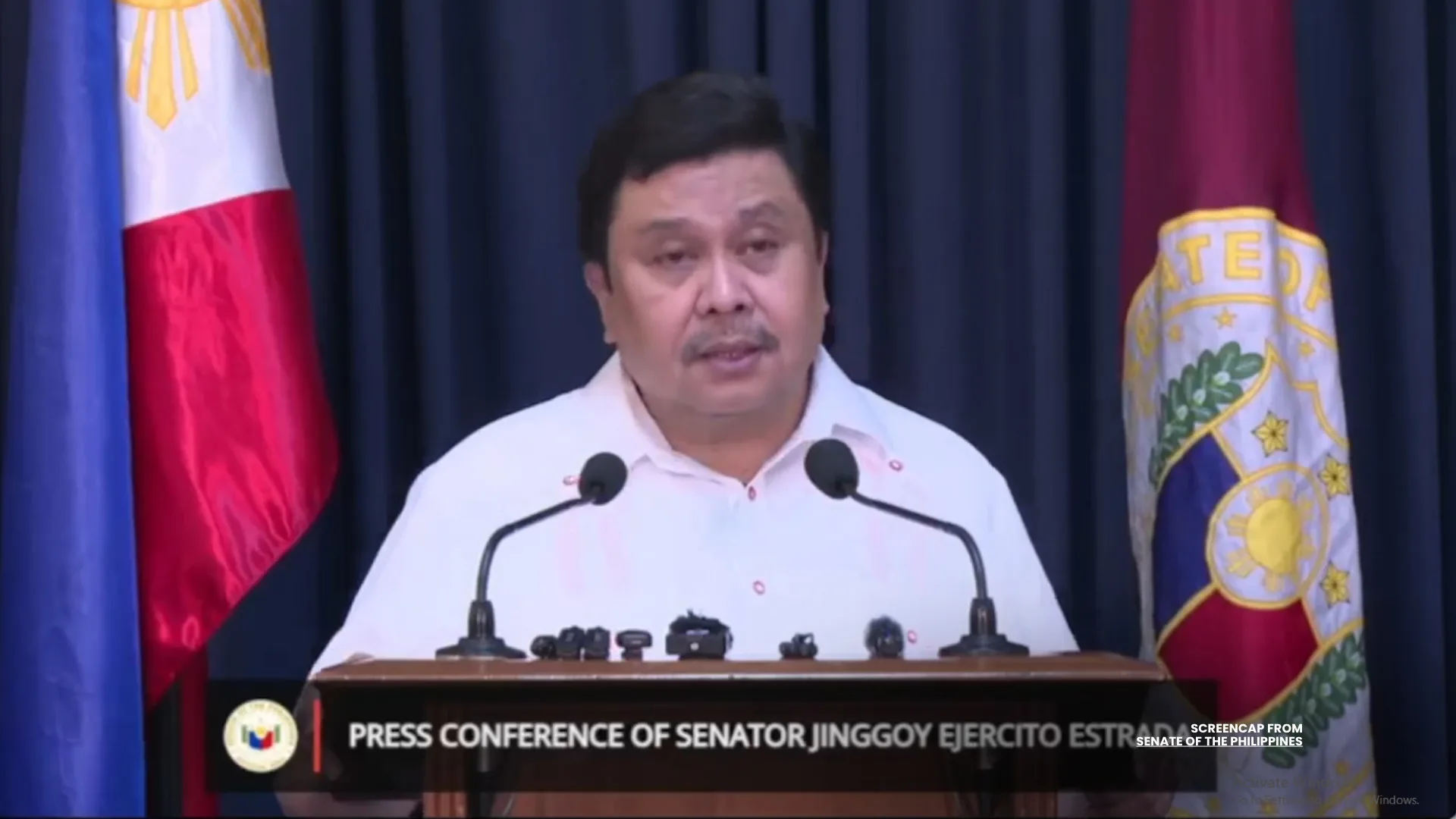
Sen. Jinggoy Estrada surrendered to the Philippine National Police-Criminal Investigation and Detection Group after the Sandiganbayan issued a warrant for his arrest in connection with a plunder case involving alleged irregularities in flood control projects.
Estrada turned himself in after holding a press conference at the Senate, where he said he would not seek protective custody from the chamber and was ready to face the charges in court.
The senator was accompanied by Interior Secretary Jonvic Remulla as he left the Senate building for the CIDG headquarters.
The Sandiganbayan Fifth Division issued the warrant against Estrada over plunder and graft charges filed by the Office of the Ombudsman. The cases involve alleged irregularities in flood control projects amounting to ₱573 million.
“If this is the price I must pay for the decisions I have made and the principles I have chosen to uphold, then I am prepared to face the consequences, however difficult they may be, especially for my family,” Estrada said.
Estrada denied the allegations, saying there was no basis to accuse him of inserting items into the 2025 national budget.
“This is all nonsense. The Senate Legislative Budget Research and Monitoring Office itself informed the Ombudsman that it has no documents or records showing that I inserted any item into the 2025 national budget,” he said.
He also questioned why he was charged with plunder, saying he was not identified as the mastermind or a participant in the alleged scheme.
“How can I be charged with plunder when I am not even alleged to be part of, or the mastermind of, the supposed operation? I have nothing to do with it,” Estrada said.
Estrada said he would remain with the Senate majority bloc despite the case, adding that he would not be intimidated by accusations, pressure, or political maneuvering.
He also said he would voluntarily forgo his salary while the case is pending.
The senator said the controversy goes beyond his personal situation and involves the independence of the Senate as an institution.
“What is at stake here is the independence of the Senate itself. This institution must never become vulnerable to external pressure or influence. It must remain a free and independent branch of government,” Estrada said.