
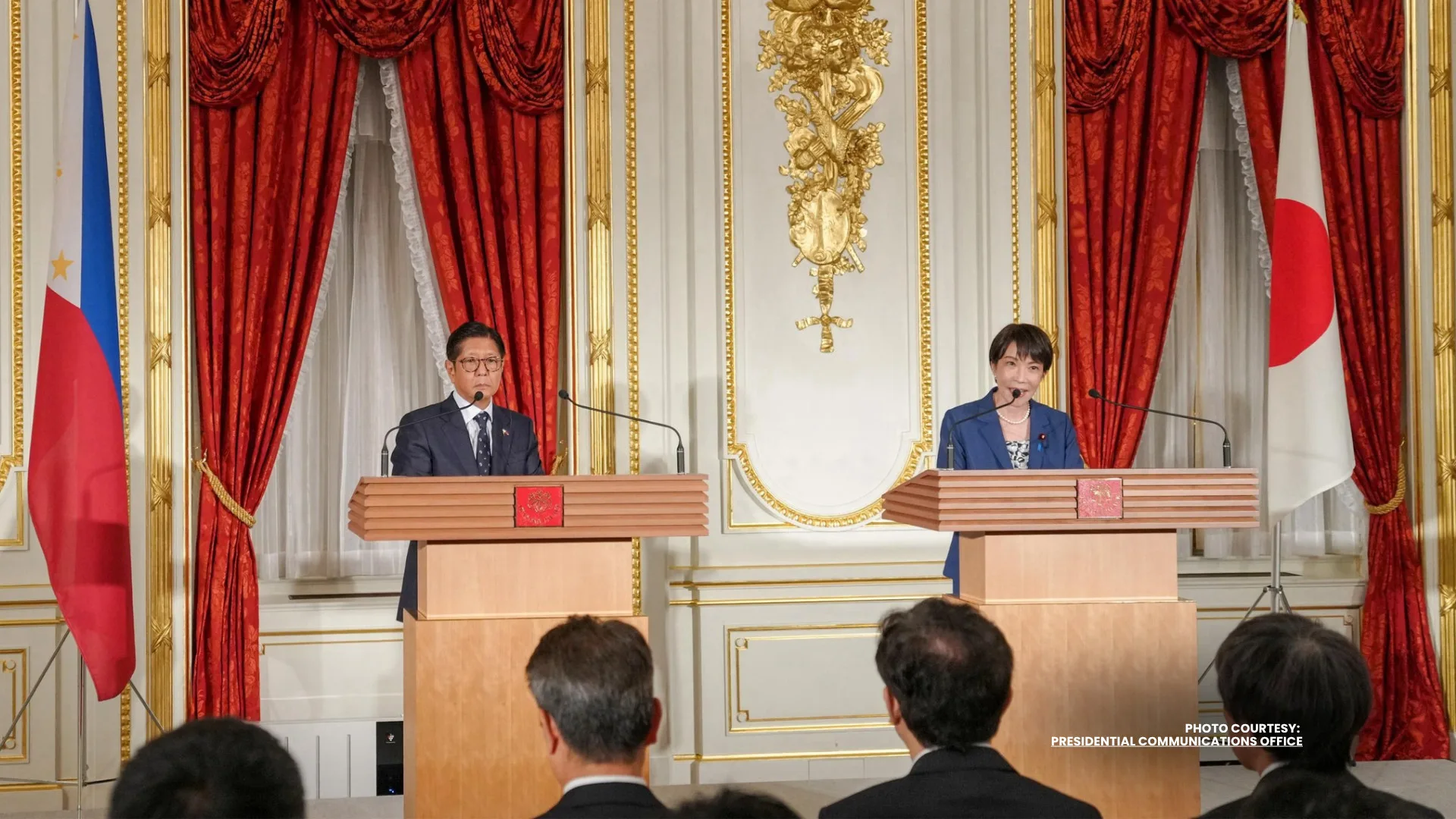
The Armed Forces of the Philippines welcomed Japan’s move to deepen defense cooperation with Manila, saying the possible transfer of Abukuma-class destroyers would support the country’s push to strengthen maritime security, surveillance, and external defense capabilities.
Rear Admiral Roy Vincent Trinidad, AFP spokesperson for the West Philippine Sea, said Japan’s commitment to provide military equipment and technology comes at a crucial time as the Philippines continues its Horizon 3 modernization program and shifts toward a stronger archipelagic defense posture.
“The AFP warmly welcomes the commitment to further enhance defense cooperation through the provision of military equipment and technology,” Trinidad said.
The statement followed the meeting between President Ferdinand Marcos Jr. and Japanese Prime Minister Sanae Takaichi in Tokyo, where both leaders agreed to expand security cooperation in response to what Japan described as an increasingly severe regional strategic environment.
Among the key points discussed was the acceleration of talks on the possible transfer of Abukuma-class destroyers to the Philippines. Six of the vessels are expected to be decommissioned by Japan next year.
If transferred, the ships could give the Philippine Navy additional platforms for maritime patrol, monitoring, humanitarian assistance, disaster response, and operations across the country’s territorial waters and exclusive economic zone.
“This defense partnership augurs well with the ongoing Horizon 3 modernization program and aligns perfectly with our Comprehensive Archipelagic Defense Concept,” Trinidad said.
“As a maritime nation, upgrading our maritime domain awareness and humanitarian assistance and disaster response capabilities is a necessity,” he added.
The two countries also agreed to begin negotiations on an agreement for the protection of classified information, a step that could pave the way for deeper defense coordination and possible technology-sharing.
The AFP said it regards the Japan Self-Defense Forces as a like-minded strategic partner committed to maintaining a free, open, and rules-based Indo-Pacific.
“This cooperation underscores our shared commitment to international law, specifically the 1982 UNCLOS, ensuring peace and stability in the region,” Trinidad said.
Philippine Navy public affairs chief Capt. Marie Angelica Sisican said the warship discussions reflect the growing strategic partnership between the Philippines and Japan amid evolving security challenges.
She said the initiative would support efforts to improve interoperability, maritime domain awareness, operational coordination, and regional maritime security.
The Navy also thanked the Japanese government and the Japan Maritime Self-Defense Force for their continued support in capability development, professional exchanges, and defense cooperation.
“The Philippine Navy also recognizes Japan as a trusted and reliable strategic partner that continues to contribute significantly to maritime capability development, professional exchanges, interoperability initiatives, and defense cooperation in support of a secure and stable Indo-Pacific region,” Sisican said.
The development comes as maritime defense, surveillance, and rapid-response capabilities become central priorities in the Philippines’ military modernization program.