

Most 15-year-olds are thinking about exams, sports, or what course to pursue in college. Laurent Simons had already completed a doctorate in quantum physics.
The Belgian prodigy, who has drawn international attention for his extraordinary academic pace, successfully defended his PhD at the University of Antwerp in November 2025. His achievement places him among the youngest people ever to earn a doctoral degree in the field.
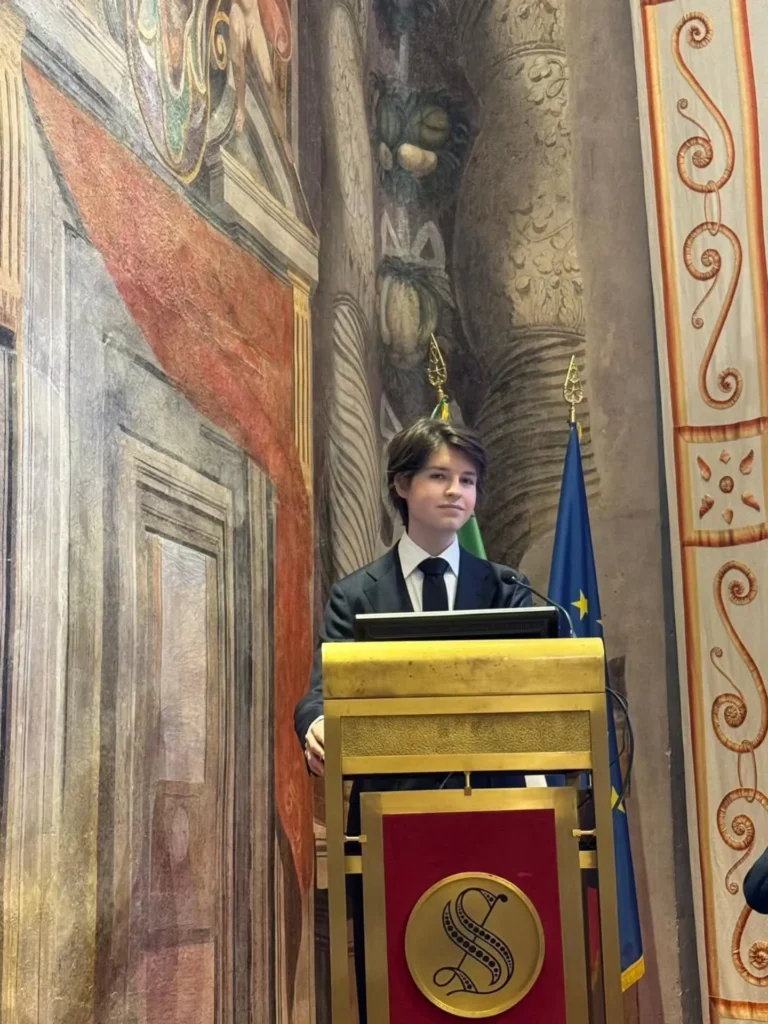
Simons’ education has been anything but conventional. He completed primary school at six years old and finished secondary education just two years later. His aptitude for mathematics and science allowed him to move through university-level studies at an exceptional speed, eventually specializing in physics while still in his early teens.
His doctoral research focused on Bose polarons, tiny quantum systems that help physicists understand how particles behave under extreme conditions. The work belongs to the field of condensed matter physics, where researchers study the unusual properties of matter at ultracold temperatures. While simplified social media posts often describe his research as being “about black holes,” the reality is more nuanced. Scientists use certain quantum systems as laboratory models to explore mathematical principles that resemble phenomena associated with black holes, but Simons was not studying black holes directly.
Although quantum physics has become his academic foundation, Simons has made it clear that he does not intend to remain confined to a single discipline. In interviews, he has expressed interest in combining physics with artificial intelligence, biology, chemistry, and medicine to address some of science’s most difficult challenges, particularly aging and human health.
His long-term vision is ambitious. Rather than chasing recognition for being a child prodigy, Simons has spoken about contributing to research that could help people live longer, healthier lives. Extending the healthy human lifespan, he believes, will require breakthroughs across multiple scientific fields rather than a single revolutionary discovery.
His story has fascinated audiences worldwide not simply because of his age, but because it challenges conventional ideas about education and scientific careers. While most researchers spend decades building expertise before earning a doctorate, Simons reached that milestone before many of his peers had entered senior high school.
Still, scientists caution that remarkable academic acceleration does not automatically translate into groundbreaking discoveries. Meaningful scientific progress is measured through years of research, collaboration, and peer-reviewed contributions. For Simons, the PhD is less a finish line than the beginning of a career that many will be watching closely.
Whether his future work leads to advances in quantum science, artificial intelligence, or medicine remains to be seen. What is already certain is that Laurent Simons has rewritten expectations of what one young scientist can accomplish—and he is only getting started.