
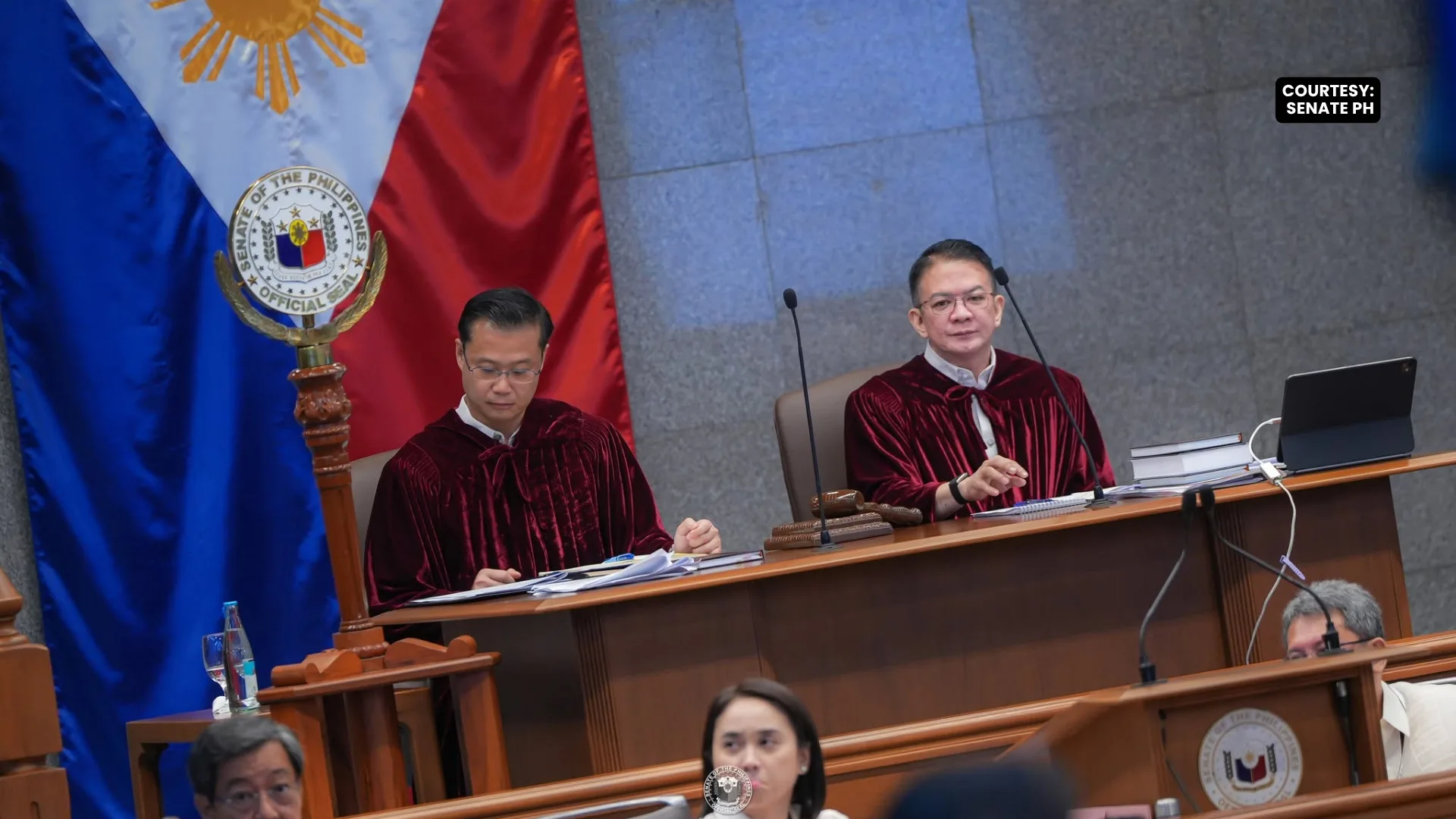
Senate President Sherwin Gatchalian reminded senator-judges to remain impartial as they weigh the four Articles of Impeachment filed against Vice President Sara Duterte.
“Impeachment is a constitutional mechanism that holds the highest public officials of the Republic accountable to the people. We cannot achieve accountability, nor can we faithfully serve justice without the truth,” Gatchalian said in his opening statement as the impeachment court convened Monday for Duterte’s trial.
Sen. Gatchalian said the Filipino people deserve to know the truth behind the allegations against Duterte, stressing that senator-judges must carefully evaluate the evidence and testimonies to be presented by both the prosecution and defense panels.
He said the proceedings must also be understandable to the public so Filipinos can clearly follow the accusations and the evidence against the Vice President.
Sen. Gatchalian also emphasized that Duterte must be accorded due process throughout the trial.
“Due process and fair play must remain paramount at every stage of this trial. Let us be firm in the search for truth. And let us remain faithful to the rules of this Court, the rule of law, and above all, the Constitution,” he said.
“Magalang kong hinihikayat ang bawat senator-judge, nawa’y tuparin natin ang ating tungkulin nang may dangal at pananagutan sa ating Konstitusyon upang maging karapat-dapat tayo sa tiwalang ipinagkaloob sa atin ng sambayang Pilipino,” Sen. Gatchalian said.
“I humbly encourage every senator-judge to perform our mandate with honor and accountability to the Constitution so we can be worthy of the trust given us by the people,” he added.
Speaking as presiding officer, Sen. Francis “Chiz” Escudero said an impeachment trial is not an ordinary proceeding, describing it as the “most difficult and cumbersome mode of removing a public officer from office.”
Sen. Escudero said Duterte’s trial is also no ordinary task, noting that she is the first official to be impeached twice and the first vice president to stand impeachment trial. He also noted that Duterte received more than 32 million votes in the elections.
“Terminating an elected mandate before the end of its term is among the most drastic acts our constitutional democracy can undertake. This is why the trial must be guided with prudence, tempered by caution, and marked with unquestionable impartiality. We must avoid even the appearance of impropriety and observe the ‘cold neutrality of an impartial judge’ at all times,” Sen. Escudero said.
He reminded senator-judges, prosecutors, the respondent, their counsels, and witnesses “to refrain from making any comments and disclosures to the public pertaining to the merits of the trial.”
Sen. Escudero said he would remain impartial as presiding officer.
“As Presiding Officer, I shall do my part to uphold the fairness and integrity of this process and shall see it through its proper conclusion,” he added.
Sen. Escudero also addressed threshold questions on the trial, including the number of votes needed to convict Duterte, the quantum of proof required to sustain a judgment of conviction, and how strictly or liberally the impeachment court would apply rules on procedure and evidence.
“First, what is the number of votes needed to convict the respondent? Second, what is the quantum of proof required to sustain a judgment of conviction or proceedings? Third, how strictly or liberally will this Court apply the Rules in resolving questions and procedure and evidence,” he said.
On the number of votes required for conviction, Sen. Escudero cited the constitutional provision stating that “no person shall be convicted without the concurrence of two-thirds of ALL the members of the Senate.”
“With 24 members of the Senate, a literal interpretation of this means that conviction requires the affirmative vote of at least 16 senator-judges. This literal interpretation finds direct support in the 2000 case of Bayan v. Zamora, which concerned the Senate’s compliance with two-thirds vote required to concur in a treaty,” he said.
Sen. Escudero said that when Gloria Macapagal-Arroyo was elected president, the Senate had only 23 senators, but the Supreme Court ruled that “not less than 16 members is an unquestionable compliance with the requisite number of votes mentioned in Section 21 of Article 7.”
“It behooves therefore all of us, to observe the same fidelity to the Constitution, in this trial, which affects not only the mere ratification of a treaty, but more so affects the substantial rights of the respondent as well as the sovereign will of the people as expressed in the overwhelming mandate given to her,” he said.
“This is the prevailing law today. And whether we agree with it or not, we must abide. However, those who disagree are not without recourse because this is without prejudice to the right of any party who holds a different view to seek judicial relief,” he added.
On the question of quantum of proof, Sen. Escudero said the impeachment court is “sui generis,” meaning the standards of proof used in administrative, civil, and criminal proceedings “do not apply.”
He said Duterte would be afforded the presumption of innocence, and it would be up to the prosecution to prove otherwise.
Duterte is the fifth official impeached by the House under the 1987 Constitution.
The first was President Joseph Estrada in 2001, but his trial was overtaken by EDSA 2. The second was Ombudsman Merceditas Gutierrez in 2011, but she resigned before trial. The third was Chief Justice Renato Corona, also in 2011, who was convicted and removed from office. The fourth was Commission on Elections Chairman Andres Bautista in 2017, who resigned before the Senate could begin trial.
Duterte was first impeached in 2025, but the Supreme Court declared the Articles of Impeachment null and void ab initio. She was impeached again this year, bringing the case before the Senate.