
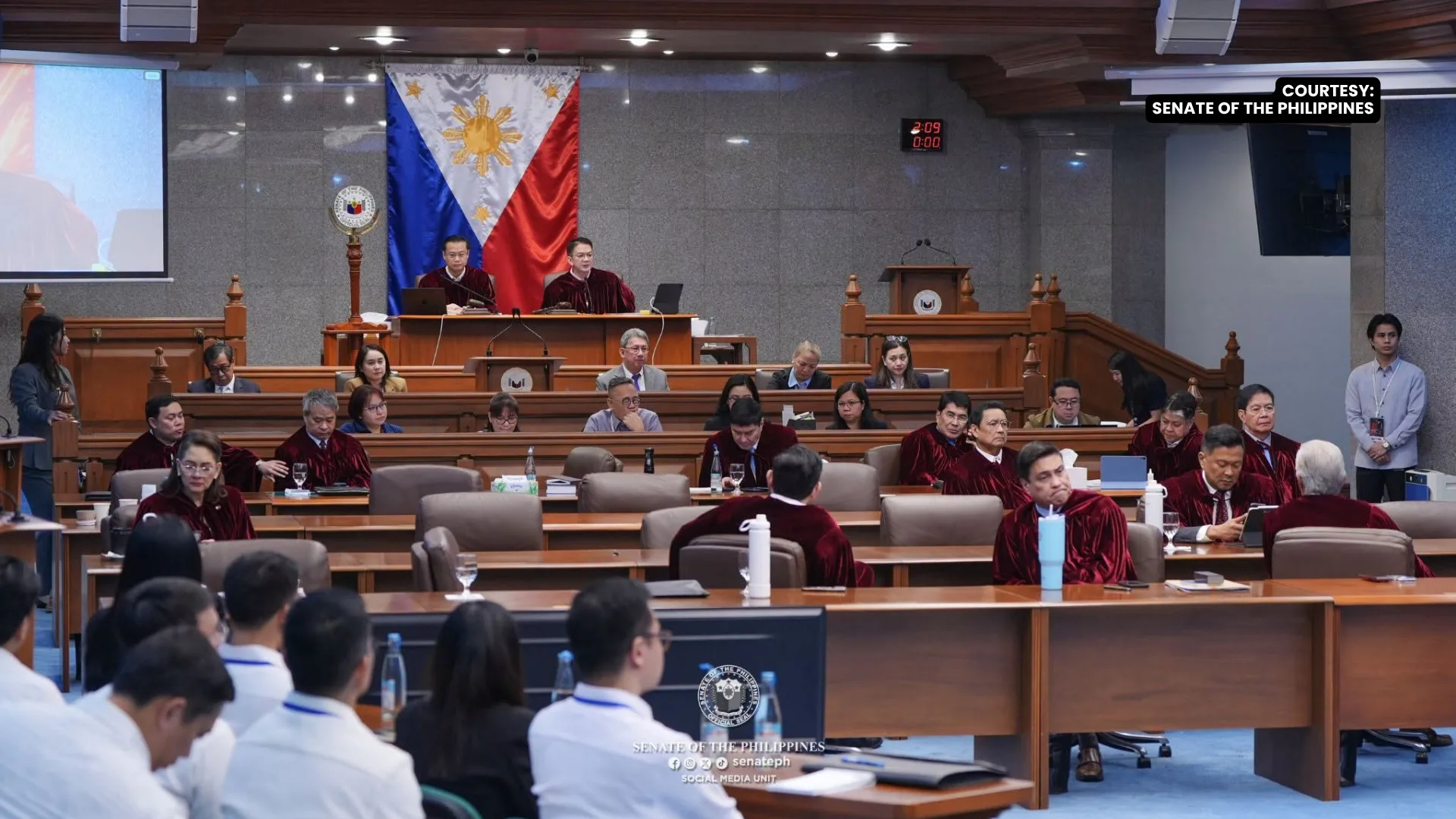
The House prosecution team clarified that the Senate Impeachment Court did not modify the Constitution when it defined which members are eligible to vote when rendering a verdict in an impeachment trial.
Lead House Prosecutor and Batangas Representative Gerville “Jinky Bitrics” Luistro maintained that the required voting threshold remains firmly at two-thirds, explaining that the Senate simply applied its constitutional mandate to define who counts as a legally and factually qualified voter.
“Ang kapangyarihan ng Senado o ng impeachment court upang bigyan ng kaliwanagan ang threshold vote ay ayon sa kanilang exclusive power to try and decide all impeachment cases,” Luistro said during a press briefing.
“Natuldukan na ang usapin, diskusyon, debate ng sambayanang Pilipino sa kung ilan ba talaga ang kailangan for purposes of conviction at kung ilan ba talaga ang kailangan for purposes of acquittal,” she added.
Under the Senate’s determination, certain categories of senators are excluded from the total count used to compute the two-thirds requirement. These exclusions cover lawmakers who are detained, suspended, under legal constraints, physically or medically incapacitated, hiding, outside the Senate’s coercive authority, or in similar circumstances.
“So, I think this is very significant as we continue the impeachment trial? Kasi mas mahirap din na hanggang sa oras na ito ay wala pang kaliwanagan. At least with what happened yesterday, maliwanag na, what is the threshold vote? And the threshold vote remains two-thirds of all the members who are legally and factually present or qualified,” Luistro said.
“I wish to make it clear, walang binago sa two-thirds. At kagaya ng naging posisyon ng prosecution, two-thirds is two-thirds,” she added.
Addressing claims of bias, Luistro noted that adjusting the voting base affects both sides equally, as reducing the total number of qualified senators lowers the threshold for both conviction and acquittal.
“By giving clarity to the denominator, what is lowered is not only the number for conviction, but also the number for acquittal. Two-way consequence yan. When they said that all members of the Senate pertain only to those who are legally and factually present, ang naapektuhan ay hindi lamang numero ng conviction, naapektuhan din ang numero ng acquittal,” Luistro said.
Illustrating the impact of the ruling, Luistro noted that if only 20 senator-judges are qualified to vote at the end of a trial, 14 votes would be required for conviction, while only 7 would be needed to secure an acquittal.
“But remember, the acquittal needs only seven. Unlike when we have all the senators actively participating in the trial, 24 ang denominator, 16 ang conviction, they only needed nine to acquit,” Luistro said.