
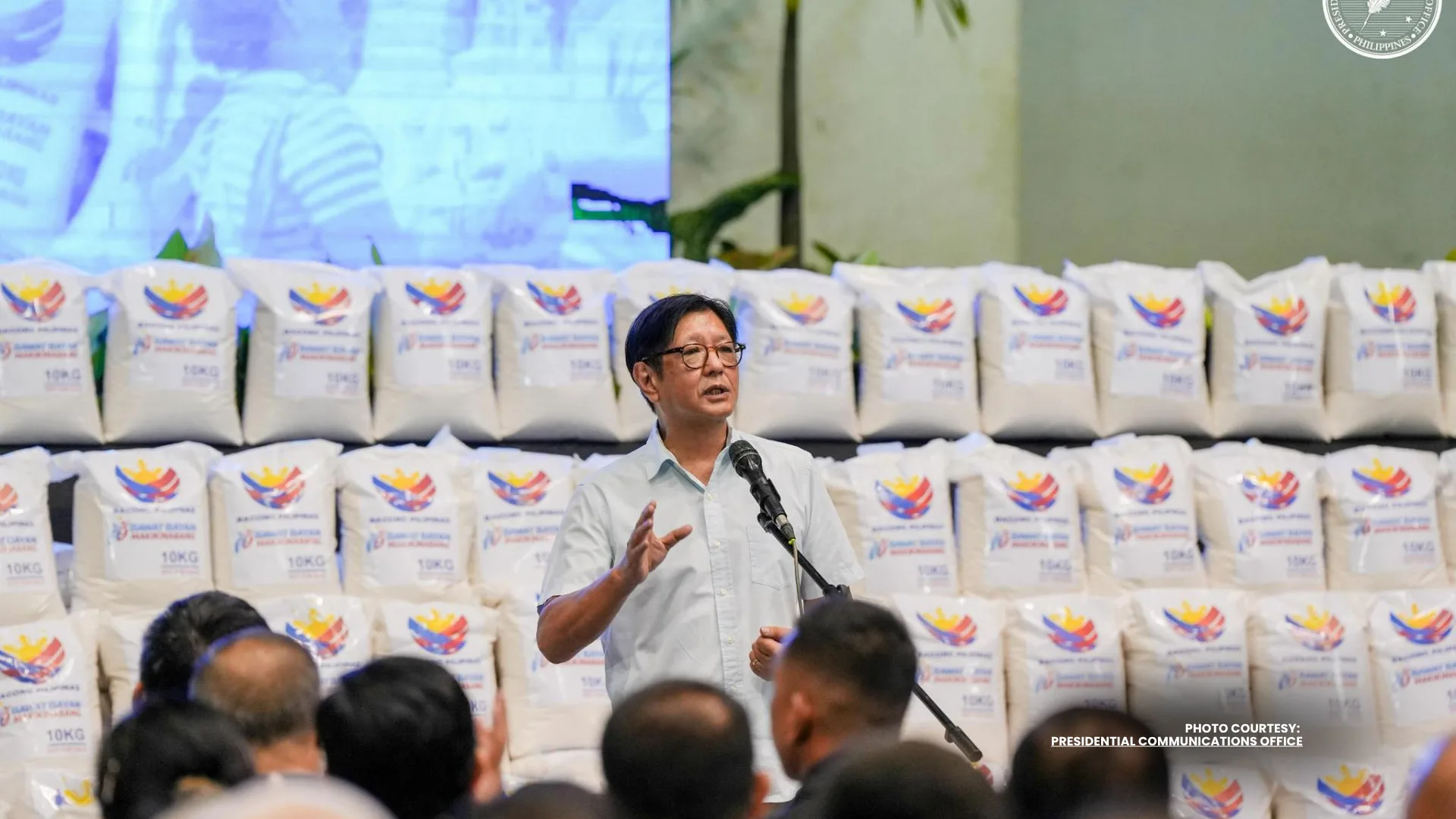
President Ferdinand Marcos Jr. formally launched the “Bawat Bayan, Makikinabang (BBM)” program in General Trias, Cavite, positioning it as a long-term grassroots assistance initiative that the government says will help communities cope with rising prices and economic pressures, including the impact of global oil volatility.
Speaking at the launch held at the General Trias Sports Park, Marcos said the program was not designed as a short-term response to any single crisis but is part of a broader effort to strengthen direct government support to local communities.
“Hindi namin ginawa ito dahil sa krisis. Ginawa talaga natin ito bilang programa. Suwerte lang na sabay ito sa mga hamon ngayon sa presyo at langis,” the President said.
Under the BBM program, local government units will tap their share of the Local Government Support Fund (LGSF) to distribute 10 kilograms of rice to identified vulnerable households every two months, or up to six times a year. The initiative aims to stabilize food access at the community level, especially as households face rising basic commodity costs.
Marcos said the timing of the rollout is crucial, noting that increases in global oil prices often trigger higher costs of other goods and services.
“Kapag tumataas ang presyo ng langis, sumasabay din ang presyo ng ibang bilihin. Kaya mahalaga na may ganitong programang direktang umaabot sa tao,” he said.
Aside from food support, the program also includes a Socio-Civic Projects Fund (SCPF), under which each barangay will receive P200,000. Half of the amount will be allocated for education-related support, including scholarships for selected students, while the remainder will fund local community projects chosen by barangay officials.
The President said the government is open to expanding funding for the program if implementation proves effective at the local level.
“Kung maayos ang pagpapatupad at nakikita nating epektibo, sisikapin nating dagdagan pa ang pondo sa susunod na taon,” Marcos added.
Alongside the launch, the Department of Social Welfare and Development (DSWD) reaffirmed its ongoing targeted assistance programs for sectors affected by fuel price increases, particularly public utility vehicle (PUV) drivers.
DSWD Assistant Secretary and spokesperson Irene Dumlao said programs such as the Assistance to Individuals in Crisis Situation (AICS) are being continuously implemented to ensure aid reaches those most affected by economic shocks.
“Sa pamamagitan ng AICS, masisiguro nating ang tulong ay napupunta sa mga tunay na nangangailangan, kabilang ang mga driver na direktang tinatamaan ng pagtaas ng presyo ng gasolina,” Dumlao said.
A recent Asian Development Bank (ADB) report also noted that the Philippines has been among countries actively responding to the ongoing energy-related pressures through both cash and non-cash interventions.
The DSWD has already disbursed billions of pesos in fuel subsidy and cash aid programs for transport workers, while continuing coordination with transport network companies for expanded rollout of assistance.
Government officials said both the BBM program and existing social protection measures form part of a wider strategy to cushion households and workers from external economic shocks while maintaining essential services at the community level.