
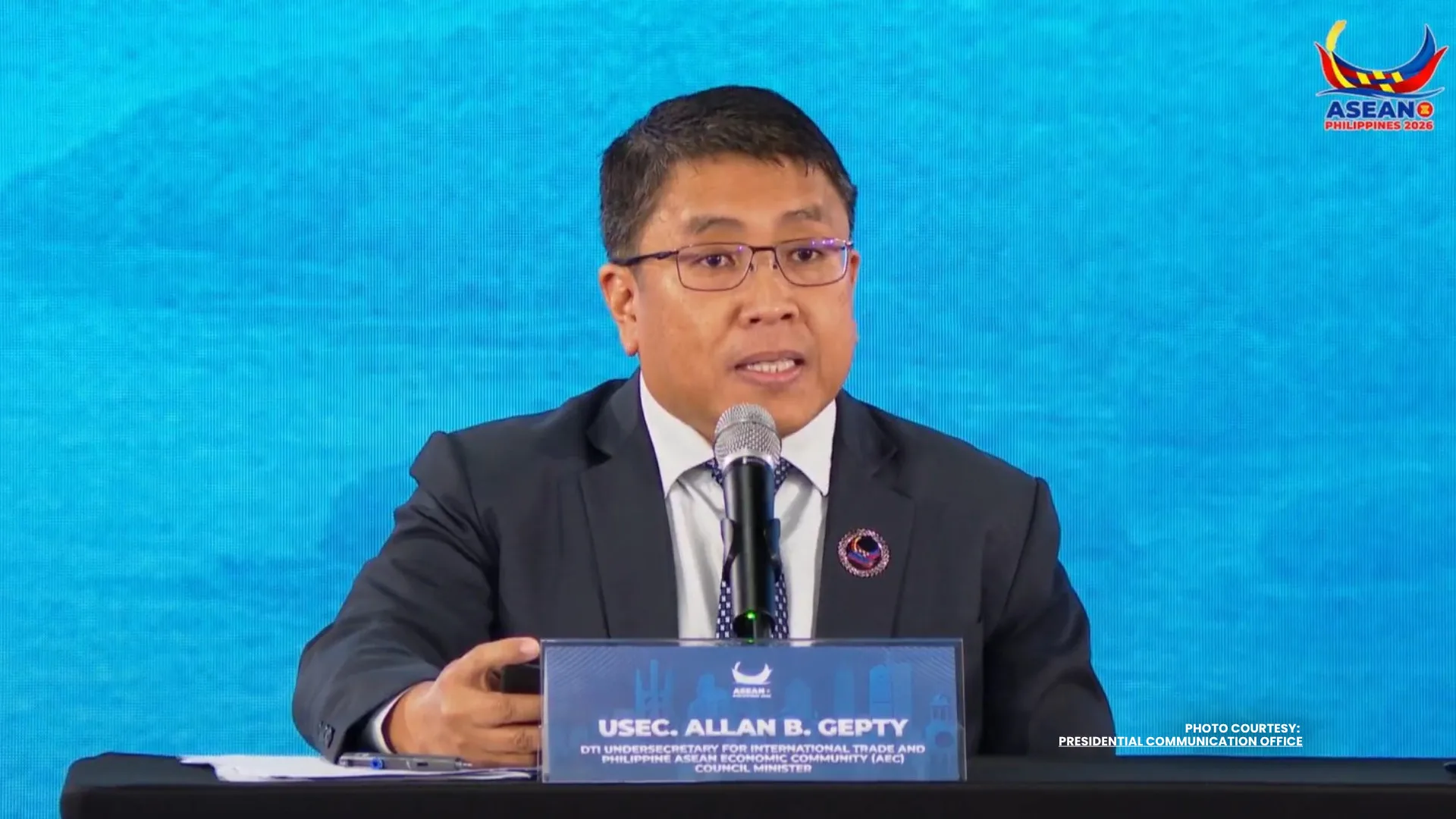
A senior trade official said deeper regional integration within the Association of Southeast Asian Nations (ASEAN) has become essential, not optional, as global uncertainties continue to test the resilience of economies across the bloc.
Speaking on the sidelines of the 48th ASEAN Summit, Department of Trade and Industry (DTI) Undersecretary Allan Gepty said recent geopolitical tensions, including the ongoing crisis in the Middle East, have exposed vulnerabilities in energy supply, food systems, and global logistics, areas where stronger regional coordination is needed.
“The current crisis underscores the need to deepen cooperation. National responses alone are not sufficient,” Gepty said during a press briefing at the International Media Center in Cebu.
He emphasized that ASEAN must move toward tighter coordination in critical sectors such as energy security, food security, and supply chain management to better withstand external shocks.
“A more integrated ASEAN is not just an aspiration; it is a necessity,” he stressed.
Gepty noted that ASEAN’s collective strength lies in its ability to act as a unified economic community, pointing to decades of cooperation that have opened markets, expanded trade, and created opportunities for businesses and workers across the region.
He said regional integration has enabled producers, farmers, and enterprises, particularly micro, small, and medium enterprises (MSMEs), to access broader markets and participate in regional value chains, while also improving mobility for workers and investors within Southeast Asia.
“These are not abstract ideas. These are everyday advantages that come from our regional cooperation,” he said.
The Philippines, one of ASEAN’s founding members, continues to play an active role in shaping the bloc’s economic direction, which Gepty described as increasingly vital during periods of global instability.
“When energy prices rise, supply chains tighten, and inflationary pressures build, ASEAN provides a platform for stability,” he said, adding that cooperation helps sustain trade flows and maintain investor confidence.
Gepty also highlighted Cebu’s role as host of this year’s summit, describing it as a key gateway for trade, tourism, and logistics in the region.
“By strengthening its role as a hub for commerce and services, Cebu can help ensure that supply chains remain efficient despite external disruptions,” he pointed out.
Looking ahead, Gepty said the Philippines’ chairmanship of ASEAN this year offers an opportunity to advance priority economic initiatives, including regional energy connectivity through the ASEAN Power Grid, resilient agricultural systems, expanded digital trade rules, and stronger trade partnerships with external partners such as Canada.
The 2026 ASEAN Summit, chaired by President Ferdinand Marcos Jr., carries the theme “Navigating Our Future, Together,” reflecting the bloc’s focus on collective action in addressing shared challenges.