
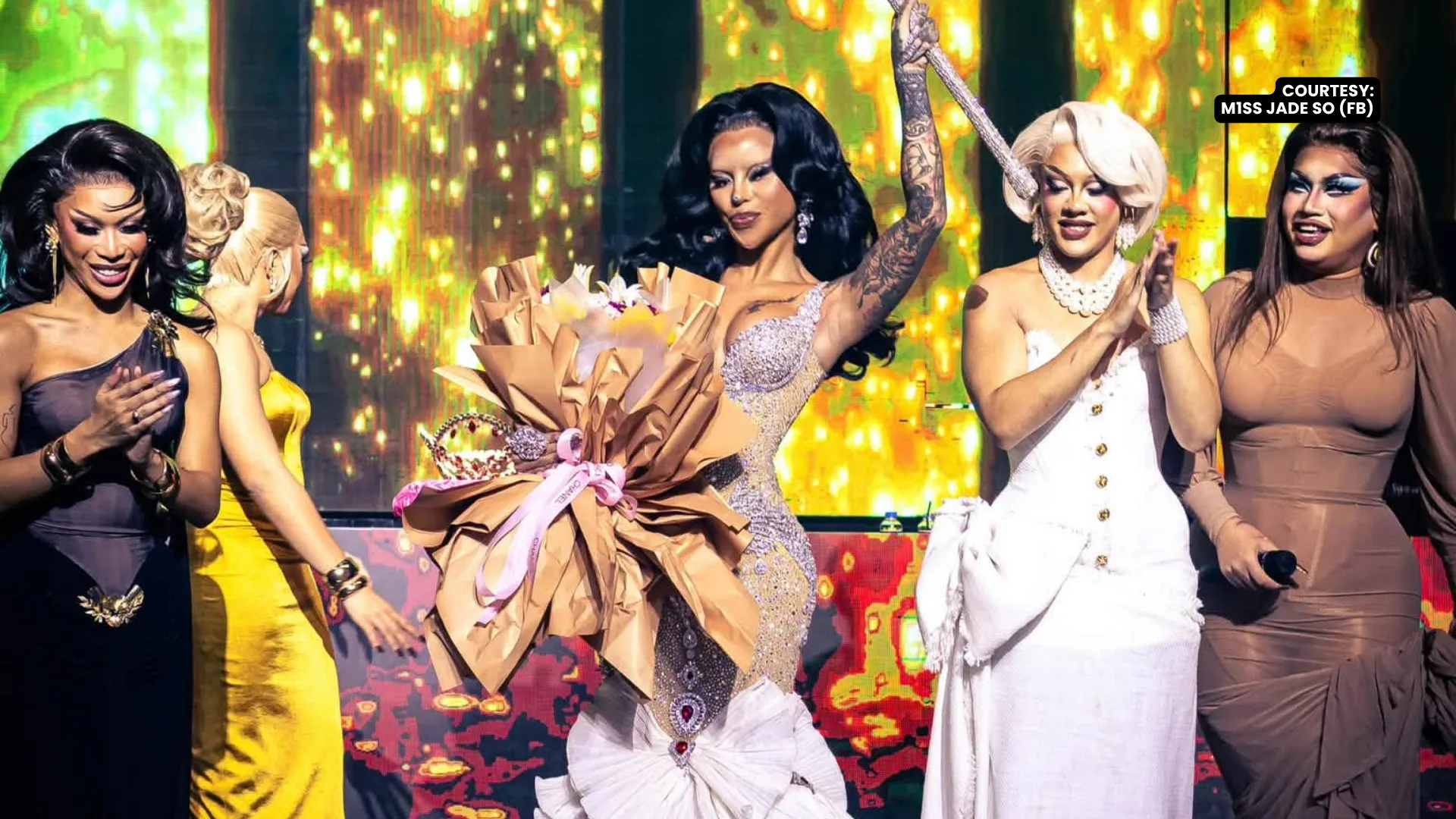
The Filipina drag artist finished the inaugural international competition with three challenge badges, a celebrated runway portfolio and a platform that put Filipino drag and trans representation before a global audience
M1ss Jade So ended her Drag Race Down Under vs The World journey as one of the season’s final four, bringing her distinctive “Goddessa” persona to an international audience.
In the finale released on September 11, host and main judge Michelle Visage advanced Britain’s Michael Marouli and Australia’s Art Simone to the final showdown, while Jade and Australian queen Vybe ended their runs in the Top 4.
Michael eventually defeated Art in the final lip-sync to win the inaugural season and the AUD$50,000 grand prize.
For Jade, however, the season became more than a race for the crown.
The Drag Race Philippines Season 2 alumna entered the competition with an aesthetic built around fantasy, femininity and her self-created “Dakesang Goddessa” mythology. Rather than toning down that eccentric identity for an international audience, she leaned further into it. The approach paid off.
Jade earned three challenge badges during the season, including recognition in the opening design challenge, “Franken-Drag” and “House of Whores: A Trilogy of Terror.”
Her runway presentations also became one of the strongest elements of her campaign.
For the finale’s “Best Mothertucking Drag” category, Jade appeared in a metallic, angelic-inspired creation incorporating Baybayin characters linked to the familiar Drag Race qualities of charisma, uniqueness, nerve and talent.
The look brought together the futuristic imagery associated with her drag and a distinctly Filipino element.
From ‘Dollification’ to ‘Goddessafication’
Behind Jade’s elaborate visual identity is a personal story tied closely to her experience as a transgender woman.
During her conversation with Visage in the finale, Jade discussed how an earlier concept she called “Dollification” emerged from embracing her femininity before eventually evolving into “Goddessafication.”
The latter became a broader expression of her personality, experiences and emotions — explaining why her drag can move between glamour, fantasy, humor and surrealism without fitting neatly into one category.
That individuality became one of Jade’s defining strengths throughout the competition.
Using drag as a platform
Jade also used her time on the show to discuss issues affecting the LGBTQIA+ community in the Philippines.
During the semifinal makeover challenge, she was paired with Matthew, whom she transformed into Miss Yasmine Hard Suso in a presentation inspired by Marimar.
Their interaction opened a conversation about LGBTQIA+ rights in the Philippines, including Jade’s support for the proposed SOGIESC Equality Bill.
It reinforced another dimension of her appearance on the competition: representing the Philippines was not confined to fashion or cultural references, but also involved speaking about issues affecting the community she belongs to.
A distinctly Filipino presence
Jade ultimately missed the final lip-sync for the crown, but her run added another chapter to the growing international visibility of Filipino drag performers.
She reached the finale without abandoning the eccentricity that first made her stand out on Drag Race Philippines.
Her combination of high-concept fashion, Filipino references and personal storytelling gave her a recognizable identity throughout the season — one that did not need to be simplified for a global audience.
Michael Marouli may have taken home the crown, but Jade left the competition having expanded the world of the “Goddessa” far beyond the Philippines.