
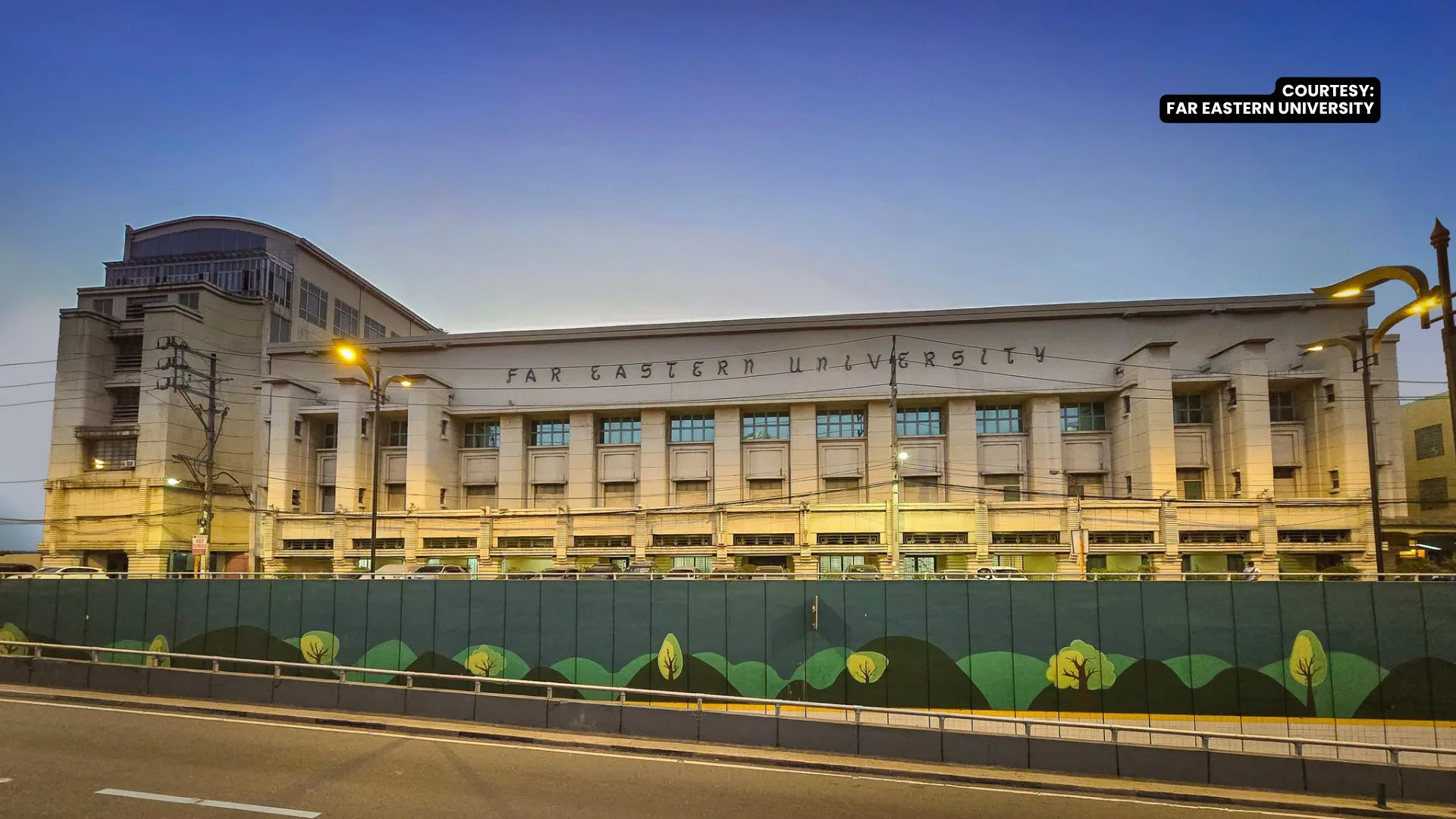
For 98 years, Far Eastern University has stood at the center of one of Asia’s most resilient cities. What happens when a building outlives every reason it was supposed to fall?
The School That Manila Built Around
For 98 years, Far Eastern University has stood at the center of one of Asia’s most resilient cities. What happens when a building outlives every reason it was supposed to fall?
A Feature Report
On a June evening in 2026, inside the Metropolitan Theater, a name was called that most people in the room probably did not expect. Among the corporations honored at Gawad Manileño, the annual awards that Manila holds to recognize its most dedicated civic contributors, only one was a university. The citation read out for Far Eastern University was for something unglamorous, something most institutions would not think to advertise: paying its taxes. Promptly, fully, and for nearly a century without interruption.
It sounds like a small thing. It is not.
In a city where institutional memory is frequently swallowed by construction cranes and election cycles, an organization that has been showing up, in every sense of the phrase, since 1928 is worth paying attention to. FEU has not just survived Manila’s convulsions. It has grown inside them, brick by brick, degree by degree, through a world war, a dictatorship, five constitutions, and the kind of urban transformation that has left almost no corner of the metropolis unchanged.
The campus along Nicanor Reyes Street in Sampaloc is the most visible proof of what that continuity looks like. Walking through its gates is one of the stranger experiences available to anyone with an interest in Philippine architectural history. The buildings are Art Deco, with all the geometric swagger and vertical ambition the style demanded in the interwar years. Six of them have been declared National Cultural Treasures. Their designer, Pablo Antonio, is a National Artist. His son, Pablo Jr., continued the work. The result is the largest ensemble of Art Deco structures in the country, and unlike virtually every other heritage campus in Southeast Asia, not one of these buildings has been converted into a museum.
They are classrooms. They are offices. Students eat lunch on their steps. Campus security guards nod at passersby beneath their archways. During enrollment season, the corridors fill to capacity and the buildings absorb, without complaint, the specific controlled chaos of ten thousand people trying to get their schedules sorted at once.
“A great city is not built by the government alone; it is built by the citizens who choose to care.” — Manila Mayor Francisco Domagoso, Gawad Manileño 2026
It is a distinction that matters more than it might appear. Preserving a building is a decision anyone with money and political will can make. Preserving a building’s purpose, keeping it doing what it was designed to do, for the population it was designed to serve, across nearly a century, is something different entirely. It requires a succession of institutional choices, stretching across administrations and generations, that consistently favor continuity over reinvention.
What a century looks like from the inside
FEU was founded in 1928, three years before the Art Deco buildings that would define it were completed. Manila at the time was a colonial city in the middle of an identity negotiation, part American administrative project, part Spanish inheritance, part something that had no name yet. The University Belt was already taking shape as the neighborhood where families who could not afford the tuition at Santo Tomas or De La Salle could still send their children to earn a degree.
The institution that Nicanor Reyes founded was, from the beginning, a bet on the middle. Not on the elite, not on the margins, but on the vast and growing population of Filipinos who needed education to be accessible rather than exclusive. That orientation, unfashionable to articulate but relentlessly practical in its implications, has shaped every subsequent decision the university has made about what it is for and who it serves.
The Second World War nearly ended the bet. Manila sustained more destruction in 1945 than any city in the Pacific theater except Warsaw. The Battle of Manila killed more than 100,000 civilians. The University Belt, sitting in the heart of the city, did not escape. What FEU rebuilt afterward, and how quickly it rebuilt, remains part of institutional memory that the current generation of students inherits whether they know it or not.
The postwar decades brought other tests. Martial law, which began in 1972 and lasted nearly a decade, compressed civil life in ways that touched every institution in the country. Universities occupied a peculiar position during those years, sites of dissent and surveillance simultaneously, places where the language of civic formation continued to be spoken even when its implications were dangerous.
FEU navigated it. The way institutions navigate things like that is rarely heroic and rarely visible from the outside. It is mostly the accumulation of small decisions, about what to teach, who to hire, which pressures to absorb and which to resist, made by people whose names do not appear in the history books.
The architecture of continuity
Stand in front of the FEU main building long enough and something becomes clear. These structures were not built to be temporary. The proportions are too deliberate, the ornamentation too considered, the stone too committed to its own permanence. Whoever commissioned them believed the institution would last, and they built accordingly.
Art Deco arrived in the Philippines at a moment when the country was constructing a version of modernity for itself. The style, with its faith in geometry and its unapologetic confidence in the future, suited a young nation that wanted to signal ambition without borrowing too explicitly from colonial precedent. Pablo Antonio understood this. His buildings for FEU are not imitations of New York or Chicago originals. They are something that belongs specifically to Manila, to its light, its scale, its particular blend of aspiration and pragmatism.
What the National Cultural Treasure designation confers is formal acknowledgment of something the buildings already possessed: the status of irreplaceability. There are things about a city that, once removed, cannot be reconstructed. Not exactly. Not with the specific gravity that comes from a structure that has witnessed decades of actual human life unfolding inside it.
“Our history has always been closely linked with the history of Manila. For almost 100 years, FEU has grown alongside the city and its people.” — Dr. Rowena Capulong Reyes, FEU Vice President for Corporate Affairs
The students who pass through the campus today are, in most cases, not thinking about architectural heritage. They are thinking about their next exam, their org meetings, the thesis that is due in three weeks, the jeepney they need to catch. That is entirely correct. That is precisely what these buildings are for. Heritage that requires constant awareness of itself is heritage that has already failed. The best kind is so thoroughly woven into ordinary life that it becomes background, the way the best cities become background, present and shaping without demanding to be acknowledged.
The unglamorous work of civic belonging
The Gawad Manileño award that FEU received in June did not go to an institution that had just built something or launched something or rebranded itself. It went to one that had been quietly, consistently doing what responsible membership in a city requires. Paying taxes is not a narrative. It does not make for a compelling press release. What it represents, however, is a form of civic commitment that is rarer than it should be.
FEU Chief Finance Officer Rosanna Salcedo framed the recognition as a reflection of the university’s financial stewardship, its integrity and accountability over time. What she described is the institutional equivalent of what the city’s founding fathers had in mind when they imagined civic life as something built by participation rather than by government mandate alone.
Manila Mayor Francisco Domagoso put it directly at the awards ceremony: a great city is not built by the government alone. It is built by the citizens who choose to care. An institution ninety-eight years into choosing to care is not making a philosophical statement. It is demonstrating one.
That choice has costs. Maintaining heritage buildings is expensive. Active campuses require perpetual investment. Staying in Sampaloc, one of Manila’s most densely populated districts, when land values in other parts of Metro Manila might have offered easier returns, is the kind of institutional decision that gets made by people who understand that an organization’s address is also a statement of values.
A centennial and what comes after it
In 2028, FEU will mark one hundred years. The milestone will arrive at a moment when Manila is, once again, in the middle of reinventing itself. New infrastructure is reshaping the city’s geography. Development is pushing into neighborhoods that have been stable for decades. The pressures on heritage are, if anything, more acute than they have ever been, because the economics of land in a growing megacity do not naturally favor preservation.
The FEU campus will stand through it. Not because the buildings are protected, though they are. Not because the institution is financially secure, though it is. But because there is something about an organization that has already survived the things FEU has survived that develops a different relationship to time. It has seen enough city-wide upheaval to know that the instinct to tear down and start over is almost always more expensive, in every sense, than the harder work of staying put and maintaining what you have.
The question for Manila is whether the lesson extends beyond a single campus. Every city eventually faces a version of the same choice: what do you keep, and what do you let go? The buildings along Nicanor Reyes Street offer one answer to that question. Not because they are old, but because they are still useful. Still full. Still doing, on any given Tuesday morning, exactly what they were built to do.
That is not a small thing either.