
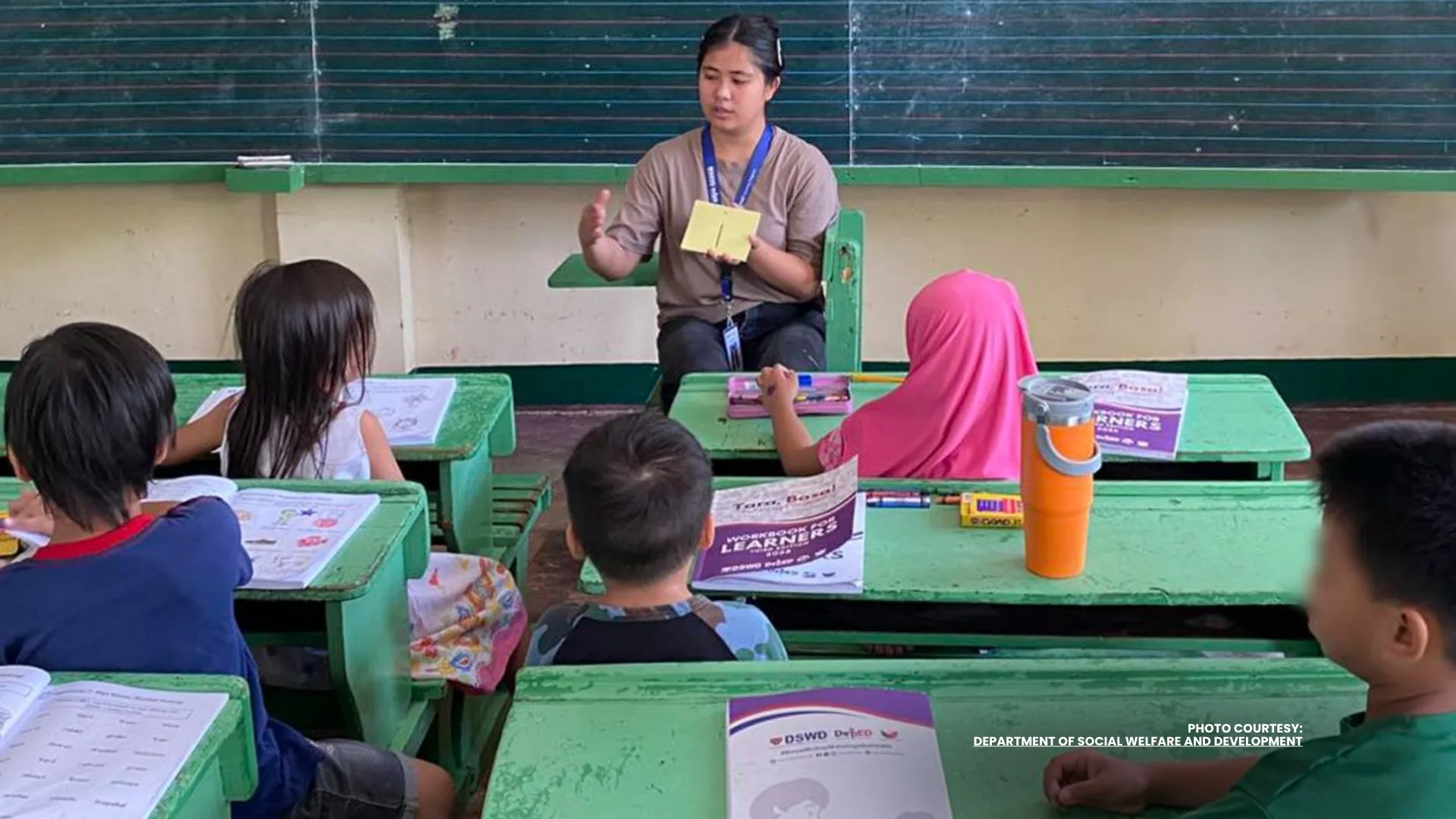
The Department of Social Welfare and Development (DSWD) is expanding its Tara, Basa! Tutoring Program to reach more vulnerable learners and communities, including poor households, Indigenous Peoples, and residents of Geographically Isolated and Disadvantaged Areas.
TBTP Officer-in-Charge National Program Manager Director Elma Salamat said the DSWD is strengthening the program through new learning methods and modalities aimed at addressing literacy gaps beyond the usual classroom setup.
Aside from the program’s annual 20-day tutorial and parenting sessions for incoming Grade 2 learners, Salamat said the DSWD has developed additional approaches based on lessons from its previous implementation.
“Base sa experience namin last year, ‘yung pilot testing natin, kailangan nating gumawa ng isa pang method or isa pang approach. Ito ‘yung teaching at the right level. Halimbawa, may mga high school na hindi pa rin marunong magbasa at wala pa ring comprehension. So, ngayon i-e-enhance namin ang aming module at ‘yung knowledge product namin on that,” Salamat said during the DSWD Media Forum aired Thursday.
To widen its reach, the DSWD launched the Tara, Basa! sa Barrio modality in 2025 in partnership with Caritas PH. The initiative brings community-based literacy sessions to barangay halls, parishes, and other public facilities instead of limiting learning activities to traditional classrooms.
“Through the Caritas PH, nagkaroon tayo ng Tara, Basa! sa Novaliches, sa parish nila. Then also sa Laguna din, ka-partner natin dito ang Magna Anima Teachers College. We also have in Region 3, mayroon tayo sa San Jose del Monte, Bulacan,” Salamat said.
The DSWD has also introduced Tara, Basa! sa Centers and Residential Care Facilities, a modality designed for beneficiaries staying in government centers and care facilities.
Under this initiative, the TBTP converges with the Walang Gutom Program and the Pag-abot Program to establish reading corners and provide tutoring services inside the centers.
The modality was pilot-tested in 2025 for teenage mothers, rescued beneficiaries in processing centers, and internally displaced persons.
Salamat said the program is no longer limited to basic reading and writing, as it also seeks to provide functional literacy and life skills that beneficiaries can use in their daily lives.
“Dito namin nakikita na all walks of life, mayroon talagang naiiwan pagdating sa pagkatuto, pagdating sa edukasyon,” she said.
The DSWD said the enhancements will help ensure that beneficiaries receive appropriate interventions based on their specific learning gaps.
The agency said the initiative is in line with President Ferdinand Marcos Jr.’s directive to prioritize programs that help children and the youth reach their full potential.
Youth Development Workers and tutors lead the program’s tutorial and parenting sessions. They are indigent college students enrolled in TBTP partner state and local universities and colleges, including the Polytechnic University of the Philippines.
Partner schools must formally endorse students who want to serve as tutors or Youth Development Workers. Applicants must come from poor or near-poor households, have good moral character, and have no record of school policy violations, including bullying.
Local government units, meanwhile, identify the child learners and parent-beneficiaries who will participate in the tutorial and parenting sessions.