
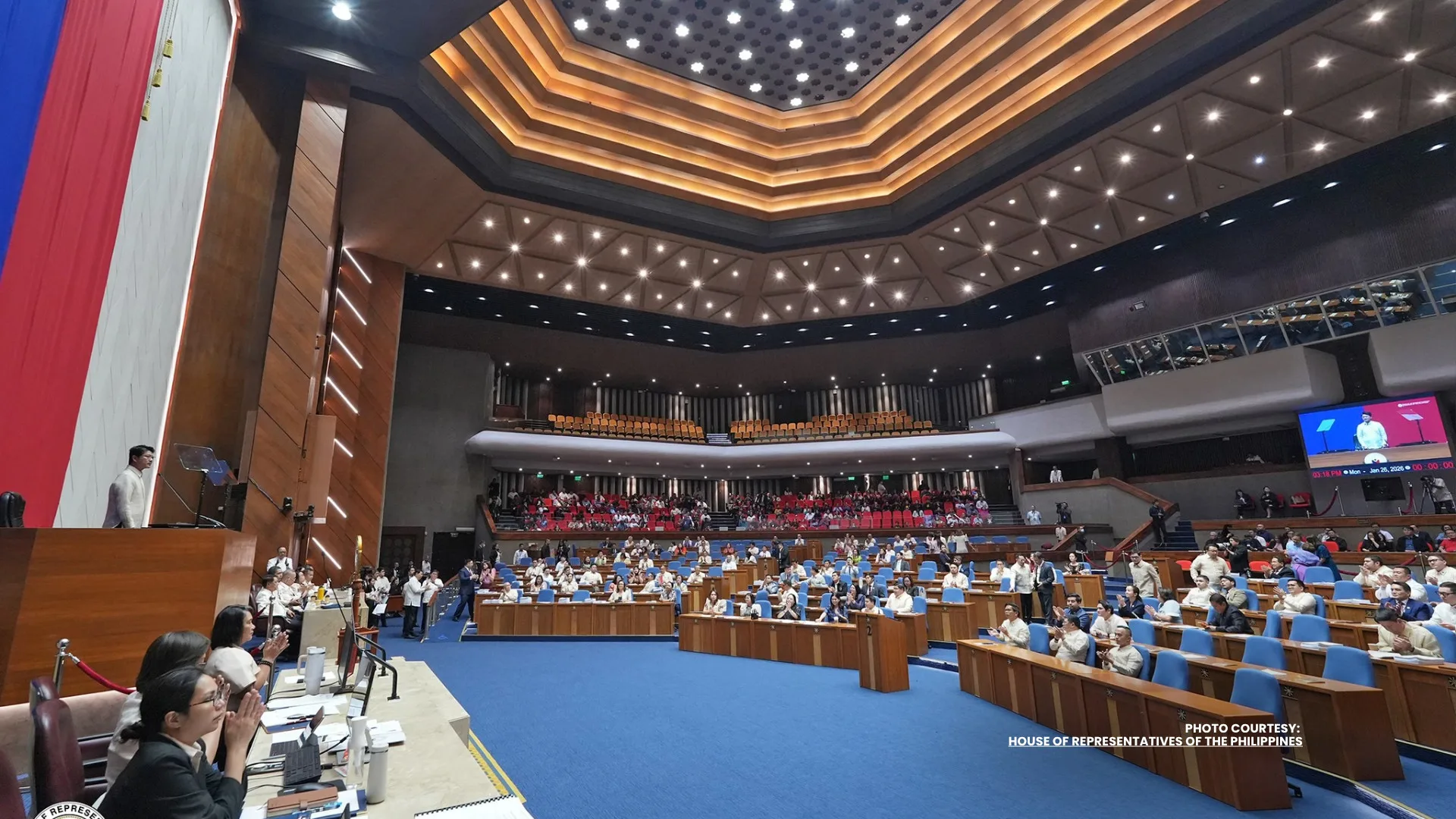
House lawmakers on Tuesday defended the House-approved version of the proposed P7.2-trillion national budget for fiscal year 2027, urging critics to allow the legislative process to unfold following concerns raised by civil society groups over P170 billion in infrastructure allocations.
House Committee on Justice Chairperson and Batangas Representative Gerville “Jinky Bitrics” Luistro expressed confidence that the House General Appropriations Bill (HGAB) addresses critical community needs and aligns with public interest.
“Tayo po’y naniniwala sa ating mga kasama dito sa House of Representatives, headed by the House leaders, na kung anuman ang nasa HGAB, it represents the concerns and interests of the Filipino people,” Luistro said during a press briefing. (We believe in our colleagues here in the House of Representatives, led by the House leadership, that whatever is in the HGAB represents the concerns and interests of the Filipino people.)
Luistro cautioned against pre-judging the proposed spending plan, noting that budget deliberations are only midway through the congressional approval process.
“I think it is too early. Too early to preempt, to say na may problema sa budget. Because as a matter of fact, halfway pa lang po tayo,” she added. (I think it is too early to say there is a problem with the budget because, as a matter of fact, we are only halfway through.)
Luistro’s remarks respond to calls from the People’s Budget Coalition urging the Senate to excise approximately P170 billion in additional funding earmarked for local roads and multipurpose buildings, citing potential irregularities and questioning project necessity.
Addressing the critique, Luistro emphasized that infrastructure spending remains valid when grounded in genuine public utility. “Kung merong actual need for those projects, there is nothing wrong about that, so long as it will serve the interest of the Filipino people. What I take offense is, ’yung talagang mga ghost projects,” she noted. (If there is an actual need for those projects, there is nothing wrong with that… What I take offense to are actual ghost projects.)
She highlighted that the Senate retains full authority to propose amendments, with any conflicting provisions to be resolved in a bicameral conference committee.
Echoing Luistro’s stance, Bicol Saro Party-list Representative Terry Ridon, chairperson of the House Committee on Public Accounts, argued that lawmakers should evaluate line items individually rather than enacting blanket cuts on entire infrastructure categories.
“Ang very important basic question ay ’yun po bang mga inilagay po na mga line items po roon ay may actual na pangangailangan? Meron po bang maseserbisyuhan na mga komunidad?” Ridon stated, citing senior citizens’ centers, barangay facilities, and municipal halls as examples of local projects with direct social value. (The very important basic question is: Are the inserted line items backed by an actual need? Are there communities that will be served?)
Similarly, Manila Representative Joel Chua, who chairs the House Committee on Good Government and Public Accountability, cautioned against removing funds for multipurpose structures that double as disaster relief infrastructure.
“Halimbawa po ’yung mga evacuation center, bawal din po ba ’yun? So paano ’yung mga ganitong klase na multipurpose at makikinabang naman ’yung mga kababayan natin?” Chua questioned, stressing that local needs vary across districts and require tailored funding considerations. (For example, evacuation centers—are those forbidden too? So what happens to these types of multipurpose structures that directly benefit our countrymen?)
The proposed 2027 General Appropriations Act now moves to the Senate for committee and plenary review prior to finalization.