
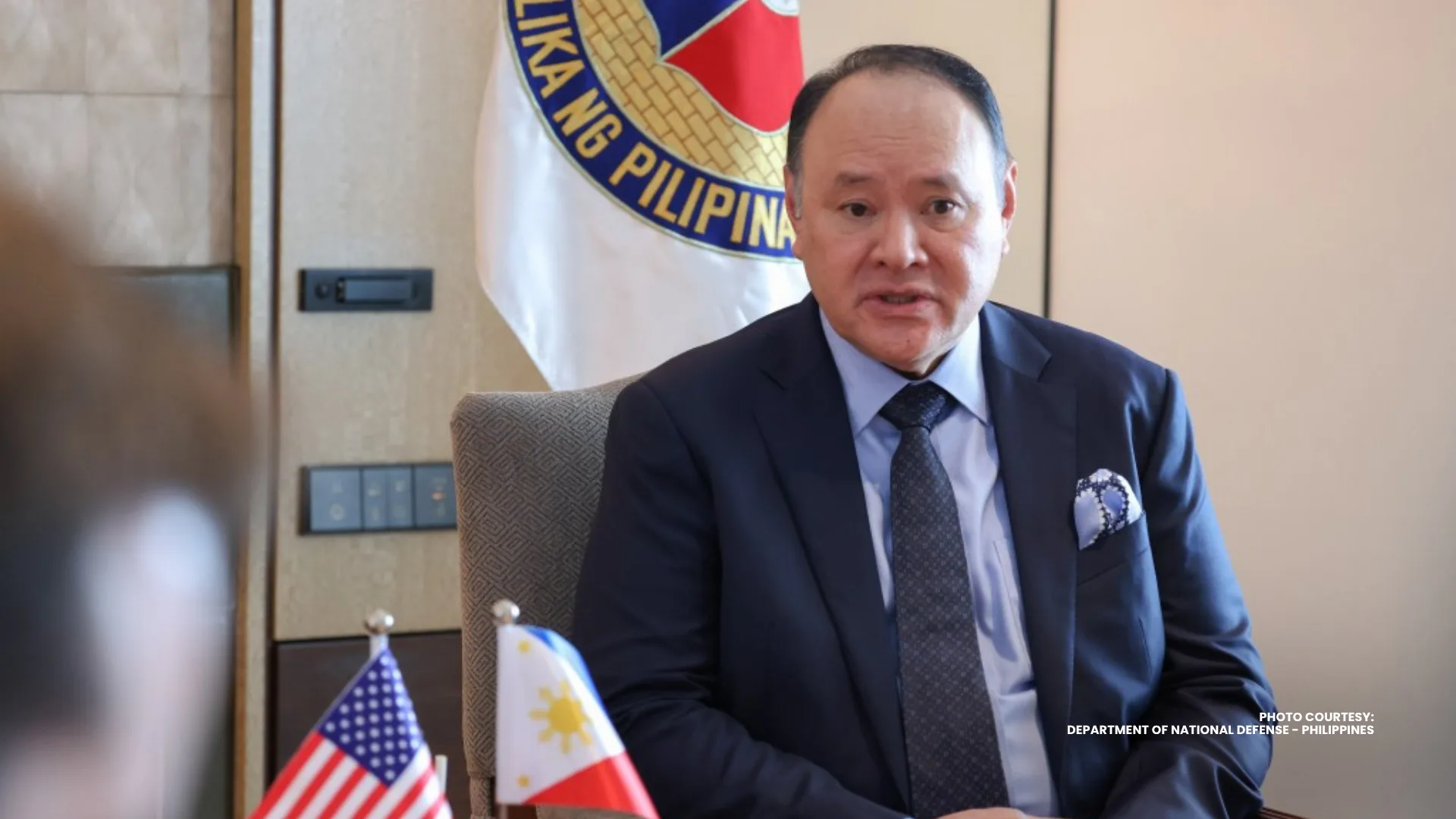
Defense Secretary Gilberto Teodoro Jr. said the Philippines is emerging as a key hub for cooperation among countries committed to defending freedom of navigation, international law, and stability in the Indo-Pacific.
In a statement, Teodoro said the global order is undergoing a period of transition as long-standing institutions, rules, and partnerships face mounting pressure from shifting interests, resource constraints, and emerging security challenges.
For the Philippines, he said these changes are most clearly felt at sea, where the rules-based order continues to be challenged.
Teodoro noted that this year marks the 10th anniversary of the 2016 South China Sea arbitral award, which rejected claims based on “historic rights” and affirmed that maritime entitlements must be grounded in international law, particularly the United Nations Convention on the Law of the Sea (UNCLOS).
He said the ruling remains central to the country’s defense of its maritime rights in the West Philippine Sea.
“With our defense of international law and strategic location, unlike any other, the Philippines has emerged as a hub for convergence among those committed to a rules-based order in the maritime domain,” Teodoro said.
He described the Philippines as an “Archipelagic Sentinel” and “Guardian of the Freedom of the Seas,” citing the country’s location along vital trade routes linking the Indian and Pacific Oceans.
Teodoro said the Philippines would continue to uphold the UN Charter, UNCLOS, the 2016 arbitral award, ASEAN centrality, and peaceful dispute settlement mechanisms.
He also stressed that the country would work with partners that share its goal of protecting maritime rights and ensuring that Southeast Asia remains free from domination by any single power.
Teodoro cited the Philippines’ expanding network of security partners, including the United States, Japan, Australia, New Zealand, Canada, France, and India, through maritime cooperative activities in support of a free and open Indo-Pacific.
He said these efforts reflect growing recognition that countries must find common ground amid concerns over actions that threaten smaller states.
The defense chief also criticized China’s continued rejection of the arbitral award, saying refusal to participate in proceedings does not remove a state’s obligation to comply with international law.
He said the Philippines would not accept any move that weakens UNCLOS, which he described as the foundation of the country’s territory and maritime rights under the Constitution.
Beyond maritime security, Teodoro also raised concerns over foreign interference, espionage, malign influence, substandard industrial activities, and risks to national resilience.
He said like-minded countries must build reliable supply chains and resist activities that undermine political, economic, and social stability.
Teodoro said diplomacy remains important, but defense and military institutions must also act to protect sovereignty, territorial integrity, and human life amid rapid changes in the international system.
He also called for stronger cross-regional security cooperation, warning that conflicts in Europe and the Middle East produce spillover effects that affect countries far beyond their borders.
Teodoro said the international community must pay particular attention to the safety of migrant workers, including Filipinos, who play critical roles in global seafaring, healthcare, and other essential sectors.
“In a fragmenting world, convergence is not merely an option. It is an imperative, and the Philippines is actively embracing and acting on this imperative,” he said.