
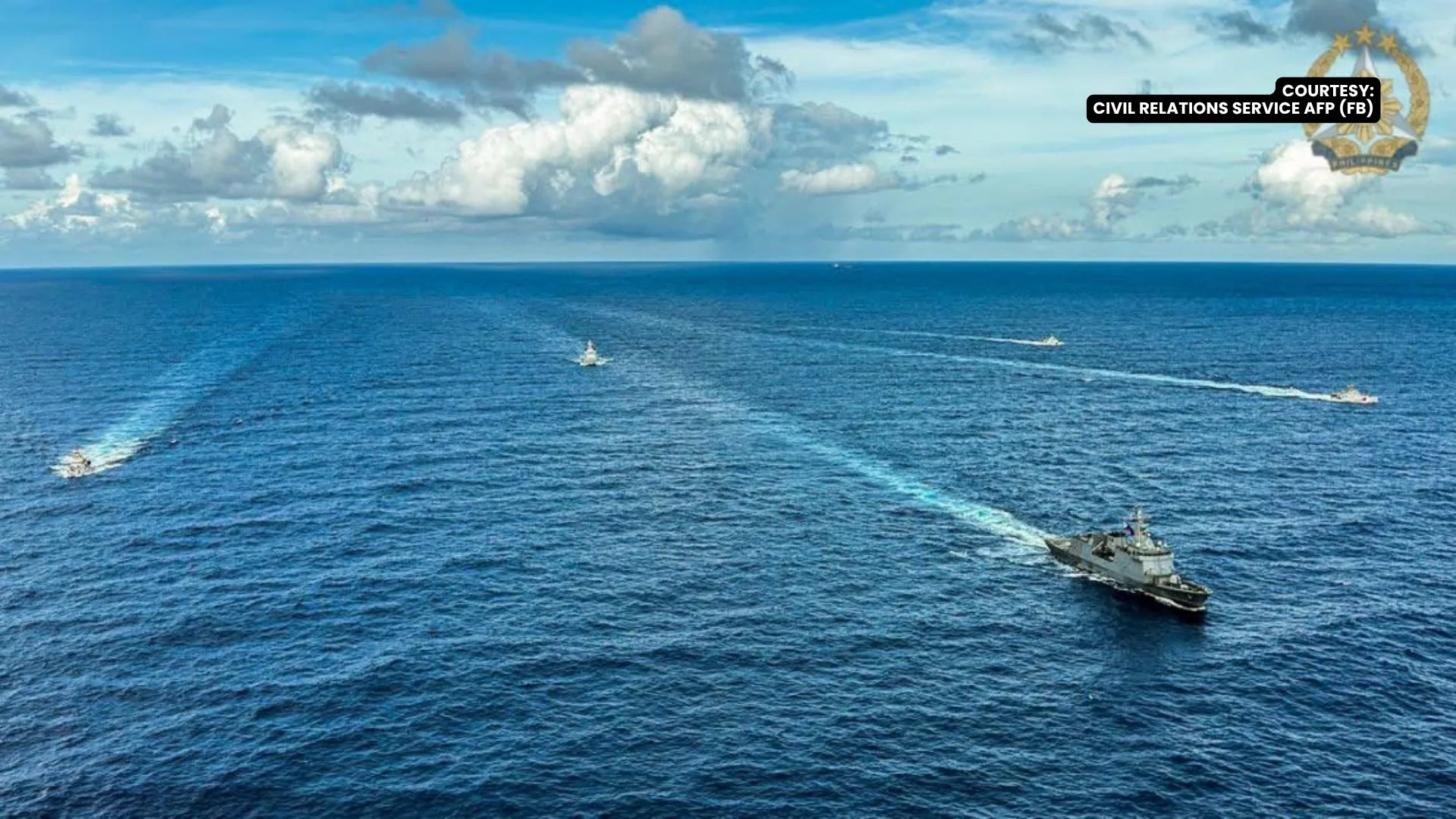
Defense Secretary Gilberto C. Teodoro, Jr. warned Thursday that China’s aggressive stance in the maritime domain is bound to persist, urging the Philippines and its international allies to overhaul their strategic responses rather than await a change in Beijing’s conduct.
Speaking at the 2nd Manila Strategy Forum hosted by the Center for Strategic and International Studies (CSIS), Teodoro addressed China’s ongoing maneuvers in the West Philippine Sea. He highlighted recent escalations, including the harassment of Philippine vessels and aircraft, alongside Beijing’s intent to build a marine observatory at Bajo De Masinloc.
“As I keep on repeating, we are in a struggle; this is not going to be solved overnight. But I know that it’s not going to be resolved if we are not resilient, if we are not firm on our positions in not only the West Philippine Sea but the whole of the maritime domain of the Philippines to include our extended continental shelf,” Teodoro said during a discussion with CSIS Senior Fellow Gregory Poling.
Teodoro pointed out that Beijing’s push for a Sinocentric international order, driven by “Xi Jinping Thought,” is generating similar anxieties globally, noting that several European nations are increasingly worried about Chinese threats to critical maritime infrastructure and submarine cables.
“I think we will see more of the same. We should not expect any change in their behavior; what we should change is the way we react,” Teodoro remarked.
Fresh off an appearance at the Seoul Defense Dialogue 2026, the Defense chief escalated his criticism of China’s diplomatic tactics, referring to the recent written note dispute and broader “wolf warrior diplomacy” from the Chinese Embassy as unacceptable behavior.
Teodoro stated that “the world has been coddling them and indulging them too much, and they abuse the courtesy shown them and I might as well call it out.”
He described Beijing’s actions as marked by “rudeness, boorishness, abusiveness, and whatever adjectives you can find for it,” emphasizing that calling out such conduct was a necessary reaction.
“I said this is already too much. And that was an instinctive reaction, by the way, and nothing great about it, I mean, it’s instinctive, I think, anyone in his or her right mind with a basic sense of values and a basic sense of norms would react,” he added.
Outlining the Department of National Defense’s deterrence blueprint, Teodoro emphasized a dual approach: accelerating self-reliant defense modernization while deepening ties with like-minded partner nations. He pointed to progress on the Status of Visiting Forces Agreement with France, which gained endorsement from the Senate Committee on Foreign Relations on Thursday, as a concrete example of this alignment.
He argued that collective resistance from archipelagic and smaller states creates a stronger defense against unlawful aggression and attempts to distort international norms.
Teodoro praised the diplomatic trust within ASEAN, referencing partnerships like the Philippine-Vietnam alliance and how regional neighbors resolve disputes through legal frameworks.
“For example, Malaysia and Singapore, they have gone to arbitration several times, and I believe Thailand and Vietnam too, if I’m not mistaken. With us, there’s no problem. That’s why China is our problem, admittedly. So I think within ASEAN the possibilities are endless,” Teodoro said.
He reinforced the foundational value of the 2016 Arbitral Tribunal Award, which invalidated China’s expansive nine-dash line claim, noting that it provides a shared legal basis for Southeast Asian nations to settle overlap in territorial entitlements peacefully.
“It [the 2016 Ruling] benefits all of us, because that is the major problem here. And then we can settle differences in the features which we hold, in our maritime entitlements, peacefully within ASEAN,” Teodoro stated.