
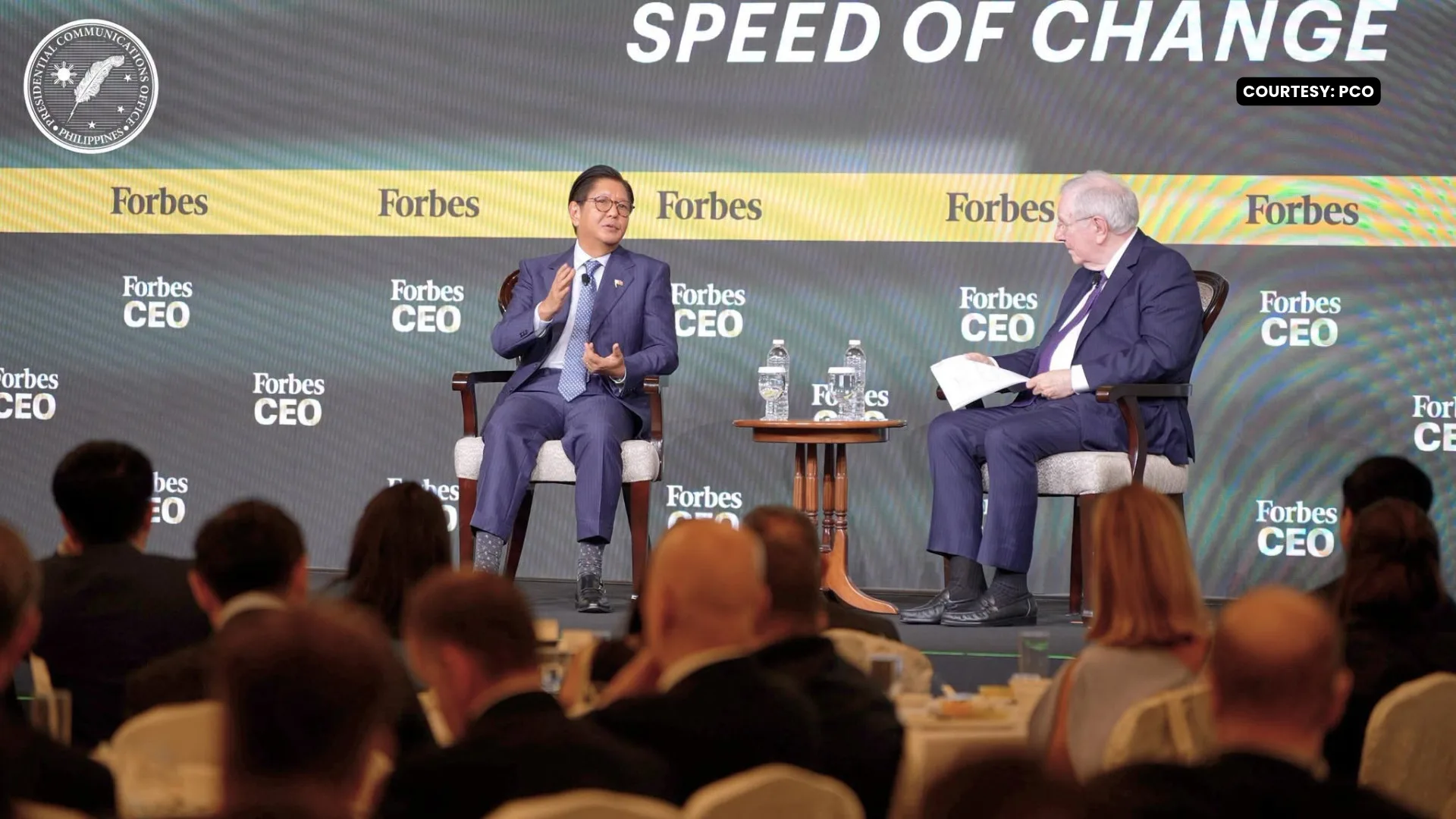
President Ferdinand Marcos Jr. showcased investment opportunities across key Philippine sectors while promoting the country’s business climate and skilled workforce during an address to international business leaders in Singapore.
Speaking at the 24th Forbes Global CEO Conference, Marcos highlighted potential investment areas including digital technology, artificial intelligence, manufacturing, infrastructure, energy, and healthcare.
In a discussion with Forbes Media Chairman and Editor-in-Chief Steve Forbes, Marcos outlined structural policy reforms implemented to enhance the business environment, such as process streamlining, easing foreign ownership limits, digitalizing government operations, building infrastructure, and strengthening public-private partnerships.
Marcos described the country’s workforce as its primary competitive advantage, characterizing Filipino workers as young, knowledgeable, and well-trained.
Marcos also said the government continues to upskill and reskill workers to align with evolving industry demands.
Addressing corporate governance and anti-corruption efforts, Marcos discussed government measures to combat corruption, specifically referencing steps taken to address flood control issues, emphasizing that corruption remains unacceptable in the country.
Marcos also highlighted key economic initiatives, including the Luzon Economic Corridor and the United States-led Pax Silica program. The Pax Silica initiative aims to establish high-tech manufacturing and artificial intelligence hubs in the Philippines to secure critical supply chains for microchips and advanced technology.
Marcos said the government is very excited about the Pax Silica initiative, noting that it coincides with efforts to move the domestic semiconductor industry up the value chain.
Touching on regional affairs as the Philippines serves as ASEAN chair, Marcos detailed efforts within the regional bloc to establish artificial intelligence cooperation.
The Digital Economy Framework Agreement (DEFA) is expected to be adopted by ASEAN member states during the 49th ASEAN Summit and Related Summits in Manila in November.
Marcos also noted that ASEAN nations remain committed to negotiating a binding Code of Conduct with China to secure commercial transit and freedom of navigation across disputed waters.
“Sixty plus percent of global commerce goes through that waterway. And we must maintain the peace, we must maintain the freedom of navigation, not only for ourselves, but also for the rest of the world. And so, the Code of Conduct takes on that very, very particular importance. And that is why we are very still, continue to be optimistic,” Marcos said.
Marcos also said ASEAN members agree that a binding code of conduct is necessary to avoid difficulties and maritime incidents between Manila and Beijing, as well as in other areas of the South China Sea.
Attending the conference alongside at least 450 global executives, Marcos also met on the sidelines with FedEx Airline and International President and CEO Richard Smith. The two discussed FedEx’s operations in the country, which currently include nearly 40 weekly flights across the Clark Gateway Hub in Pampanga and the Manila Gateway at Ninoy Aquino International Airport (NAIA) in Pasay City.
During the Singapore visit, Marcos is scheduled to tour the Nuclear Research and Safety Institute to study nuclear technology safety frameworks and hold a bilateral meeting with Singaporean Prime Minister Lawrence Wong to discuss regional cooperation and Singapore’s upcoming ASEAN Chairship.