
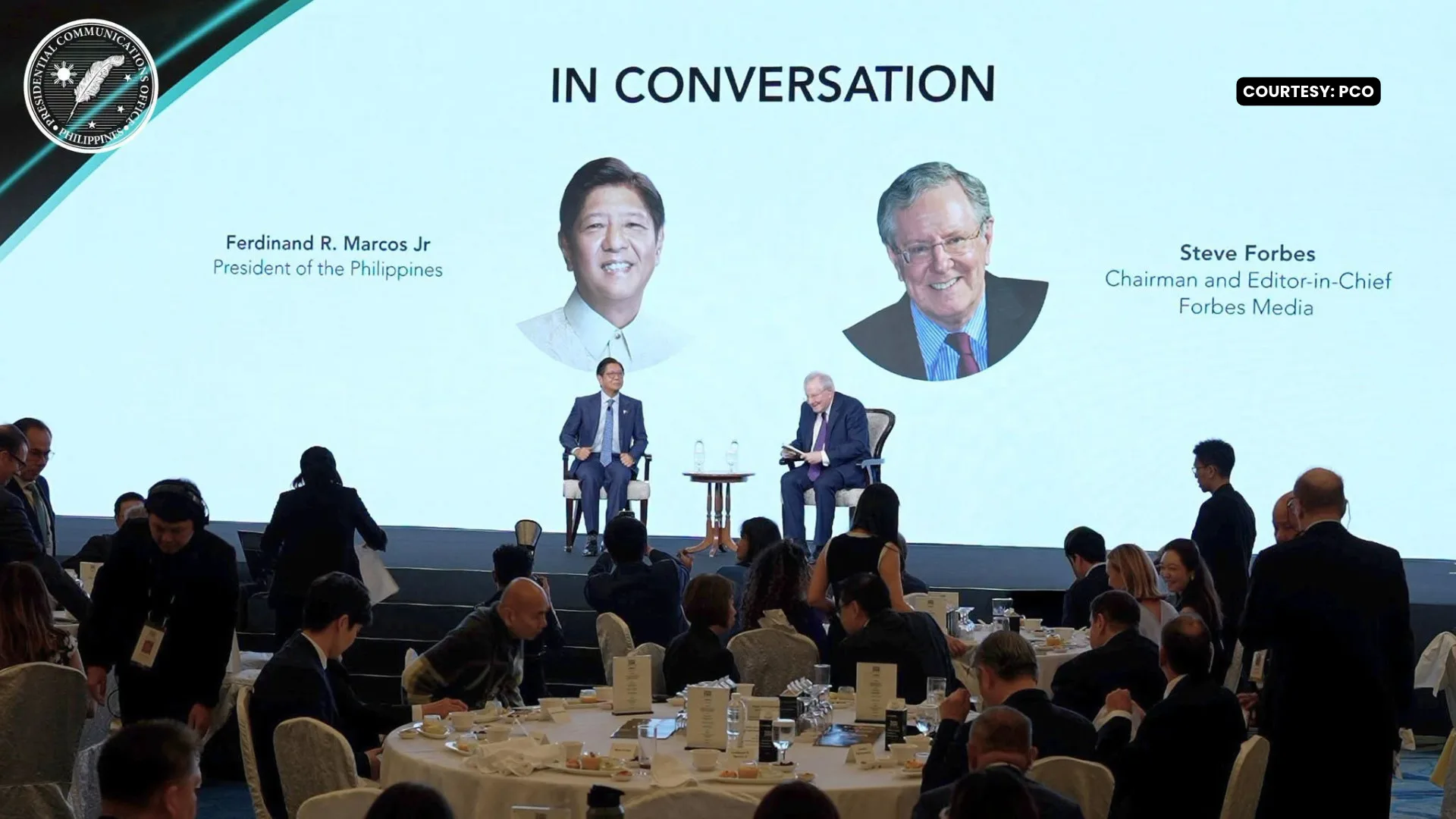
President Ferdinand Marcos Jr. reaffirmed that the West Philippine Sea forms an integral part of national territory, sovereignty, and exclusive economic zone while emphasizing the country’s commitment to finalizing a binding Code of Conduct in the South China Sea alongside ASEAN partners and China.
Speaking at the 24th Forbes Global CEO Conference in Singapore, Marcos underscored the necessity of establishing a legally binding framework to prevent maritime incidents.
“All the countries in ASEAN, all the number of states of ASEAN, are in agreement that this is absolutely necessary to avoid all of these difficulties, all of these incidents,” Marcos said.
Marcos described the Code of Conduct negotiations as similar to establishing a treaty between ASEAN and China, noting that regional stakeholders are making positive progress toward an agreement.
“Sixty plus percent of global commerce goes through that waterway. And we must maintain the peace, we must maintain the freedom of navigation, not only for ourselves, but also for the rest of the world. And so, the Code of Conduct takes on that very, very particular importance. And that is why we are very still, continue to be optimistic,” Marcos also said.
The President acknowledged that while prolonged multilateral discussions have occasionally caused frustration, participating states remain determined to reach an accord to de-escalate tensions in maritime areas overlapping claims held by the Philippines, Vietnam, Malaysia, Brunei, and China.
Reiterating his constitutional mandate, Marcos pledged to protect national territorial integrity.
“When I took my, every office that I took on, I took that oath that I will support and defend the constitution of the Philippines. And the constitution of the Philippines defines the territory, the sovereign territory of the Philippines as such. And that is my duty to do that as president, and it is the duty in my view of every Philippine citizen to do the same. And that’s what we are trying to do,” Marcos also said.
Addressing an audience of around 450 global business leaders, Marcos highlighted reforms aimed at strengthening the domestic economic climate, including digital transformation, public-private partnerships, ease of doing business, and the country’s skilled workforce.
On the sidelines of the conference, Marcos met with FedEx Airline and International President and CEO Richard Smith to discuss the logistics carrier’s expansion in the country, where it currently operates nearly 40 weekly flights through facilities at the Clark Gateway Hub in Pampanga and the Manila Gateway at Ninoy Aquino International Airport in Pasay City.
During his working visit to Singapore, Marcos is scheduled to visit the Nuclear Research and Safety Institute to observe scientific developments in nuclear safety, as well as hold a bilateral meeting with Singapore Prime Minister Lawrence Wong to discuss regional affairs and Singapore’s upcoming assumption of the ASEAN Chairship.