
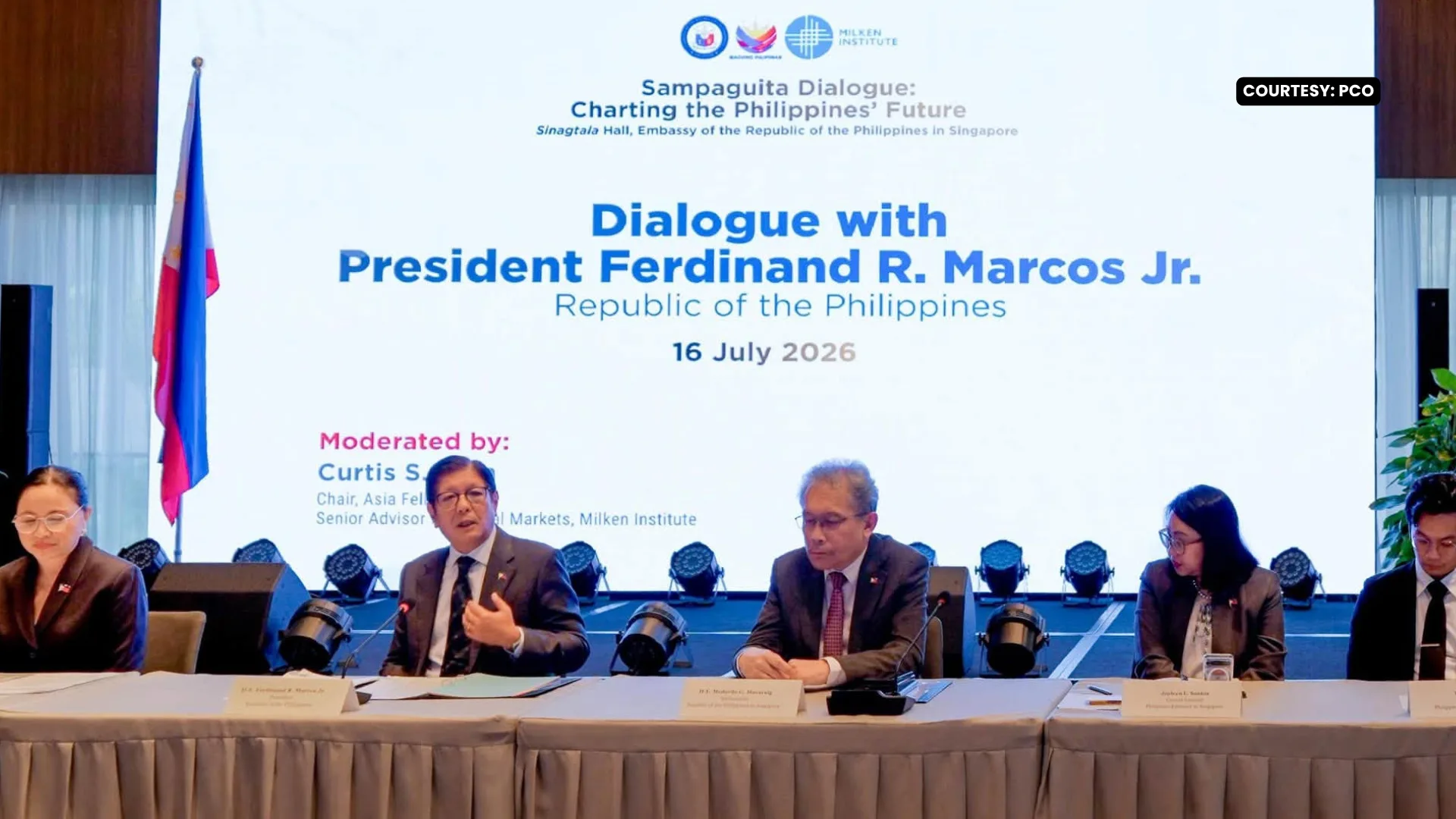
President Ferdinand Marcos Jr. on Thursday assured regional business leaders that the Philippine economy remains resilient and open for investment despite continuing global trade and geopolitical challenges.
Speaking at a business roundtable hosted by the Milken Institute at the Philippine Embassy in Singapore, Marcos said the country continues to record sustained economic growth, supported by a workforce of more than 52 million people and one of the largest consumer markets in Southeast Asia.
The President highlighted the government’s “Build Better More” infrastructure program, valued at more than US$170 billion and covering over 200 projects, including the Luzon Economic Corridor.
He said the infrastructure push would serve as a foundation for expanding advanced manufacturing, electronics production and critical mineral processing in the Philippines.
Marcos also discussed government reforms intended to attract more foreign investment, including the relaxation of ownership restrictions in public services and retail trade and the extension of land lease periods to up to 99 years.
He cited the policy allowing 100 percent foreign ownership in renewable energy projects, which supports the government’s goal of increasing the share of renewable energy in the country’s power mix to 35 percent by 2030 and 50 percent by 2040.
The President said qualified businesses may also receive up to 40 years of tax and non-tax incentives under the government’s investment incentive framework.
Marcos added that the Philippines is finalizing at least five new free trade agreements to broaden trade and investment opportunities, including proposed deals with the European Union and Canada.
These would complement the country’s existing trade agreements, including the Regional Comprehensive Economic Partnership, the Philippines-European Free Trade Association agreement, the Philippines-Japan Economic Partnership Agreement and the Philippines-Korea Free Trade Agreement.
The roundtable was organized by the Department of Foreign Affairs through the Philippine Embassy in Singapore, in partnership with the Department of Trade and Industry and the Milken Institute.
Before the discussion, Marcos met on Wednesday with executives from Temasek Trust, ABC Impact, and the Ayala Group to discuss efforts to expand access to quality healthcare across the Philippines.
He also met with representatives of the Singtel Group and Globe Telecom regarding their continuing investments in telecommunications, digital services and data centers aimed at strengthening the country’s digital economy.
The Ayala Group, backed by Temasek Trust and ABC Impact, reaffirmed its commitment to developing a more integrated healthcare ecosystem to provide Filipinos with high-quality, affordable medical services.
Fresh capital is supporting the expansion of Ayala’s healthcare investments, including plans to build at least 10 hospitals, 300 multispecialty clinics and 1,150 retail pharmacies by 2027 through new developments, hospital bed expansion and strategic acquisitions.
The expansion is expected to generate around 10,000 direct healthcare and retail jobs, depending on the final mix of new facilities and acquisitions.
Singtel, meanwhile, highlighted its continuing investments in telecommunications, digital services and data centers.
A joint venture between Singtel’s technology services arm NCS and Globe’s Yondu is expected to increase its workforce from 150 to 1,200 professionals.
Singtel said its investments reflected Singapore’s sustained confidence in the Philippine economy while supporting digital transformation, high-value employment and long-term technology infrastructure growth.
Marcos was in Singapore for a working visit from July 14 to 16 and was expected to return to Manila on Thursday evening.