
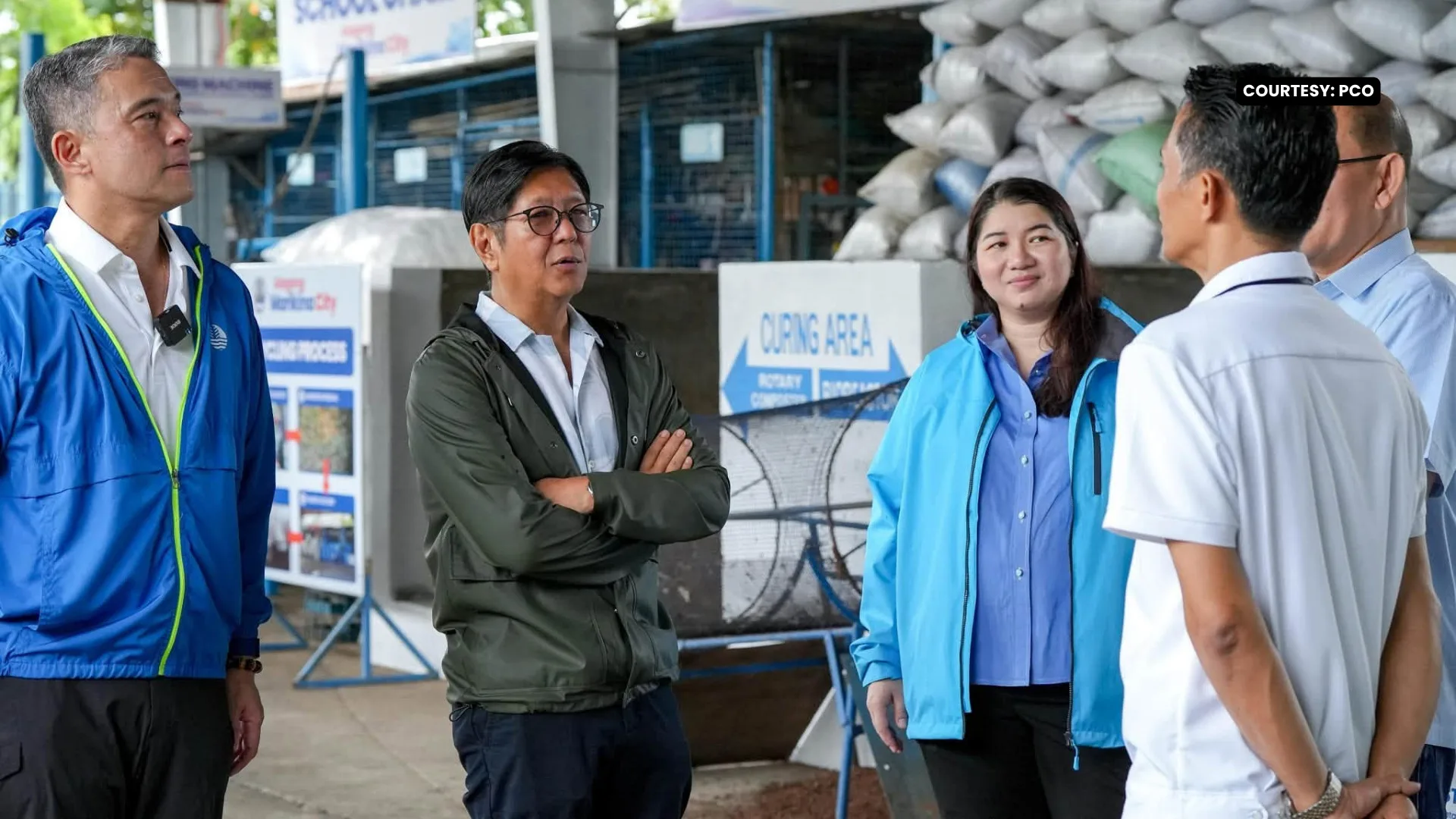
President Ferdinand Marcos Jr. on Monday ordered national government agencies to strictly enforce environmental laws while urging local government units (LGUs) across the country to adopt Marikina City’s successful flood mitigation and solid waste management models.
During an inspection of environmental infrastructure projects in Barangay Sto. Niño, Marikina City, President Marcos directed the Department of Environment and Natural Resources (DENR) to tighten monitoring of local government compliance with ecological regulations, while asking the Department of the Interior and Local Government (DILG) to encourage LGUs to emulate Marikina’s initiatives.
Palace Press Officer Claire Castro relayed the President’s directives following his site visits to the ongoing construction of the 11-kilometer Marikina River Linear Park and the city’s Centralized Materials Recovery Facility (MRF).
“Binigyang-diin din ng Pangulo na mahalagang paigtingin ng DENR, sa pangunguna ni Secretary Juan Miguel Cuna, ang monitoring sa pagsunod ng LGUs sa mga batas tungkol sa solid waste management,” Castro said during a press briefing.
“Ipinag-utos din ng Pangulo sa DILG, sa pangunguna ni Secretary Jonvic Remulla, na hikayatin ang lahat ng LGU na tularan ang mga epektibong patakaran ng Marikina City,” she added.
The 11-kilometer Marikina River Linear Park project integrates flood defense measures into 428.57 hectares of urban green spaces. Designed as a bio-shield, the linear park serves as a natural cooling element, a localized flood buffer, and a physical barrier against illegal dumping along the riverbank.
President Marcos also visited the city’s Centralized MRF, where he was briefed on Marikina’s circular economy framework. The facility converts food waste into compost and turns plastics into reusable goods such as bags, eco-bricks, and plant pots.
Under its Integrated Ecological Solid Waste Management (ESWM) system, Marikina successfully diverts and converts 55 percent or 225.16 tons of its daily 409.38 tons of generated waste into useful materials, reducing daily landfill garbage to 184.22 tons.
“Ito ay dapat ang maging template, at nagiging template na ngayon sa lahat ng iba’t ibang lungsod sa Pilipinas, lalong-lalo na siyempre dito sa NCR,” President Marcos declared, highlighting how Marikina transformed itself from a flood-prone city into an environmental benchmark. He noted that the city cleared no-build zones, relocated at-risk structures and deployed trash catchers to keep waterways clear.
Oliver Villamena, head of the Marikina City Environmental Management Office (CEMO), explained that the city’s success relies on strict local ordinances, including bans on single-use plastics and plastic sando bags, mandatory waste segregation, and strict enforcement. Violators face fines starting at P2,000, mandatory community service, blood donation, or business closure for non-compliant establishments.