
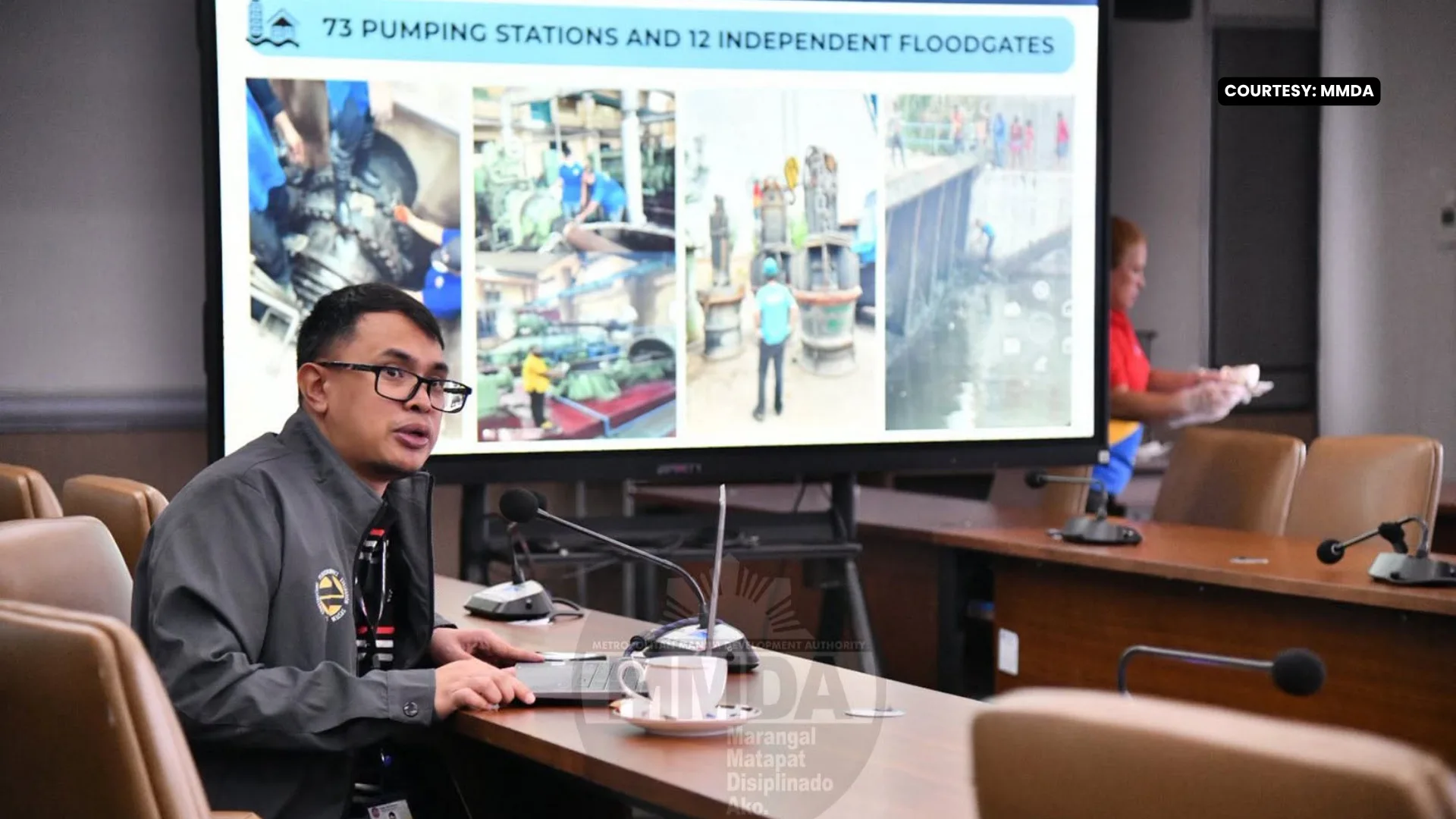
The government is targeting 30 sites across Metro Manila for underground water catchments and nature-based solutions to store floodwater and mitigate chronic flooding, President Ferdinand Marcos Jr. announced Wednesday during a briefing at the Metropolitan Manila Development Authority (MMDA) Command Center in Pasig City.
A Dutch engineering team from the Netherlands is currently conducting a detailed study, with a final report expected within the month.
“‘Pag natapos na ‘yung detailed engineering, titingnan namin, ipa-prioritize na namin, sisimulan na namin ang paghukay,” Marcos said.
“We are already, at present time, conferring and speaking to the areas, kung sinuman ang namamahala doon sa mga area na ‘yun na pumayag sila para hukayin nga ‘yung kanilang lugar,” he added.
Potential locations include Rajah Sulayman, Rizal Memorial, Camp Aguinaldo, and the University of Santo Tomas (UST). MMDA Chairman Don Artes noted that Miriam College has “agreed in principle” to a catchment project, while discussions with UST remain pending. He added that other areas, such as the University of the Philippines Sunken Garden, may utilize deepened surfaces rather than underground catchments.
Beyond flood control, the administration is studying cistern storage to repurpose rainwater for domestic, industrial, and agricultural use.
“Nakakapanghinayang makita natin nakapag-kolekta tayo nang napakarami na tubig na freshwater, eh tatapon lang natin sa dagat, at kailangan na kailangan natin ‘yan,” Marcos said, noting that recent rainfall reached 201.7 millimeters, equivalent to 50,000 Olympic-sized swimming pools.
Construction could run from six months to 1.5 years once finalized, with funding targeted for the 2027 budget alongside co-financing from the Asian Infrastructure Investment Bank.
Addressing recent severe weather, Marcos observed that floodwaters in several areas receded faster compared to past years.
“‘Yan ang ating hinaharap ngayon dahil nga sa climate change,” he said, adding that all 73 regional pumping stations and 11 mobile units were operational.
At least 27 fatalities and 17 injuries were reported due to the southwest monsoon (habagat). Data from the Department of Social Welfare and Development (DSWD) as of August 19 showed 1.73 million families (6.16 million individuals) affected across 4,740 barangays in 10 regions, with 2,003 houses damaged. More than 10,000 families remain in 434 evacuation centers.
Palace Press Officer Claire Castro confirmed over P861 million in relief assistance has been distributed to affected families, alongside P832 million in standby disaster response funds nationwide.
In response, several national agencies have mobilized targeted interventions. The Department of Environment and Natural Resources intensified clearing operations across rivers, esteros and drainage channels. The Department of Public Works and Highways continues inspections of submerged zones for structural interventions, while the Department of the Interior and Local Government directed local governments to maintain tight coordination with disaster management councils.
Additionally, the Department of Health placed Centers for Health Development on Code White Alert to monitor potential leptospirosis spikes, prepositioning 3.1 million doxycycline capsules. Meanwhile, the National Irrigation Administration monitored major reservoirs, confirming Magat Dam (178.27m) and Pantabangan Dam (187.72m) maintained safe levels with no spillway gates opened.