
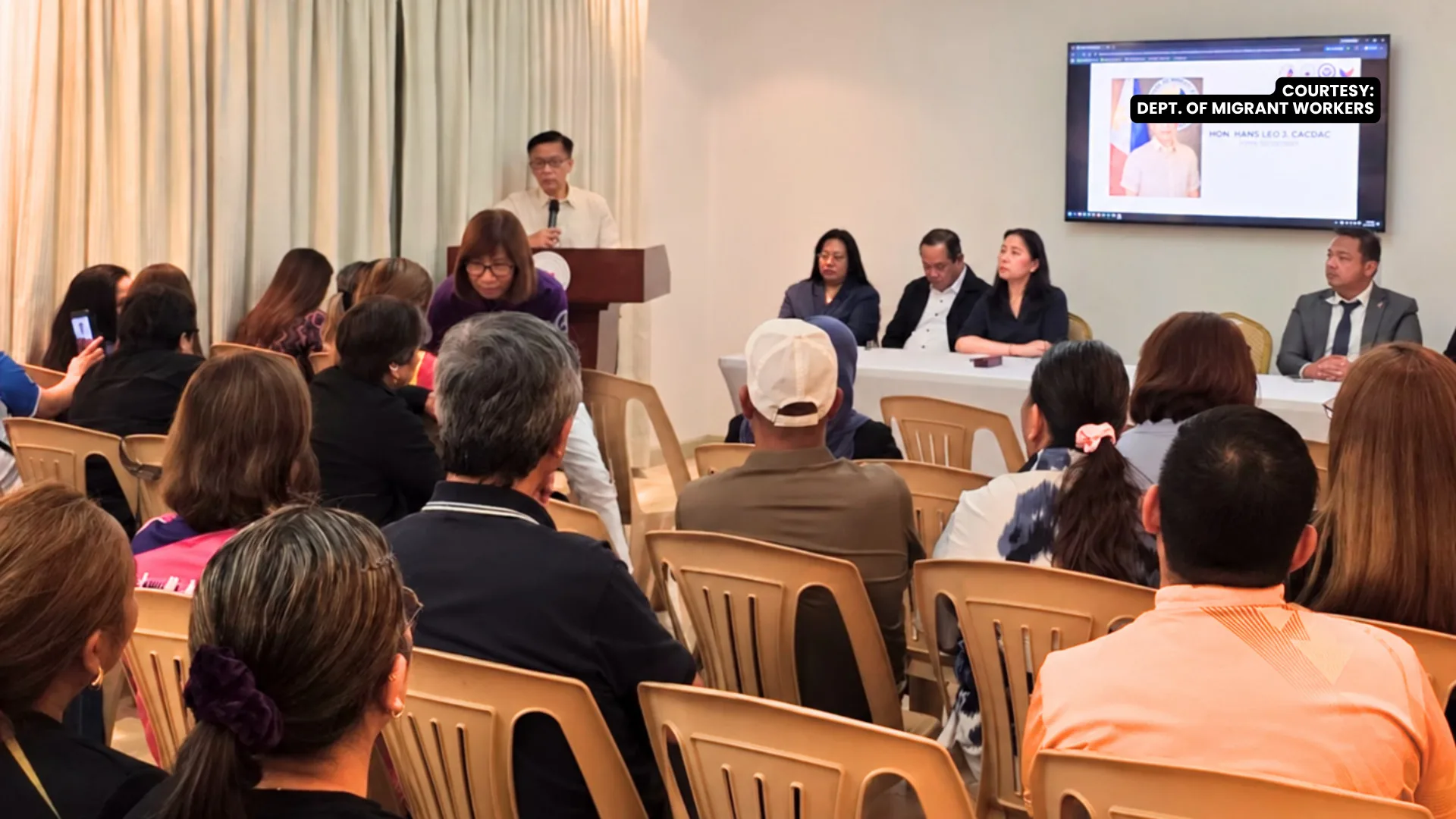
Department of Migrant Workers (DMW) Secretary Hans Leo J. Cacdac met with members of the Filipino community in Bahrain on Sunday, Oct. 25, to discuss their concerns and proposals on employment, pensions, education, healthcare, and livelihood.
The meeting also provided an opportunity to discuss government services and programs available to overseas Filipino workers (OFWs) and their families.
Cacdac reported that the government had provided financial assistance to 4,300 OFWs in Bahrain amid the Middle East crisis, distributed 6,000 food packs, and repatriated 1,000 OFWs. Assistance was also extended to Filipino workers in Saudi Arabia.
For OFWs facing employment disputes or requiring urgent assistance, Cacdac discussed the legal and medical assistance available through the AKSYON Fund and services offered by the OFW Hospital.
The meeting also covered complaints involving domestic workers, efforts against illegal recruitment and human trafficking, and the closure of unregistered and inadequate workers’ accommodations.
Cacdac also presented opportunities for OFWs seeking to complete their college education or establish businesses. These include the Expanded Tertiary Education Equivalency and Accreditation Program (ETEEAP), in coordination with the Commission on Higher Education (CHED) and the Overseas Workers Welfare Administration (OWWA), as well as entrepreneurship training and livelihood capital assistance through partnerships with the Department of Trade and Industry (DTI) and the Department of Agriculture (DA).
“Per instruction of the President, just continue to serve the OFWs,” Cacdac said, emphasizing emergency preparedness, continued engagement with Filipino workers, and coordination with host governments to improve working conditions.
During the open forum, participants proposed including the Professional Regulation Commission (PRC) in future Serbisyo Caravans to assist nurses who had passed their board examinations.
Other proposals included pension programs for OFWs, benefits for former migrant workers running small businesses, amnesty for undocumented Filipinos, scholarships for OFW children, and referral services for children with special needs.
The meeting aimed to bring government services closer to Filipinos overseas and provide a venue for them to raise concerns and recommend measures to improve their welfare and that of their families.