
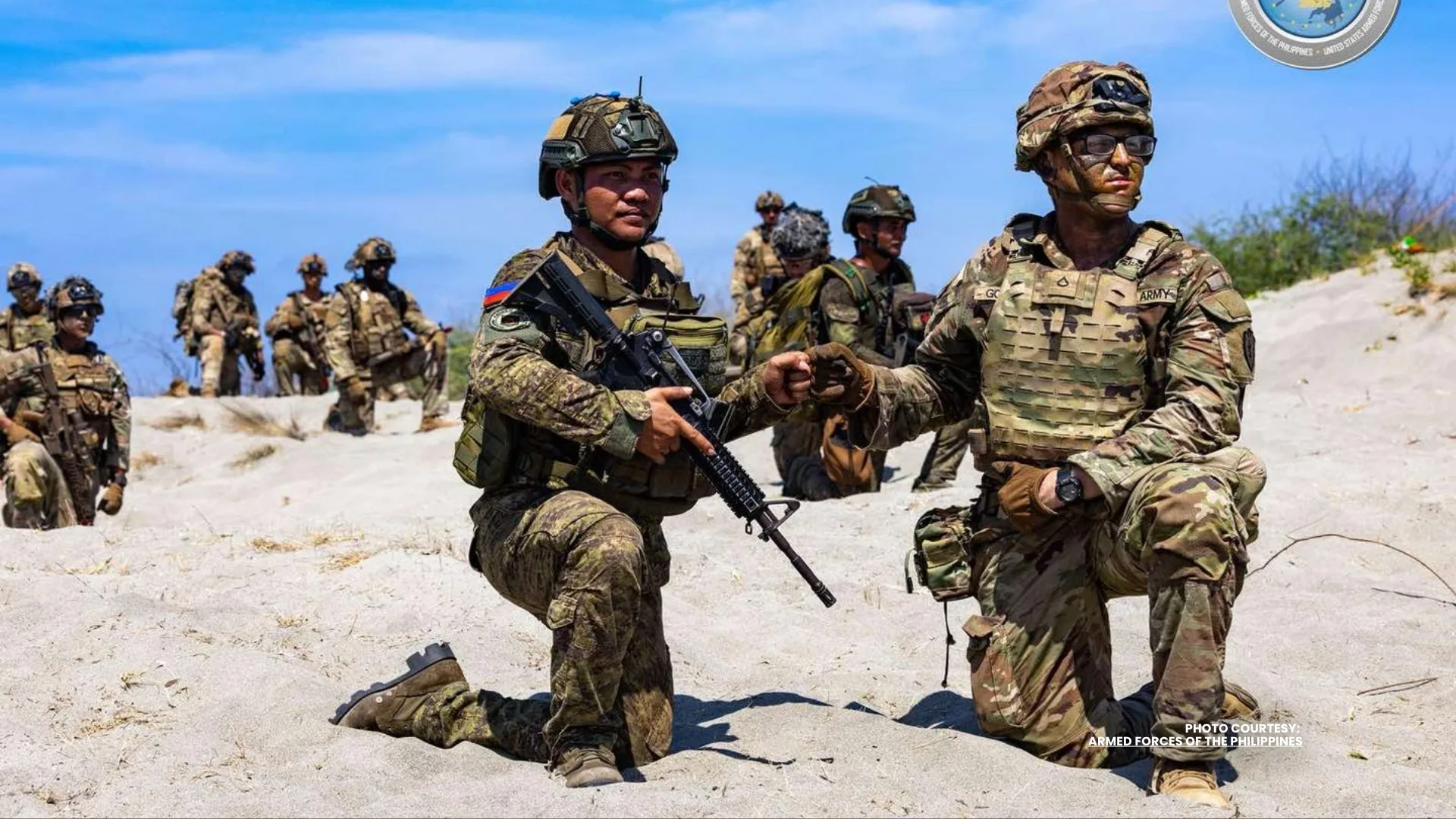
The Armed Forces of the Philippines (AFP), alongside the United States Armed Forces, the Japan Air Self-Defense Force, and the Canadian Armed Forces, conducted a high-intensity Counter-Landing Live Fire Exercise North (CLLFX-North) on May 4 at the La Paz Sand Dunes. The drill formed part of the ongoing Balikatan 41-2026, one of the region’s largest annual defense engagements.
The exercise simulated a hostile amphibious landing on Philippine shores. In response, combined forces from the four countries executed a coordinated defensive operation aimed at neutralizing the threat before it could establish a foothold, reflecting an integrated approach to coastal defense under the Comprehensive Archipelagic Defense Concept.
A range of Philippine military assets was deployed, highlighting ground-to-air coordination in a live-fire environment. These included Sabrah light tanks, ASCOD command post vehicles with 25mm cannons, armored mortar carriers with 120mm systems, and 105mm artillery units. Aerial support came from A-29 Super Tucano aircraft, AW109 helicopters, and Hermes unmanned aerial systems.
The United States contributed additional firepower and surveillance capabilities, including High Mobility Artillery Rocket Systems (HIMARS), AH-64 Apache attack helicopters, F-16 fighter jets, and P-8A Poseidon maritime patrol aircraft, enhancing the multinational force’s situational awareness and strike coordination.
The participation of the Japan Air Self-Defense Force underscored growing defense cooperation among Indo-Pacific partners. Meanwhile, the Canadian Armed Forces supported both combat and humanitarian components, including a mass casualty response drill and the deployment of troops from the 3rd Battalion, Princess Patricia’s Canadian Light Infantry. Canadian forces also conducted defensive operations at Culili Point using small arms, heavy machine guns, and rocket systems.
According to Dennis Hernandez, the exercise demonstrated the growing ability of allied forces to operate as a unified defense network.
He said the drill showed how land, sea, and air capabilities can be integrated to counter maritime threats before they reach Philippine territory. Exercises like Balikatan, he added, reinforce readiness, strengthen interoperability, and support long-term regional stability.
Officials said the exercise also reflects the continued commitment of participating nations to uphold security in the Indo-Pacific through collective defense preparedness and sustained military cooperation.