
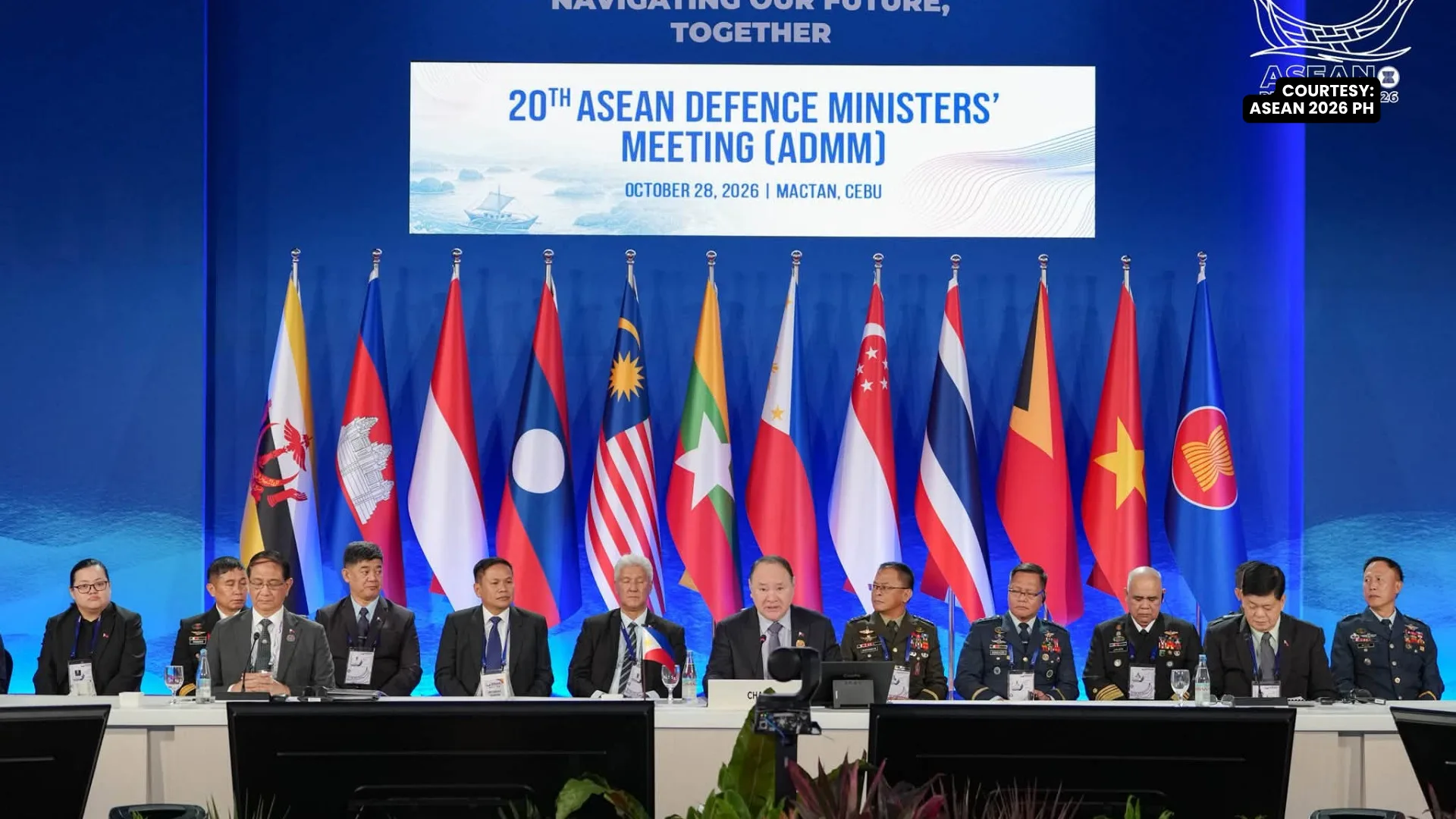
United States Secretary of War Pete Hegseth on Wednesday proposed to his counterparts in the Association of Southeast Asian Nations (ASEAN) the establishment of a defense cooperation framework to ensure peace and stability in Southeast Asia.
During the ASEAN-US Defense Ministers Meeting in Lapu-Lapu City in Cebu, Hegseth reiterated the US commitment to protecting the interest of its allies.
“And as we look to the future in this region, I’d like us to be even more ambitious,” Hegseth said, who noted that next year marks the 50th year of the US-ASEAN dialogue relations which he said is an “important milestone.”
“In recognition of this milestone, we propose that we work together to develop a US-ASEAN framework for defense cooperation, a practical framework that guides our cooperation over the next several years. I will note critically important next several years,” Hegseth also said.
Hegseth said the US is ready to craft the framework with Minister Chan Chun Sing of the Ministry of Defense of Singapore who is due to assume the chairship of the ASEAN Defense Minister Meeting-Plus in 2027.
“The United States is a proud Pacific nation, and alongside our ASEAN partners, we are resolved to deliver peace through strength – peace, prosperity, and sovereignty for all member nations based on mutual respect and strength,” Hegseth said.
Hegseth emphasized the US commitment to protecting the interests of its allies in the region, reiterating the Trump administration’s vision of a “more stable, secure, and prosperous Pacific.”
“It is a vision based on strength, built not on wishful thinking but on the backs of strong, self-reliant nations – nations capable of defending their own sovereignty and contributing to the favorable balance of power that benefits us all,” Hegseth also said.
He said the US approach is strong, quiet, and clear.
“Strong enough to deter coercion and aggression; quiet enough to avoid needless escalation or public theatrics, and to let our actions speak for themselves; but clear enough that our friends, our partners, and potential adversaries understand precisely where the United States stands and that we will defend our interests and the interests of our allies and partners,” Hegseth said.
Hegseth pointed out that these define what the US calls as “peace through strength”, adding that the US is ready to work with ASEAN members ”based on your circumstances and your own priorities and shared interests thereafter.”
Hegseth said the US and ASEAN members may not agree, and need not agree, on every issue.
Nevertheless, he said an “agreement on fundamentals is enough to support practical cooperation where our shared interests are overlapping and are clear”, adding this is what the US Department of War will pursue with its ASEAN partners.
He mentioned the need to strengthen maritime domain awareness, improve interoperability, and advance cooperation among the navies.
“These are not symbolic things. They are concrete demonstrations of what serious partners do. Serious partners train together, learn together, plan together, and build the confidence and competence necessary to prevent conflict,” Hegseth also said.
Defense Secretary Gilberto Teodoro Jr. cited the importance of the US presence in the ASEAN region even as he expressed appreciation to the US’s “steadfast support” to ASEAN centrality and participation in ASEAN-led mechanisms, including the ADMM-Plus framework.
“We value the United States’ sustained engagement with the defense establishments of ASEAN as a robust US presence is necessary for peace and stability in Southeast Asia and in the broader Indo-Pacific region,” Teodoro said.
Teodoro said these ASEAN initiatives strengthened maritime partnerships and enhanced people-to-people relations “in support of peace and stability in Southeast Asia and a free and open Indo-Pacific.”
“For our part, the Philippines hopes to build on these efforts in the years to come because all of us have relied and will continue to rely on freedom of navigation for the security, prosperity, and resilience of our people,” Teodoro also said.
On Tuesday, Teodoro had a bilateral meeting with his Malaysian counterpart, Dato’ Seri Mohamed Khaled.
“Let us be ambitious together,” Teodoro told Khaled during the meeting as he emphasized the need to foster a stronger working relationship between the two countries.
The Philippines and Malaysia are among the several countries claiming features in the West Philippine Sea. The others are China, Brunei, Vietnam, and Taiwan.
Teodoro and Khaled exchanged views on developments in the West Philippine Sea, according to DND spokesman Arsenio Andolong in a statement.
Teodoro mentioned that the nine-dash claim of China in the West Philippine Sea lacks legal basis.
“Secretary Teodoro emphasized that the 2016 Arbitral Award is not solely a Philippine matter, noting that its fundamental principles form part of international law and are grounded in the United Nations Convention on the Law of the Sea (UNCLOS),” Andolong said.
The award invalidated China’s excessive claim in the South China Sea, including the West Philippine Sea. The award also upheld the rights of the Philippines to its 200-nautical-mile exclusive economic zone and continental shelf.
“Secretary Teodoro stressed that the Award established that the so-called nine-dash line has no basis in international law and that China’s historic claims over contested maritime features are without legal basis,” Andolong also said.
He said Khaled acknowledged the challenges regarding the issue.
Nevertheless, Andolong said Khaled “emphasized the importance of adhering to UNCLOS.”
“Both officials agreed on the value of ensuring that ASEAN voices remain resonant and united on fundamental principles,” Andolong added.