
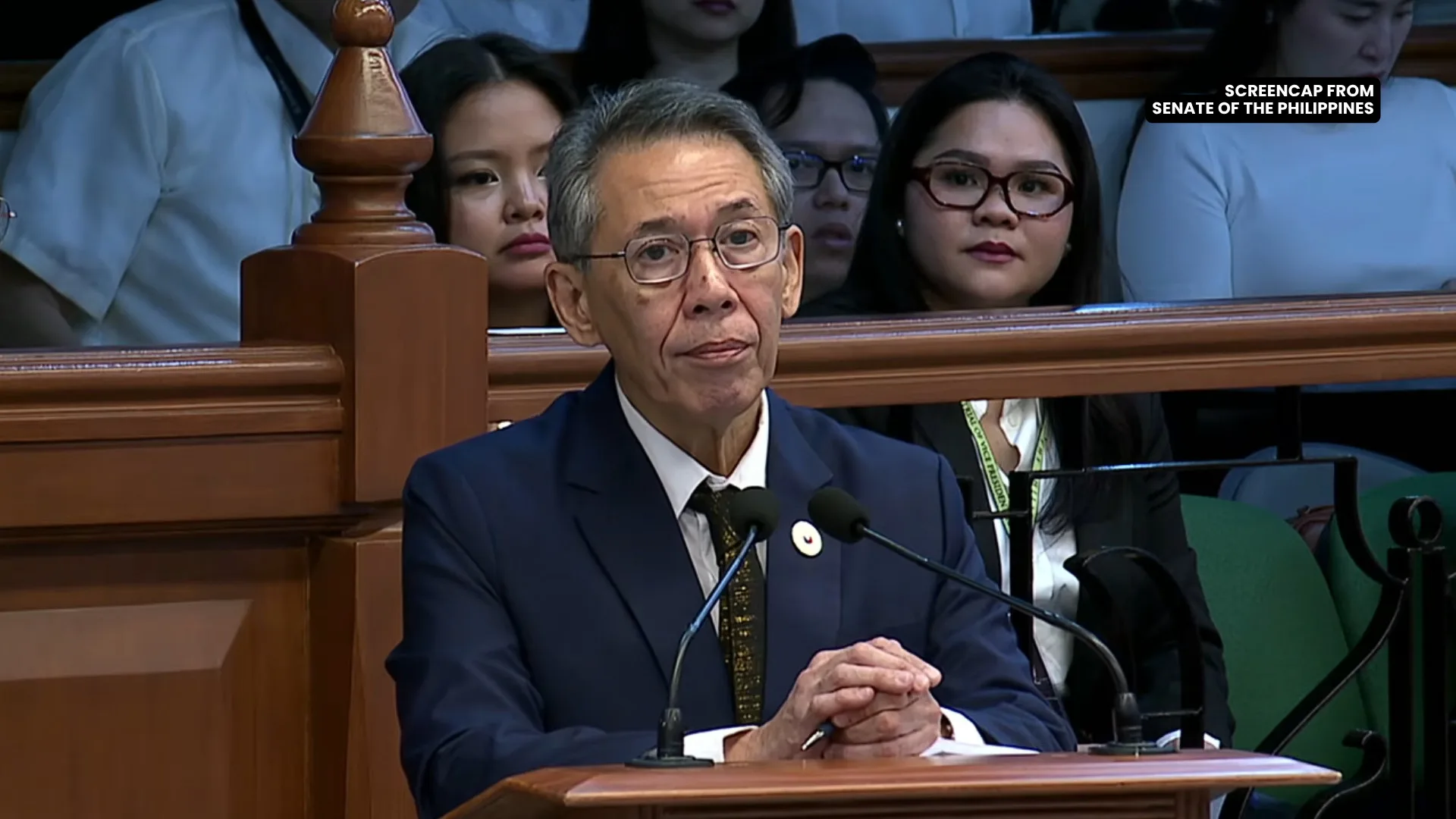
House prosecutor Representative Chel Diokno asserted on Wednesday that the two-thirds threshold required to convict Vice President Sara Duterte must be based on the number of senators legally qualified and available to sit as impeachment judges.
During oral arguments before the Senate Impeachment Court, Diokno contended that non-participating lawmakers, unsworn senators, or those legally barred from examining evidence should not automatically skew the final outcome merely by being factored into the overall denominator.
Diokno challenged the logic of counting senators who fail to attend hearings or take the mandatory oath, questioning how an absent official could properly carry out judicial responsibilities.
“Paano ito gagawin ng senador na hindi naging hukom? Dahil hindi naman nakapag-oath, paano rin ito gagawin ng hukom na wala naman sa mga pagdinig para masuri ang mga testigo at dokumento?” Diokno asked.
He further questioned the accountability of an impeached official if those tasked with judging the trial do not participate in the proceedings.
“Kanino haharap at mananagot ang impeached official kung absent o hindi available ang [judge]? Sa bakanteng upuan at mesang malamig?”
Addressing the central dispute over the voting baseline, Diokno argued that automatically fixing the baseline at 24 members produces an illogical scenario where absent or incapacitated senators effectively vote against conviction simply by remaining in the total count.
“If the denominator is fixed at 24, conviction would always require 16 votes. Absurd po ito,” he said.
While acknowledging that the Constitution purposely creates a steep hurdle for conviction, Diokno distinguished between a deliberately high standard and an outcome dictated by non-participants.
“Making [conviction] harder is not the same as making it depend on senators who are not judges or who are incapable of acting as judges,” Diokno said.
“That would be tantamount to an acquittal by default, a failure to arrive at the threshold number, caused not by the judgment of the incapacitated senators, but by their mere inclusion in the denominator.”
The House prosecutor insisted that the issue is not about lowering the bar to achieve a specific result, but about determining the proper legal composition of the court.
“What this court must determine is the constitutionally applicable membership given the Senate’s actual legal capacity to perform its impeachment function, mindful of the circumstances before the court. Ang pinagpapasyahan po ay kung sino constitutionally ang dapat isama sa bilang,” Diokno said.
“The more accurate question is ilan ang constitutionally dapat bilangin?” Diokno said. “Once that denominator is constitutionally determined, the fraction operates upon it. Two-thirds remains two-thirds.”
Impact on Arithmetic and Prosecution Strategy
Diokno dismissed assertions that adjusting the denominator serves as an automatic advantage for the prosecution. He demonstrated that recalibrating the court’s total membership shifts the mathematical requirement for both sides proportionally.
“A change in the denominator should not be described as simply lowering the votes needed to convict,” he said. “Why? Because the arithmetic moves in both directions.”
Under a fixed 24-senator baseline, 16 votes are required for conviction and nine votes suffice to block it. Conversely, if the active voting base is set at 20, the threshold for conviction falls to 14, while seven votes become enough to prevent a guilty verdict.
“So a different denominator does not guarantee conviction,” he said. “It changes the arithmetic on both sides. Parehong panig ang naapektuhan ng bilang.”
Reiterating that lawmakers in an impeachment setting act as judges rather than legislators, Diokno affirmed that the prosecution will present its full evidence regardless of the final figure adopted by the court.
“Kayo po, you hear, you examine, you deliberate, and ultimately, you judge,” he told the impeachment court.
“If the court determines 16, we present our evidence. If the court determines another number, we present the same evidence,” he said. “Because the evidence does not become stronger or weaker depending upon the denominator”.
“Ultimately, two-thirds remains two-thirds,” he said. “Ayan po ang aming pananagutan. Ayan din ang inaasahan ng taong bayan.”