
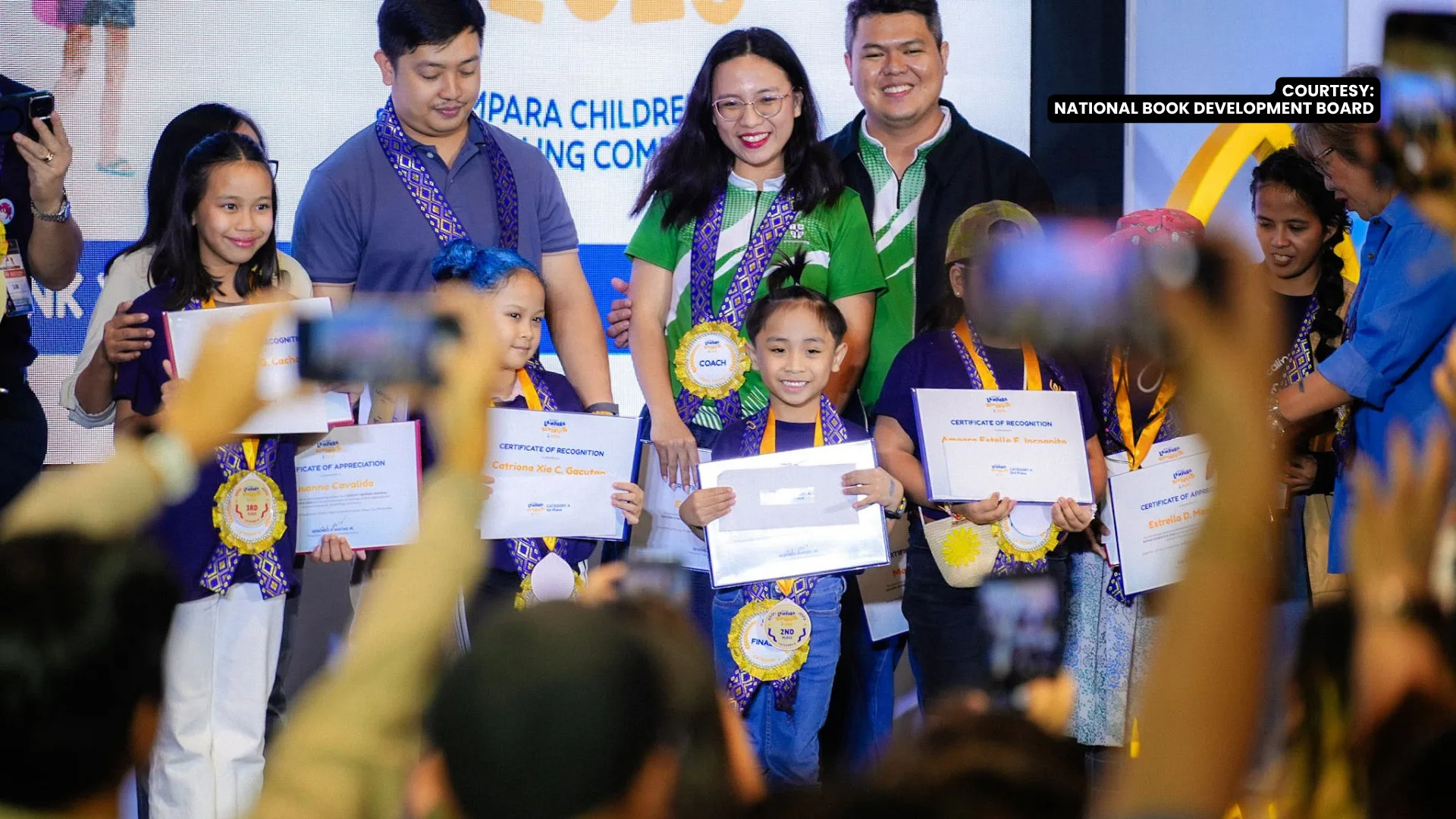
From 416 participants across 139 schools, six grade school pupils emerged as the top storytellers in Batang Lampara Batang Kuwentista 2026
A story can begin on a page, but in the hands of a child, it can become a voice, a character and a performance. That was the idea at the heart of the grand finals of Batang Lampara, Batang Kuwentista 2026, held on September 12 at the SMX Convention Center Manila in Pasay City.
The nationwide storytelling competition drew 416 participants from 139 schools. From that field, the top three finalists in two grade-level categories competed for first place, bringing their own interpretations and creative energy to the stories they performed.

Nearly half of the participants came from outside Metro Manila. According to the organizers, 45 percent represented cities and provinces beyond the National Capital Region. Online submissions made it possible for children from both metropolitan areas and far-flung communities to join without having to travel to the capital during the early stages of the competition.
Six children take the top honors
The winners were announced during a key segment of the 2026 Manila International Book Fair.
For Grades 1 to 3, Catriona Xia C. Gacutan won first place, followed by Zander Skye H. Saplagio in second place and Ameera Estelle E. Incognito in third.
For Grades 4 to 6, Czarina Sophia L. Hinanay placed first, Ma. Daniela C. Mejos finished second and Alamela G. Cacho took third place.
The finalists were evaluated by a panel whose work spans literature, education, theater, puppetry, multidisciplinary art and children’s rights. The judges were Pepot Atienza, Melanie Ramirez, Eugene Evasco, Portia Padilla and Csairus John Habla.

Creativity beyond memorization
For Segundo Matias Jr., co-founder and president of Lampara Publishing House, the children’s performances stood out because they did not feel like rigid, heavily rehearsed recitations. The young storytellers approached the material with spontaneity and gave their performances a character of their own.
“Hindi maikakailang malikhain ang mga bata,” Matias said, describing the performances as natural and highly creative.
That freedom to interpret a story is part of what makes storytelling useful in developing a child’s relationship with reading. A book is no longer something to finish for an assignment. It becomes material a child can understand, imagine and share with other people.
Keeping children connected to reading
Batang Lampara, Batang Kuwentista forms part of Lampara Books’ wider literacy efforts. The initiative complements the reading priorities identified by the Department of Education’s Academic Recovery and Accessible Learning Program, or ARAL Program, which provides structured intervention for learners who need additional support in academic competencies, particularly reading.
The publishing house also runs Magbasa Tayo, which uses the Marungko Approach, and Let’s Read, which uses systematic phonics. The programs seek to help children strengthen their reading skills while developing an appreciation for books and literature.
Matias said the need to make reading meaningful and enjoyable has become more urgent as children increasingly rely on technologies such as artificial intelligence. He said the answer is not to resist technological change, but to ensure that it does not weaken children’s connection to reading.
“Ang Batang Lampara, Batang Kuwentista ay isang inisyatibo para lalo pang matutong magbasa ang mga bata. Hindi tayo dapat magpabaya. Gusto ihatid ng Lampara Books na mas masaya ang pagbabasa, kaya ginawa itong pagtatanghal para lalo pang mapalaganap ang pagbabasa,” Matias said.
For the six winners and the hundreds of children who joined, the competition offered more than a place to perform. It gave them a reason to open a book, make sense of a story and discover how their own voice could bring it to life.
