
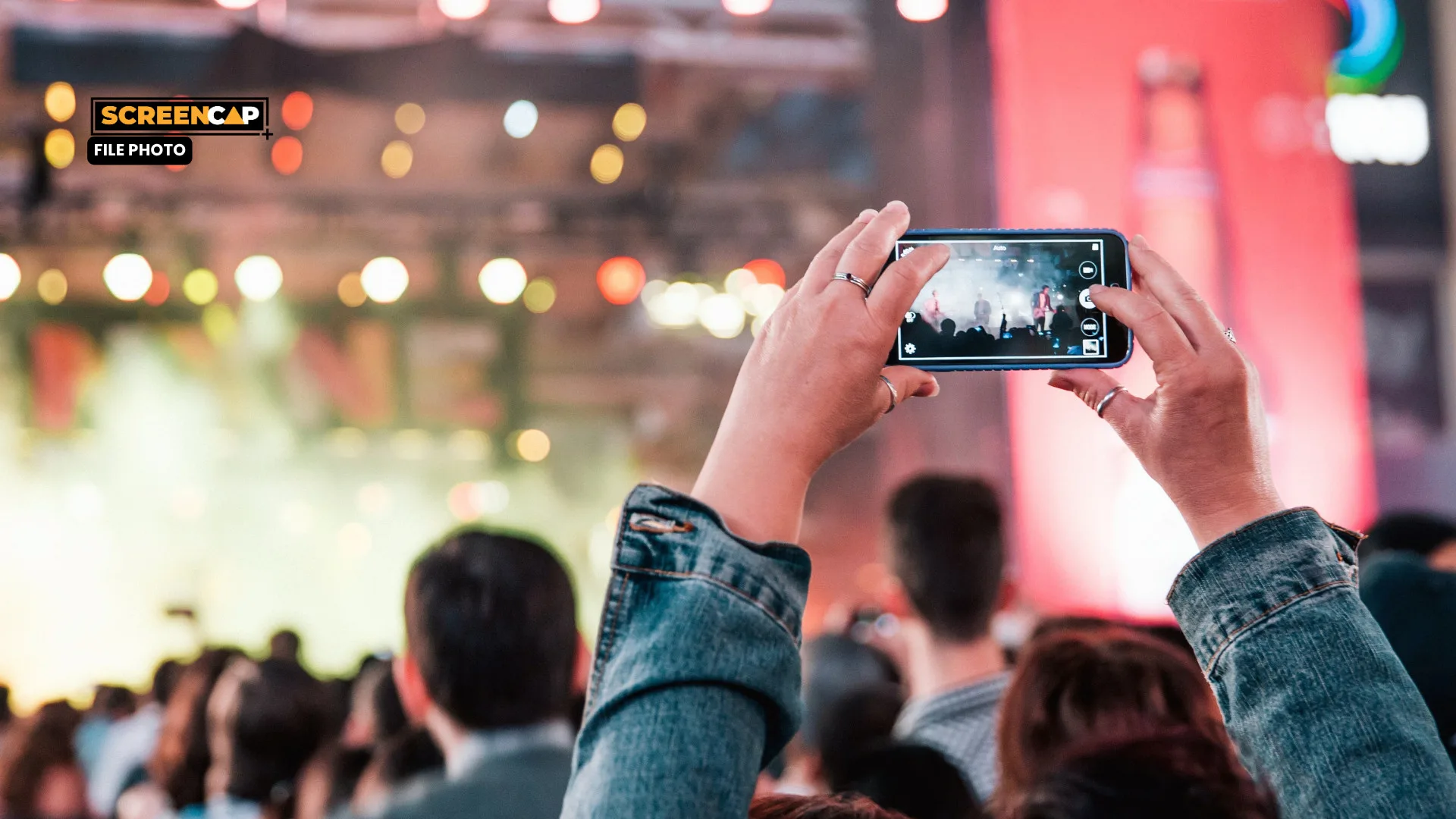
The lights go down. The opening notes hit. Thousands of phones immediately go up.
For many concertgoers, recording the moment has become almost as routine as buying the ticket itself. A favorite chorus goes on Instagram Stories. A surprise duet lands on TikTok. A shaky video becomes a personal souvenir of a night that may have cost thousands of pesos to attend.
But what happens when a 30-second memory becomes a complete song? Or when several songs become an entire concert uploaded for anyone to watch for free?
A recent dispute involving Filipino performers has pushed that question beyond concert etiquette and into something more complicated: When you pay for a concert ticket, what exactly have you bought?
The short answer is not the performance itself.
The Sessionistas controversy
The issue erupted after Sessionistas: The Playlist, featuring Ice Seguerra, Sitti Navarro, Nyoy Volante, Kean Cipriano, Princess Velasco and Juris Fernandez, was staged at The Theatre at Solaire on August 22.
Videos of the concert subsequently appeared online, including lengthy recordings of performances.
Seguerra objected publicly.
“When you buy a concert ticket, you’re buying the experience of watching the show,” Seguerra wrote in an August 24 Facebook post, as reported by GMA Entertainment.
The singer made a distinction between the fan who captures a favorite moment and someone who republishes a substantial amount of the production.
Seguerra encouraged audiences to share photographs, reactions and short clips, but asked people who had uploaded full performances to remove them.
The issue was also taken up by Liza Diño-Seguerra, CEO of Fire and Ice Entertainment, the company behind the production.
Her argument was similarly direct: admission to a show does not amount to acquiring the right to redistribute it.
The dispute soon became bigger than one concert.
Days later, the Intellectual Property Office of the Philippines stepped into the conversation.
A ticket buys admission. It doesn’t transfer ownership of the show.
On August 31, IPOPHL reminded Filipino concertgoers that unauthorized recording and distribution of live performances may infringe rights protected by Philippine law.
The distinction is important.
When someone buys a concert ticket, the transaction gives that person admission to an event subject to the conditions imposed by the organizer, performer and venue.
It does not, merely by virtue of purchasing admission, transfer the intellectual-property rights associated with what happens onstage.
And a modern concert contains plenty of protected creative work.
There are songs and compositions. There are performances by singers and musicians. There may be original arrangements, audiovisual elements and other protected material. Different rights can belong to different people or entities.
This is why the question is more complicated than: “I paid for it, so why can’t I record it?”
Paying to experience something and buying the rights to reproduce it are two different transactions.
A movie ticket does not give the viewer ownership of the movie. Buying a book does not transfer its copyright to the reader.
A concert ticket operates on a similar basic distinction: you have paid to attend the performance, not automatically acquired the rights embodied in everything performed before you.
Philippine law gives performers rights too
The controversy is not governed by etiquette alone.
Republic Act No. 8293, or the Intellectual Property Code of the Philippines, recognizes specific rights belonging to performers.
The law defines performers broadly to include actors, singers, musicians, dancers and others who perform literary and artistic works.
Under Section 203 of the IP Code, performers have exclusive rights concerning, among other things, the authorization of certain broadcasts, communications and fixation of their unfixed performances.
“Fixation” is a legal term that essentially concerns capturing a performance in a form from which it can subsequently be perceived, reproduced or communicated.
That matters in an era when nearly every audience member carries a high-definition recording device in a pocket.
IPOPHL summarized the principle in its August 31 advisory: performers have rights over whether performances are recorded and over how authorized recordings are subsequently reproduced, distributed or made available to the public, subject to limitations under the law.
The agency therefore urged concertgoers to observe the recording policies established by performers, organizers and venues.
But what about the 20-second video on your Instagram Story?
This is where the issue becomes less black-and-white.
IPOPHL did not announce that every photograph or brief concert clip posted online automatically constitutes infringement.
In fact, the agency acknowledged that taking photos and short videos has become a normal part of attending concerts.
Its warning focused on unauthorized recording or sharing of an entire performance or substantial portions of one.
That distinction resembles what the artists themselves have been saying.
Seguerra expressly encouraged people to post their favorite moments, photos and short clips.
Nina, Top Suzara and Thor Dulay subsequently joined the discussion, with all three drawing their own distinctions between brief fan content and uploading lengthy performances.
Nina said snippets could even promote a show, but considered uploading the whole performance a different matter.
Top similarly said artists can appreciate snippets from audiences while questioning why someone would record and republish an entire show.
Thor pointed to the work that goes into mounting a concert — including conceptualization and musical arrangements — while saying he had no problem with snippets.
There is therefore considerable common ground beneath the controversy.
The artists speaking publicly are not demanding a concert hall in which nobody ever takes out a phone.
Their objection is primarily about the point at which documenting an experience becomes republishing the entertainment itself.
“But I’m not making money from it” isn’t an automatic exemption
Another common assumption deserves scrutiny: what if the person uploading the concert isn’t earning anything?
According to IPOPHL, non-commercial intent alone does not automatically make a use “fair.”
Fair use exists under Philippine copyright law, but whether a particular use qualifies requires consideration of multiple factors.
Among them are the purpose and character of the use, the nature of the copyrighted work, how much of the work was used, and the effect of that use on the potential market or value of the work.
That means there is no reliable formula in which “I didn’t monetize it” automatically settles the issue.
Nor is there a magic number of seconds that automatically makes every concert upload lawful.
Context matters.
A brief excerpt included in criticism or reporting raises different questions from a nearly complete concert placed online as a substitute for watching the production.
That is precisely why sweeping claims about every concert video being either completely legal or completely illegal oversimplify the law.
There is another owner in the room: the songwriter
The singer standing onstage isn’t necessarily the only rights holder involved.
Consider a performer singing a composition written by somebody else.
The performance and the underlying musical composition involve different rights.
Songwriters, composers, music publishers, performers, producers and other parties may have interests in material incorporated into a concert.
This helps explain why uploading a concert is not simply a private matter between the person holding the phone and the celebrity being filmed.
Top Suzara raised this point while discussing the controversy, noting that songs can have different publishers and that uploads may encounter copyright claims.
The person visible in the video may therefore represent only one part of a much larger rights ecosystem.
What if the artist actually wants you to film?
Then the situation can be different.
Some performers actively encourage audiences to record particular songs, turn on their flashlights, participate in a TikTok moment or post footage using an official hashtag.
Other productions impose strict no-recording rules.
That is why IPOPHL’s advice to follow the policies of the performer, organizer and venue matters.
There is no contradiction between an artist welcoming fan-shot clips at one concert and another production restricting recording.
The permission being given — or withheld — is part of the equation.
The phone also changes the person sitting behind you
Copyright is only one side of the debate.
There is also the increasingly familiar sight of a concert audience watching a stage through hundreds or thousands of glowing screens.
A phone held at chest level for a short recording is one thing. A device raised above someone’s head for an entire song — or an entire show — can affect the view of people sitting behind it.
That is an etiquette question rather than necessarily an intellectual-property one, but the two debates have become intertwined.
For performers, there is another question: is the audience still participating in a live experience, or producing content from it?
Top put essentially that question to fans when discussing people who record whole shows: are they enjoying the concert, or are they there for the content?
There may not be one answer.
People record because memories fade. Fans want proof that they heard that song live. Parents record their children’s reactions. A favorite artist may never perform in the Philippines again.
And social media has become part of the machinery of concert promotion itself. A spectacular fan-shot chorus circulating on TikTok can make thousands of other people wish they had been in the room.
Nina acknowledged that reality when she said snippets can help promote performers and their shows.
The same device can therefore function as both a promotional tool and, when pushed much further, a mechanism for redistributing the production.
The dispute is over where one becomes the other.
So what did your ₱3,000, ₱5,000 or ₱10,000 actually buy?
It bought you something valuable.
A place in the room.
The opportunity to hear the music as it was performed that night. To watch the artist rather than a screen recording. To experience the lighting, musicians, crowd, mistakes, improvisations and moments that exist because a live performance is happening in real time.
Depending on the event, you may also be allowed to take photographs and record portions of that experience.
What the ticket does not automatically give you is ownership of the creative work unfolding onstage or an unrestricted license to reproduce and distribute it.
That distinction is now at the center of the Sessionistas controversy.
And perhaps the smartphone has simply made an old principle much easier to forget.
Twenty years ago, most people attending a concert did not have the technical ability to record a show in high definition and make it available worldwide before leaving the venue.
Today, almost everyone does.
The technology changed.
The fact that the performance belongs to more people than the person holding the phone did not.
The line isn’t “phone or no phone”
Perhaps the most useful conclusion from the current debate is also the least dramatic.
This does not have to be a war between artists who supposedly hate phones and fans who supposedly feel entitled to record everything.
The statements coming from Seguerra, Nina, Top and Thor contain a more nuanced dividing line: capture the memory without attempting to become the distributor of the show.
IPOPHL’s guidance similarly avoids declaring every fan video unlawful. Instead, it warns about unauthorized recordings and distribution, particularly entire performances and substantial portions, while recognizing that fair-use questions depend on the circumstances.
So take the photo.
Record the chorus if the show’s rules permit it. Post the moment that made the ticket worth buying. Put the phone down sometimes and watch the person you paid to see.
Because perhaps the most important thing a concert ticket buys is precisely the one thing a full upload can never reproduce:
You were there.