
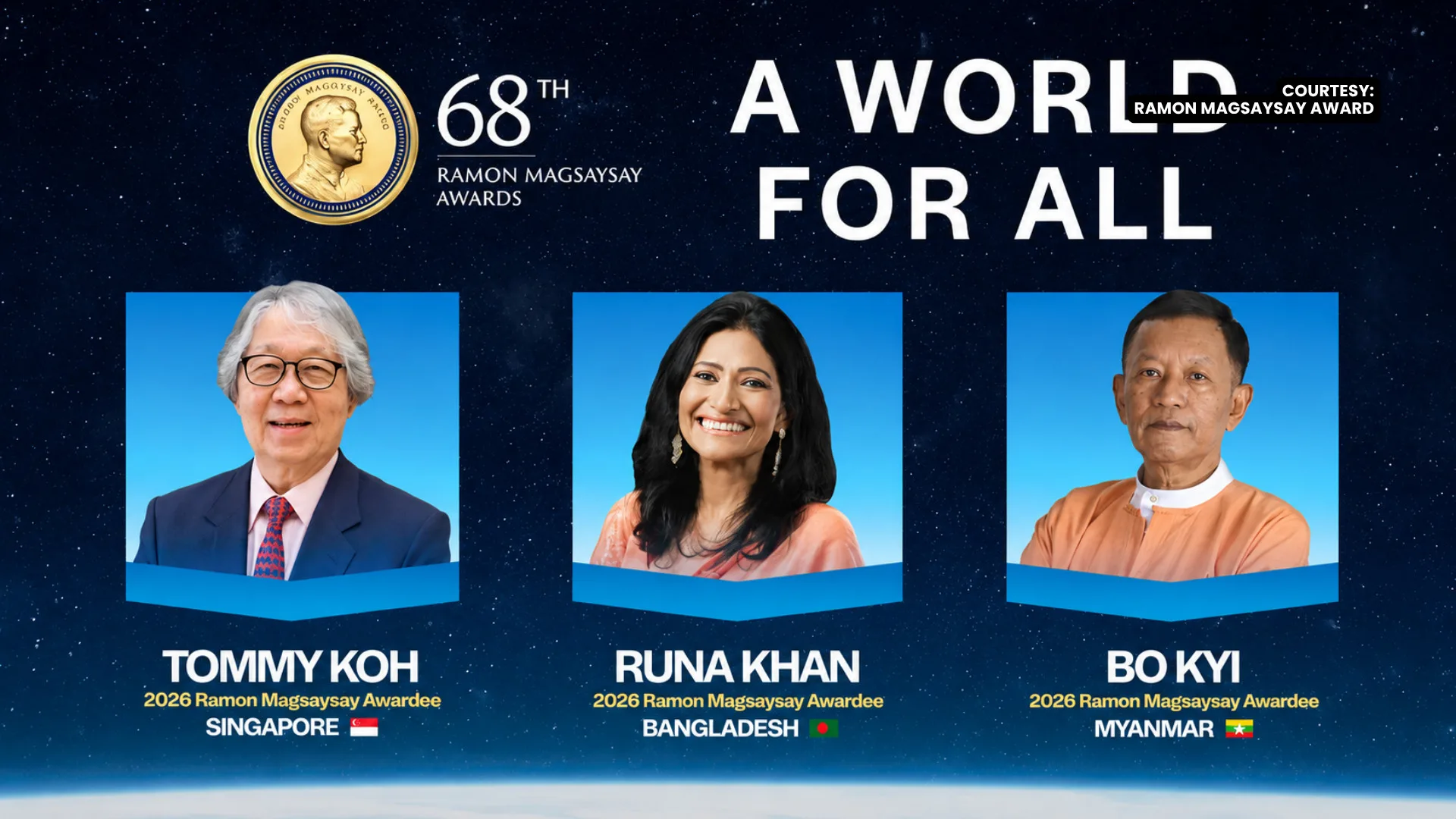
From negotiating the rules of the world’s oceans to bringing healthcare to remote river communities and documenting the stories of political prisoners, this year’s Ramon Magsaysay Awardees show how service can take radically different forms.
There is no single blueprint for changing people’s lives.
For Tommy Koh, it meant sitting across negotiating tables where countries disagreed over territory, resources and power. For Runa Khan, it began with a visit to communities living on Bangladesh’s shifting river islands. For Bo Kyi, it grew out of an experience far more personal: seven years spent as a political prisoner.
The three come from different countries and generations, but their paths converge this year as recipients of the 2026 Ramon Magsaysay Award.
The Ramon Magsaysay Award Foundation announced Koh of Singapore, Khan of Bangladesh and Bo Kyi of Myanmar as its three awardees on August 31, marking the start of the 68th Ramon Magsaysay Awards Festival Season.
Their stories also give this year’s theme, “A World for All,” a practical meaning. The Foundation describes the theme as a call for a future where progress is inclusive, dignity is protected and communities are able to participate and thrive.
Tommy Koh: Making Room for Smaller Voices
Tommy Koh’s work has unfolded on some of diplomacy’s biggest stages.
Born in 1937 and trained as a lawyer and legal scholar, the Singaporean entered his country’s foreign service in 1968 as its youngest ambassador to the United Nations. He later played a central role in negotiations that produced the United Nations Convention on the Law of the Sea, or UNCLOS.
As president of the Third United Nations Conference on the Law of the Sea, Koh helped steer negotiations involving more than 150 countries toward the convention’s adoption in 1982. He also chaired the 1992 Earth Summit and was appointed a UN special envoy in 1993.
But his career was not confined to international diplomacy. Koh also worked in education, public policy, arts and heritage, mentoring generations of Singaporean leaders, scholars and public servants.
His story offers one version of public service: influence exercised through institutions, negotiation and the belief that smaller countries should have a meaningful voice even when dealing with much larger powers.
Taking services where the land moves
Runa Khan’s story begins in a place where even the ground beneath people’s homes can disappear.
Bangladesh’s chars are temporary islands and sandbars formed by river sediment. Communities living there face isolation, flooding and limited access to basic services. Khan first visited a char along the Brahmaputra River in 1997. Five years later, she established Friendship and opened a hospital ship serving these communities.
What began with healthcare expanded into education, climate adaptation, livelihoods and disaster preparedness.
Friendship now employs more than 7,500 people, operates seven hospital ships, two land-based hospitals and 550 mobile clinics, and works with hundreds of trained community medical aides. Its programs also include movable schools designed to be dismantled and rebuilt when river erosion threatens communities.
There is something particularly contemporary about Khan’s work. Climate change is often discussed through projections, temperatures and sea levels. Her work deals with what happens afterward: How does a child continue going to school when the landscape itself changes? How does healthcare reach a community separated by water? How do people build livelihoods in places vulnerable to erosion and displacement?
Her answer has been to make services adapt to people’s circumstances rather than expect vulnerable communities to adapt to systems that cannot reach them.
Keeping a record when people disappear behind bars
For Bo Kyi, advocacy began with imprisonment.
As a university student in Myanmar, he became involved in the pro-democracy movement surrounding the 1988 demonstrations. He was arrested twice and spent a total of seven years in prison.
Denied books while incarcerated, Bo Kyi secretly learned English by writing sentences on the concrete floor with a piece of brick, learning from a professor detained in a neighboring cell and hiding his studies from prison guards.
After his second release, he fled to Mae Sot, Thailand. There, in 2000, he and other former political prisoners founded the Assistance Association for Political Prisoners.
The organization documents political imprisonment and supports detainees and their families. Its work has continued following Myanmar’s February 2021 military coup, recording arrests, imprisonment and violence while advocating for those affected.
Bo Kyi’s work underscores another dimension of service: preserving names, experiences and evidence when repression can make people disappear from public view.
Different paths, shared purpose
Koh works through diplomacy and institutions. Khan built systems around communities that conventional services struggled to reach. Bo Kyi turned his experience of imprisonment into decades of documentation and advocacy.
Their methods could hardly be more different.
What connects them is the idea that dignity is not abstract. It appears in whether a small country gets heard at a negotiating table, whether a family on a remote river island can reach a doctor, or whether the story of someone behind bars is documented rather than forgotten.
That common thread is particularly fitting for an award established in 1957 in memory of Philippine President Ramon Magsaysay and first presented in 1958. Since then, the Ramon Magsaysay Award has been conferred on 331 individuals and 28 organizations from 24 countries and territories in Asia.
Koh, Khan and Bo Kyi will formally receive their awards at the Metropolitan Theater in Manila on November 15.
Three lives, three very different kinds of work — and three reminders that changing the world does not always begin on the same stage.