
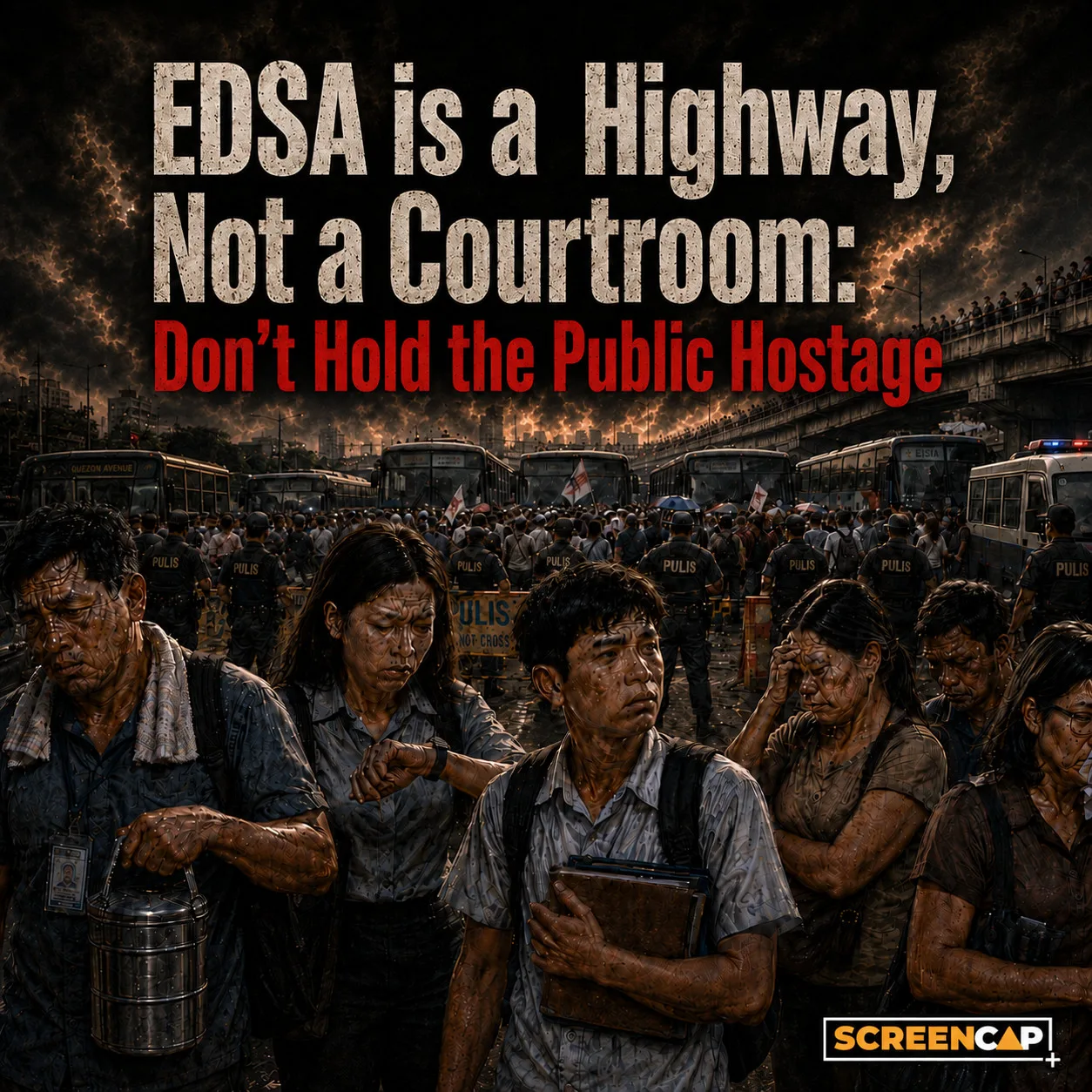
Metro Manila’s busiest highway is once again being held hostage.
For millions of Filipinos, EDSA is not a political stage. It is the road that takes them to work, to school, to hospitals, to businesses, and ultimately, to the lives they are trying to build.
Yet instead of serving the public, it has once again become the venue for a massive political demonstration.
Just a day after another large gathering near the EDSA People Power Monument caused heavy traffic, commuters woke up Tuesday to yet another disruption. Members of the Iglesia ni Cristo reportedly occupied portions of EDSA and White Plains Avenue, with buses and a stage contributing to the obstruction of traffic as they protested the legal troubles involving Senator Rodante Marcoleta.
The faces may change. The slogans may change. But the victims remain the same: ordinary Filipinos.
Let us be clear. The Constitution protects the right to peaceful assembly. That right deserves respect. But no constitutional right is absolute. Freedom of assembly does not include the freedom to illegally obstruct major highways, cripple public transportation, or deprive millions of innocent commuters of their own rights.
The right to protest should never come at the expense of everyone else’s right to earn a living.
Even more troubling is the purpose behind the demonstration.
If a public official or any private citizen is facing allegations backed by evidence and is being subjected to the country’s legal processes, why should the public be inconvenienced to pressure the system? Why should millions of commuters pay the price for someone else’s legal battle?
The proper venue for determining innocence or liability is the courtroom—not EDSA.
If there is evidence, let it be presented. If there are defenses, let them be heard. If there are legal remedies, let them be pursued.
That is how the rule of law works.
Attempting to generate public pressure through mass disruptions to shield anyone from accountability sends a dangerous message: that influence and numbers matter more than due process.
No one—regardless of political affiliation, religious organization, or social standing—should be insulated from legal scrutiny through intimidation, public pressure, or manufactured disruption.
The law must apply equally to everyone.
The greatest injustice, however, is suffered not by politicians but by ordinary Filipinos.
Every hour of gridlock means students missing classes and examinations, employees arriving late and facing salary deductions, small businesses losing customers, public utility drivers losing trips and income, daily wage earners going home with less money—or none at all—because under a “no work, no pay” arrangement, every lost hour has a direct cost.
For many Filipino families, that means one less meal on the table.
Those who organized the gathering may eventually go home. The politicians they support may continue with their legal defense. But the ordinary commuter bears the cost immediately.
Authorities are correct to respect the constitutional right to peaceful assembly. However, that respect should never be mistaken for tolerance of illegal obstruction of public roads. Laws governing public assemblies, permits, and traffic management exist precisely to balance constitutional freedoms with the rights of everyone else.
Democracy is not strengthened when highways become bargaining chips. Justice is not served by paralyzing a city. And accountability should never be decided by the size of a crowd.
If someone has done nothing wrong, our courts provide every opportunity to prove it. If evidence exists, let it be tested. If the accused is innocent, let the judicial process vindicate them. But let the legal process run its course.
Do not hold millions of innocent Filipinos hostage in an attempt to protect anyone from the very justice system that exists to determine the truth.
EDSA is a highway.
It was built to move people forward—not to stop an entire nation for someone else’s day in court.