

“Apir” is not an error. It is a lesson in how Filipinos absorb, bend, and re-own every language they touch.
From revolutionary pseudonyms to Jejemon to “Up Here not Apir,” Filipino speech has long treated language as material to be reshaped, not rules to be obeyed. What looks like distortion is actually adaptation. What sounds like corruption is often invention.
Somewhere right now, a Filipino parent is forwarding a meme in a family group chat. It uses a clean two-column format, “CORRECT” on one side, “INCORRECT” on the other. It reads like a grammar checklist: “Up Here, not Apir.” “Share it, not Sirit.” “Time Freeze, not Time First.” “JK means Just Kidding, not Joke.”
It lands as an instruction. It is immediately treated as content. Teenagers screenshot it, remix it, and send it back as humor. In that loop, correction becomes raw material.
That cycle is not new.
The word that outlived its origin
Let’s start with “Apir.”
It likely comes from “Up here,” the English phrase used in high-five gestures. Through repetition and multilingual speech, it shifts in sound and spelling until “apir” detaches from its source entirely.
At that point, it stops functioning as a borrowed phrase and becomes a standalone greeting. Linguistically, this is lexical reanalysis. The sound form becomes primary. The origin becomes irrelevant.
Filipino linguistic history already carries these transformations. Syllable inversion traditions, often described as tadbalik, predate social media. Revolutionary figures adopted pseudonyms such as “Plaridel,” a reordering of Marcelo H. del Pilar’s surname. Later decades produced widely used slang such as ermat and erpat.
The internet never invented this behavior but accelerated and scaled it.

Jejemon Phenomenon
No account of the Filipino internet language is complete without Jejemon.
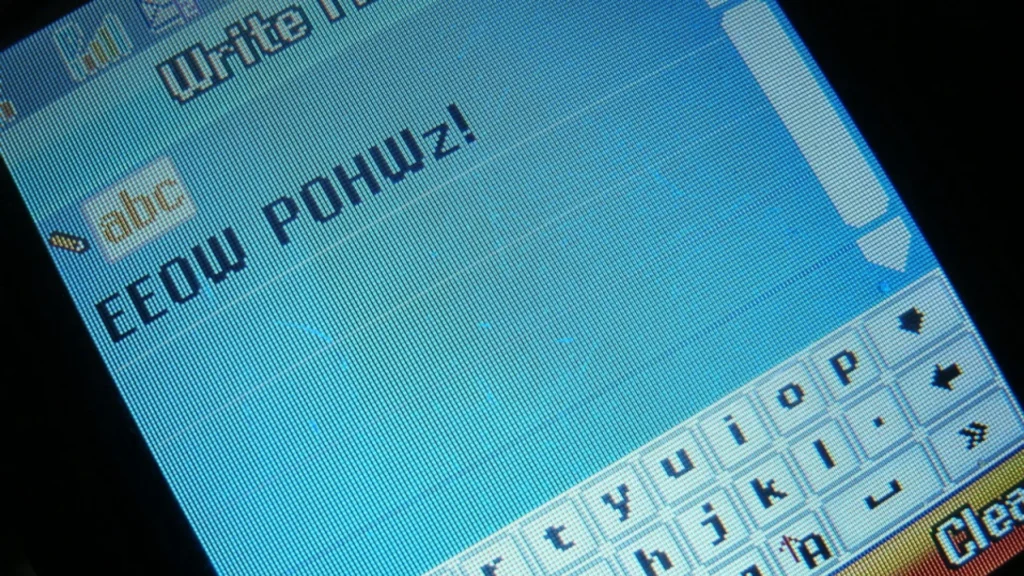
Emerging from SMS-era constraints, Jejemon text stretched language into compressed, stylized forms shaped by the 160-character limit of early mobile messaging. The result looked like distortion to outsiders: mixed capitalization, numbers replacing letters, elongated syllables, and deliberate orthographic play.
It was widely criticized at the time as linguistic decay. But it spread anyway.
From that ecosystem came widely adopted slang such as petmalu, werpa, and lodi, terms that moved quickly from subculture to mainstream usage. What began as coded text culture became spoken language in everyday settings.
The shift reflects a consistent mechanism that high-speed circulation turns stylistic deviation into normalized speech.
What “Sirit” and “Open Says Me” are doing
“Sirit,” derived from “share it,” follows the same pattern as “apir.” Phonetic compression transforms an English phrase into a locally naturalized form. The “sh” sound becomes “s,” syllables shorten, and repetition stabilizes the new version.
“Open says me,” a reinterpretation of “Open Sesame,” operates differently but follows the same logic of oral transmission. Mishearing produces a plausible alternative phrase that still fits grammatical structure and narrative context. It survives not because it is correct, but because it is recognizable.
In digital environments, recognition often outweighs accuracy. A phrase that spreads widely becomes correct in practice, regardless of origin.
The system behind the slang
Taken together, these examples describe a system rather than isolated jokes.
Filipino linguistic evolution consistently operates through three overlapping forces:
- phonetic adaptation across multilingual environments
- rapid remixing through digital platforms
- cultural preference for expressive over standardized forms
The Philippines’ linguistic landscape, with more than 180 languages and layered colonial histories, produces constant contact between speech systems. English, Spanish influence, and regional languages interact in ways that generate continuous recombination.
Within that environment, “correctness” is negotiated through usage.
Swardspeak, for example, developed within LGBTQ+ communities as both identity formation and linguistic protection. Terms such as charot and eklavush entered broader usage not because they were standardized, but because they were socially effective and expressive.
Each generation repeats this cycle in different forms.
The thing about JK
“JK means Just Kidding, not Joke” is technically correct. But its persistence in meme correction formats reveals something far more interesting.
“JK,” originating from early online and SMS communication, functions less as humor shorthand today and more as a tone regulator. It signals intent, softens statements, and provides social exit space in text-based interaction.
In practice, it operates as a pressure valve in digital conversation. It reduces friction in environments where tone cannot be heard, only inferred.
The “Up Here not Apir” meme captures how language behaves under constant circulation.
These are not mistakes that need fixing. They are artifacts of adaptation. Each term mirroring a moment where speech shifted to match the people using it, not the rules it came from.
Filipino slang does not drift away from language. It expands it. Apir!