
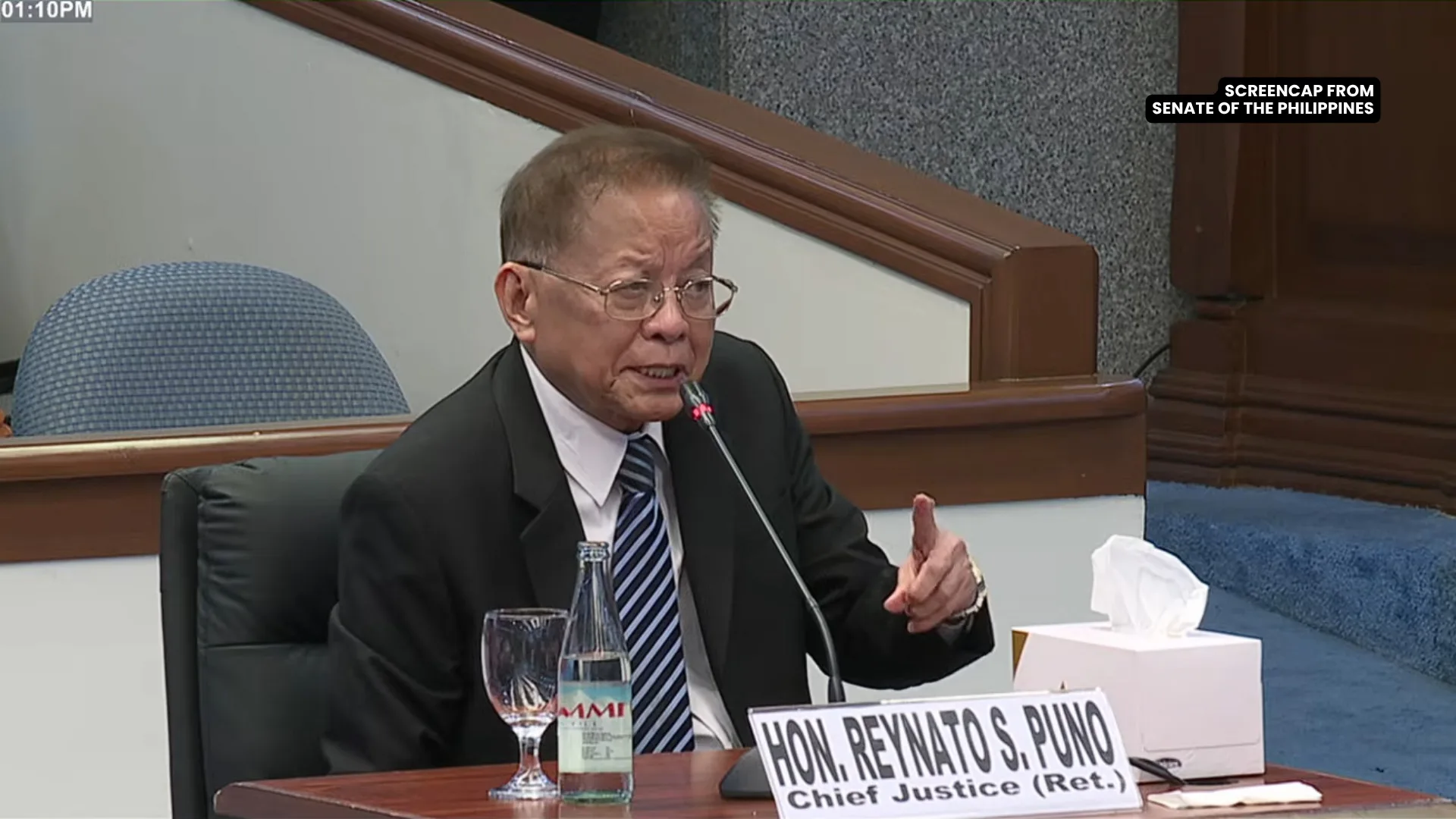
Three retired Chief Justices serving as amici curiae told the Senate Impeachment Court on Wednesday that the two-thirds vote mandated by the 1987 Constitution to convict an impeached official should not be treated as an unchangeable 16-vote requirement.
Appearing on Day 26 of Vice President Sara Duterte’s impeachment trial, retired Chief Justices Hilario Davide Jr., Artemio Panganiban, and Reynato Puno aligned in their position that automatically setting the threshold at 16; regardless of whether certain lawmakers are legally suspended, detained, or physically incapable of serving; defies common sense, tolerates absurdity and undermines constitutional intent.
Article XI, Section 3(6) of the Constitution specifies that conviction requires the concurrence of “two-thirds of all the Members of the Senate.” The legal luminaries maintained that this provision does not automatically equate to a static 16-member requirement across all circumstances.
In a formal memorandum read by Clerk of Court Renato Bantug Jr., Davide detailed five distinct classifications of senators who must be excluded from the total voting count.
“The basis of computing the two-thirds must be the number of Senators who are qualified to vote. Not the 24 in the present Senate. All those disqualified by reason of causes earlier mentioned should not be included,” Davide said.
Davide outlined that the voting baseline should exclude lawmakers who have resigned or been expelled, those suffering from mental infirmity or physical incapacity, individuals residing outside Philippine jurisdiction or evading arrest and those facing legal impediments, preventive suspension or detention due to graft or plunder charges.
Puno similarly called on the tribunal to adopt a “contextual and functional interpretation” of the conviction rule, warning that a literal headcount risks flawed outcomes when members cannot discharge their duties.
“This approach will give the senators the right to consider whether senators who are already dead, resigned, or expelled should still be counted in determining two thirds of all the members of the Senate,” Puno said.
Puno emphasized that had the framers intended to mandate 16 votes without exception, the text would have explicitly stated that figure.
“But Article XI, Section 3(6) did not say so. Instead, the language used a fraction. It says two-thirds of all members of the Senate. By using two thirds, the number of votes to convict will have to move depending on certain factors,” he said, adding that “this approach will enable the senators to consider whether senators who are legally incapacitated, like senators charged with plunder, like senators under preventive suspension, should still be counted in determining the number of votes to convict.”
Panganiban cautioned against allowing non-participating or unavailable members to inflate the voting denominator, stressing that constitutional interpretation must deliver fairness to both the respondent and the public.
“Is it truthful and fair to the parties, to our country, and to our people to allow those abroad, those looking at the pyramids along the Nile or shopping in the fashion houses of Paris or riding the romantic gondolas of Venice or deliberately hiding in the dark corners of the world while everyone here is sweating it out?” Panganiban said.
He noted that determining the vote threshold cannot be reduced to simple arithmetic disconnected from trial realities. “Mathematics, Your Honors, is an exact science in the abstract, but not always in reality. There’s a difference between abstraction and reality,” Panganiban said.
Echoing that point, Puno reiterated that constitutional analysis must transcend numerical calculations to honor the underlying purpose of the law.
“Reality, sometimes, Your Honors, changes the denominator in mathematics. In the same way, constitutional interpretation cannot always stop at abstract mathematics. We must look at the intent and the purpose of constitutional provisions, the circumstances in which they operate, and the goals they seek to achieve,” Puno said.