
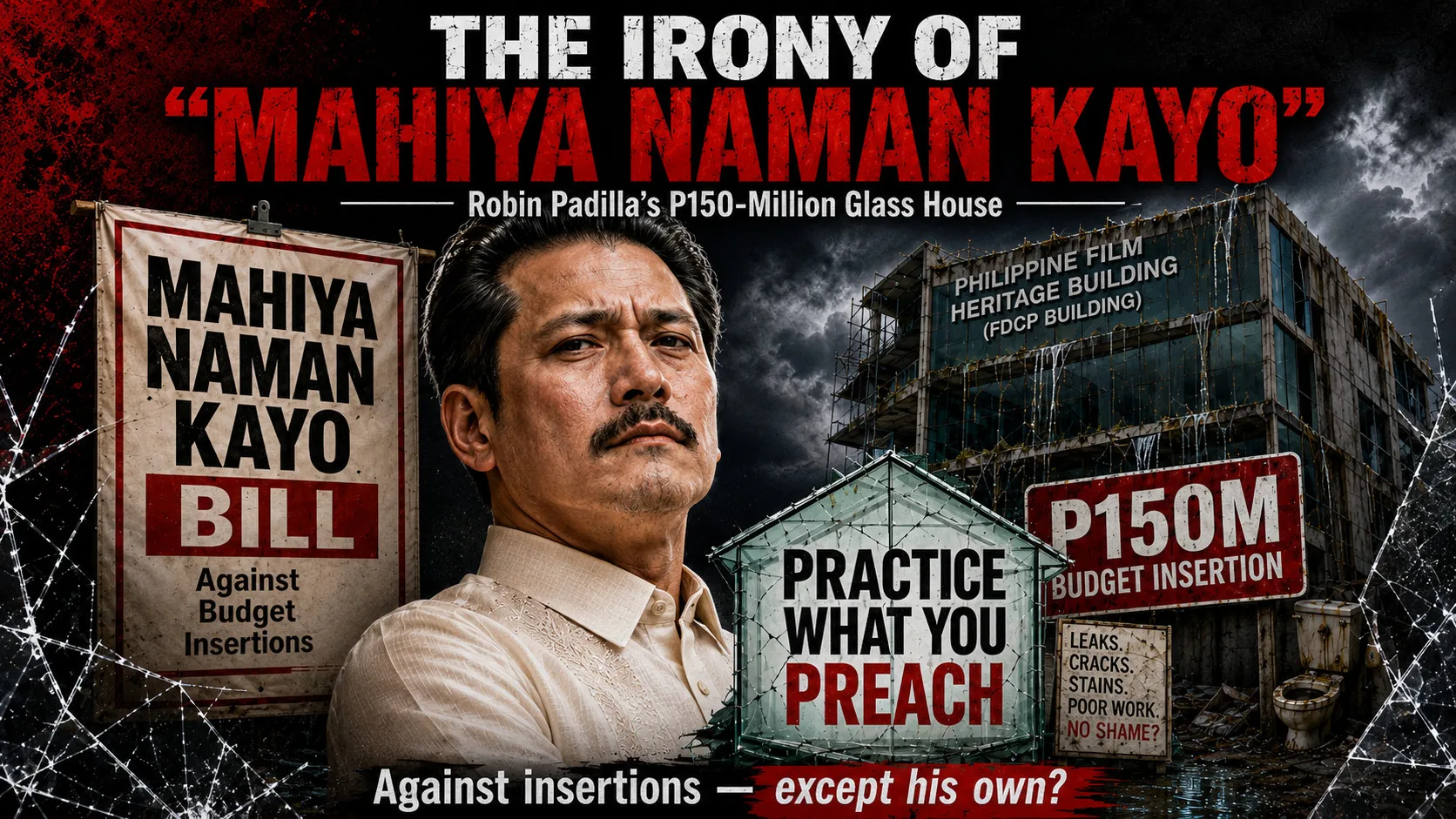
In the theater of Philippine politics, grandstanding is the preferred genre, and Senator Robinhood Padilla has always played the action star fighting for the masses. His latest blockbuster legislative move was Senate Bill No. 1299, colorfully and sarcastically titled the “Mahiya Naman Kayo” (Have Some Shame) Act. Its noble premise was to combat the deeply entrenched culture of budget insertions. It was a classic Padilla move—playing the clean, uncompromising outsider ready to dismantle a corrupt system.
But as the curtains pull back on the Philippine Film Heritage Building project, the plot twist reveals that the good senator might just be starring in his own hypocritical comedy.
The P150-Million Plot Hole
It turns out that behind the righteous indignation against legislative insertions, Padilla has a glaring one of his own. As recently confirmed by Film Development Council of the Philippines (FDCP) Chairman Jose Javier “Joey” Reyes, Senator Padilla was allegedly responsible for a staggering P150 million budget insertion intended to fund the construction of the Philippine Film Heritage Building.
While supporting the arts and heritage is undeniably a valid cause, the manner in which this was funded—and the disastrous outcome—exposes the exact systemic flaws Padilla claims to be fighting.
The story quickly derails when you look at where the money went. The P150 million contract was awarded to Discaya, a contractor that has been embroiled in controversies over substandard government projects. Instead of a state-of-the-art facility for Philippine cinema, the FDCP was left with a half-baked structure plagued by shoddy workmanship.
To make matters worse, FDCP Chair Reyes revealed that to actually make the building functional, they would need an additional P100 million. It is a staggering sum for an already botched project. The situation was only salvaged when the First Lady and Secretary Vince Dizon intervened to fix the mess, thankfully bypassing the need for a new, bloated budget.
The irony is thick enough to cut with a knife. You simply cannot aggressively campaign against budget insertions while simultaneously slipping P150 million into the national budget for a project that ultimately becomes a monument to incompetence.
The Anatomy of Political Hypocrisy
Senator Padilla’s attempt to play the immaculate crusader falls flat when measured against his own actions. The fundamental problem with the “Mahiya Naman Kayo” Act isn’t its intention; it’s the messenger.
When a lawmaker denounces budget insertions but utilizes the very same mechanism for their pet projects, it sends a clear and dangerous message: insertions are only bad when others do it.
The Double Standard. It is easy to point fingers at political rivals for manipulating the budget, but true accountability starts in your own backyard.
The Cost of Incompetence. Budget insertions often bypass the rigorous, transparent scrutiny required for national projects. This leads to exactly what happened here—taxpayer money handed to questionable contractors producing substandard results.
Performative Outrage. Writing a bill with a sarcastic, headline-grabbing title is ultimately just a PR stunt. Actual governance requires transparency and consistency, not backdoor funding allocations that you publicly condemn.
Time to Face the Mirror
Senator Padilla built his career on playing the anti-hero who champions the truth. But in the Senate halls, authenticity is measured by consistency and results, not by how loud you can shout into a microphone.
If Padilla truly wants to rid the government of backroom deals and shadowy budget allocations, he needs to practice what he preaches. Until then, the title of his own bill serves as the perfect, stinging critique of his recent actions.
To the good senator who inserted P150 million into the budget only to yield a dilapidated, unfinished building, the public has only one thing to say: Mahiya naman ka naman sa balat mo.