
In a pivotal shift that reshapes the math of the impeachment trial of Vice President Sara Z. Duterte, the Senate Impeachment Court voted Wednesday to adopt a new controlling rule that adjusts the two-thirds conviction threshold based on the number of active senator-judges legally and factually capable of participating in the proceedings.
The court approved the appeal brought by Senator-Judge Erwin Tulfo by a 13–1 vote, with six members declining to participate.
Those voting in favor were Senator-Judges Risa Hontiveros, Paolo Benigno “Bam” Aquino, Juan Miguel “Migz” Zubiri, Vicente Sotto III, Joseph Victor “JV” Ejercito, Panfilo Lacson, Manuel “Lito” Lapid, Erwin Tulfo, Raffy Tulfo, Joel Villanueva, Mark Villar, Francis Pangilinan and Sherwin Gatchalian.
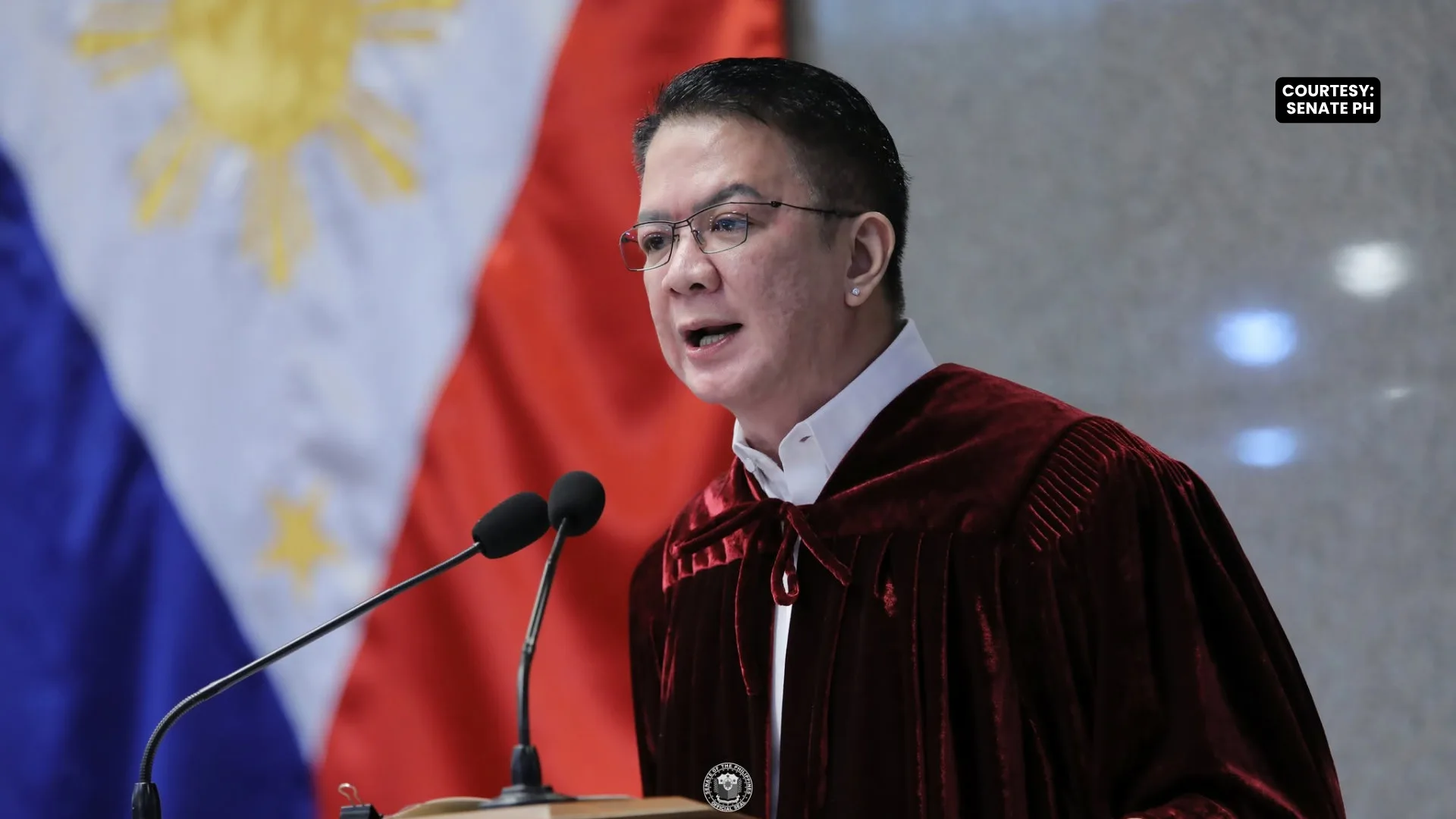
Presiding Officer Sen. Francis “Chiz” Escudero cast the sole negative vote, standing by his initial July 6 directive requiring 16 votes, a fixed two-thirds majority of the full 24-seat Senate, to convict.
Senator-Judges Alan Peter Cayetano, Pia Cayetano, Imee Marcos, Robin Padilla, Camille Villar and Christopher “Bong” Go abstained from participating in the vote.
The vote came after the court rejected an earlier motion by Senator-Judge Alan Peter Cayetano, who argued that the voting guidelines were settled at the trial’s outset and should not be modified mid-proceeding. Cayetano’s motion was defeated with 13 votes against, six in favor and one abstention.
Following a brief luncheon recess, Escudero formally declared Tulfo’s appeal carried.
“The appeal is won. Given the earlier manifestation of Senator-Judge Alan Cayetano, that on behalf of some of our senator-judge members, that they will not participate, the chair would like to put on record the actual vote as reflected based on the 20 members who responded to the roll call earlier,” Escudero announced upon resumption.
“With the casting of a nay vote by the presiding officer, 13 voted in the affirmative in favor of the appeal of Senator-Judge Erwin Tulfo. It is therefore 13 affirmative votes, one negative vote, and six did not participate. For the record,” Escudero added.
Accepting the chamber’s judgment, Escudero emphasized the boundaries of his authority as presiding officer.
“While the Chair takes exception to this decision, the Chair nonetheless accepts it as a judgment of this court and is bound to give it effect. The presiding officer, after all, is not the court. He is merely the custodian of the process, not the proprietor of its outcome,” he said.
“This is the essence of democracy that disagreement be preserved without obstruction and the lawful result be obeyed without resentment… We allow the fullest ventilation of views, even those views differ sharply from our own, But at the end of the day, we vote. We abide by the judgment of the majority even if we disagree with it,” Escudero added.
Under the new controlling standard, the constitutional requirement of two-thirds concurrence under Article XI, Section 3 (6) will be calculated against the pool of senator-judges who remain able to take part in trial proceedings at the time of voting. The calculation will exclude members who are detained, suspended, legally restrained, sought by authorities or physically or medically incapacitated.
Escudero noted that the updated formula will apply exclusively to this trial.
“This is a ruling, not an amendment of the rules. As such, it has no binding, but merely persuasive effect in future proceedings, the hands of whom we cannot shackle as there is no ‘stare decisis’ as between impeachment courts. Further, the circumstances that gave rise to this ruling are extraordinary. It has never happened before, and the Chair hopes that it shall never happen again,” Escudero explained.
Addressing potential fractional results, Escudero specified that any fractional requirement would automatically round up to the next whole integer.
“For example, if the denominator is 20, two-thirds is 13 and one-third, or 13.33. If we round it down to 13, 13 votes would fall short of the constitutionally required two-thirds concurrence, which is 13.33. Since a fraction of a vote is impossible as there is no fraction of a senator, 13.33, again by way of example only, must be rounded up to 14 votes, the next higher whole number, to ensure that the votes for conviction constitute at least two-thirds of the relevant membership,” he stated.
“This shall ensure that no person shall be convicted without the concurrence of two-thirds of all the members of the Senate, as determined by the Court in this new controlling ruling and as required under Article XI, Section 3 (6) of the Constitution. So ordered,” he added.
Explaining his decision to vote against the measure, Escudero reiterated his belief in a literal reading of the Constitution and invoked the legal principle of in dubio pro reo.
“Terminating an elected mandate before the end of its term is among the most drastic acts our constitutional democracy can undertake. Therefore, when the Constitution fixes the conditions and number for imposing a judgment of conviction, those conditions should not be relaxed by implication, nor should the number rise or fall according to the contingencies of the day,” Escudero said.
During floor debates, Cayetano voiced concern that altering procedural rules midway through trial risks inviting Supreme Court intervention or nullification.
“On the record, I would prefer — and I would insist — that if there is a question on the threshold, the question be brought before the Supreme Court,” Cayetano said. “Timing is essential. If we did it before we passed the rules of the Senate, all parties would have been informed and all parties would have had the chance to go to the Supreme Court…To discuss this in the middle of the trial, just before the prosecution is ending and just before the defense will be presenting their evidence, is not only inconvenient, but I use the word ‘ministerial’.”
Cayetano also noted the broader political landscape surrounding the proceedings.
“There are real politics happening here. It’s not an accident na hindi panay oposisyon ang puro wala dito..Inside the court nararamdaman natin ang fairness. But the reality is this court does not exist in a vacuum. May nangyayari sa labas…Hindi dapat gumawa ng mga akusasyon dito, pero hindi rin puwedeng bulag-bulagan dito na walang nangyayari sa ating bansa,” Cayetano remarked.
Senator-Judge Christopher “Bong” Go, who supported Cayetano’s motion, maintained that the text of the Constitution mandates a fixed calculation of all 24 Senate seats.
“Two-thirds of ALL the members. Beinte kuwatro. Not only those present on the day votes are cast. Hindi sinabi ng Konstitusyon na yung mga present lamang sa araw ng botohan. All means all. Ang ibg sabihin ng lahat, ay lahat…The Senate has 24 seats. Two-thirds of 24 is 16. The math is simple, simple arithmetic, madaling intidihin ito, Mr. Presiding Officer,” Go said.
Conversely, Senate President Sherwin Gatchalian defended his vote to revise the denominator as a constitutional exercise of sole Senate jurisdiction.
“The Constitution gives the Senate the sole power to try and decide all case od impeachment. Kasama sa kapangyarihang ito ang pagpapasiya kung paano isasagawa ang paglilitis, kabilang ang kung paano ilalapat ang sarili nitong mga patakaran at pasya kapag may ilan sa mga miyembro nito na hindi makalahok. Today’s vote was an exercise of that responsibility,” Gatchalian explained.
Senator-Judge Risa Hontiveros similarly supported the change, arguing that institutional processes must not be paralyzed by member absences.
“The absence of a number of senators in an impeachment trial should not paralyze and render helpless the entire institution, and the Filipino people we represent. Our constitutional process for accountability of high officials should not be so easily derailed,” Hontiveros declared. “Our people do not deserve occasional miscarriages of justice. Our people deserve senators who do our job and uphold our solemn duties. The respondent deserves judges who stay to hear both sides, peruse the evidence, and observe the witnesses. Dear colleagues, as our amici curiae have stated, the Senate generally has the final say when it comes to an impeachment verdict.”
Escudero indicated that formal written guidelines detailing the new controlling procedure will be released in the coming days.