
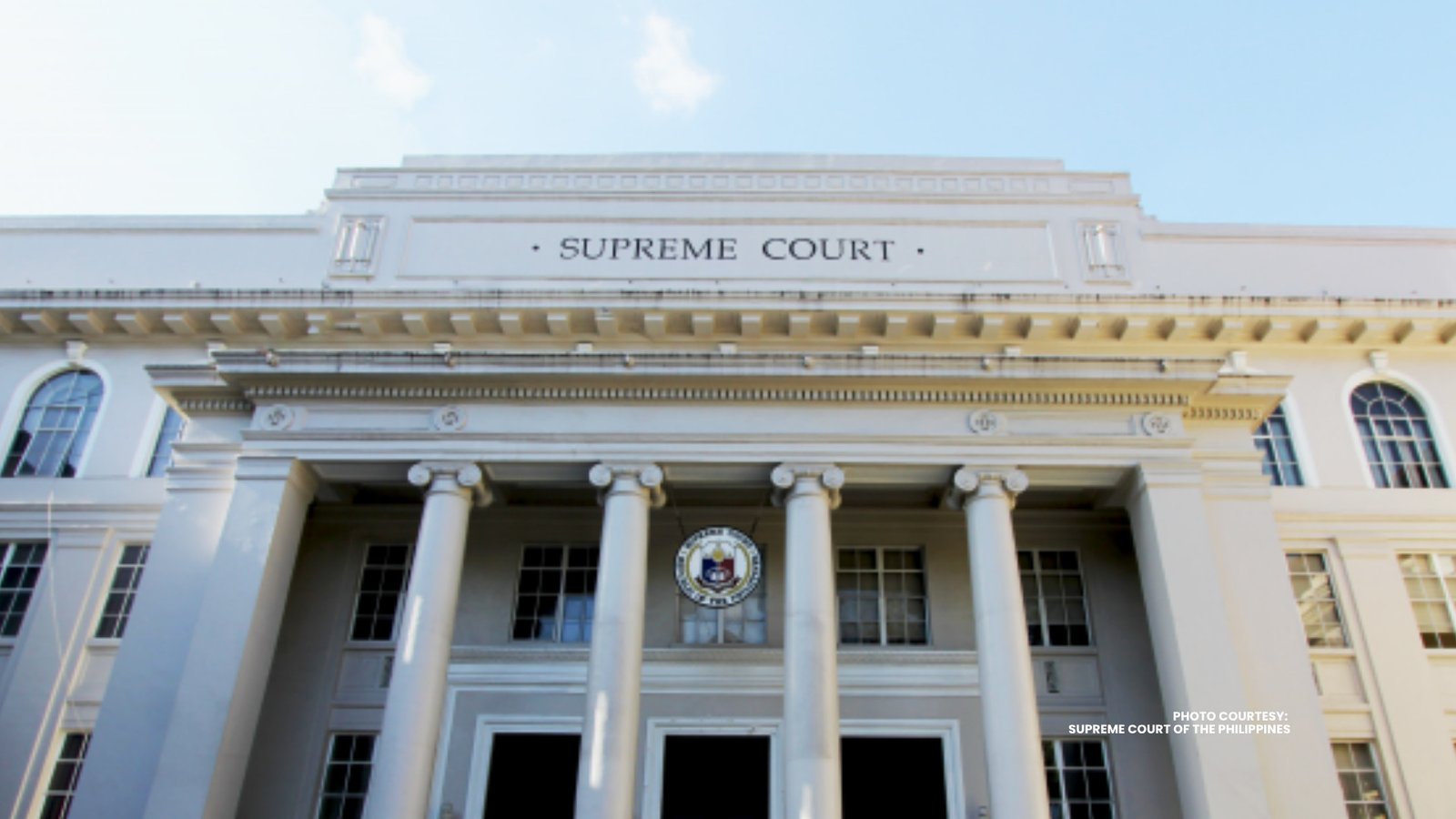
The Supreme Court En Banc found a retired clerk of court guilty of multiple administrative offenses under the 2025 Code of Conduct and Accountability for Court Officials and Personnel (CCACOP).
In a Per Curiam decision, the SC issued a penalty of dismissal to Luzviminda Hernandez, Clerk of Court II of the Municipal Trial Court (MTC) in Buenavista, Agusan del Norte, who is liable for serious dishonesty, falsification of official documents, and gross misconduct.
The severe penalties stemmed from a formal complaint filed by Maritess Yamba, a court stenographer at the same MTC. The legal dispute began when Yamba decided not to attend a convention for court stenographers from April 26 to 28, 2023, in Dipolog City, Zamboanga del Norte. The local government of Buenavista agreed to cover the travel expenses, registration fees, and daily allowances of Yamba and other court stenographers.
Hernandez then expressed interest to go to Dipolog City supposedly for a meeting with officers of the First Level Clerks of Court Association of the Philippines and asked if she could attend the convention using Yamba’s identity. Yamba explicitly refused and told her to use her own name.
However, Yamba later discovered that a certificate of attendance and an acknowledgment receipt for P3,400 were issued under her name despite not attending the convention. She eventually found out that it was Hernandez who actually attended the convention in Dipolog City but falsified her Daily Time Record (DTR) to show that she reported for work. A check worth P11,448 intended for Yamba was also released but was instead received by Hernandez.
The SC ruled that Hernandez committed serious dishonesty and fraud by stealing her colleague’s identity and secured public funds. Furthermore, the court found Hernandez guilty of falsification for making completely false entries in her DTR.
While CCACOP took effect on December 21, 2025, the SC clarified that it applies not only to future, but to pending administrative cases against court officials and personnel as well.
Because Hernandez had already reached her compulsory retirement in October 2024, the court could no longer physically dismiss her from her post. Instead, the SC ordered the total forfeiture of all her retirement benefits, except for her accrued leave credits, and permanently banned her from ever working in any public office or government-owned and controlled corporation again.