
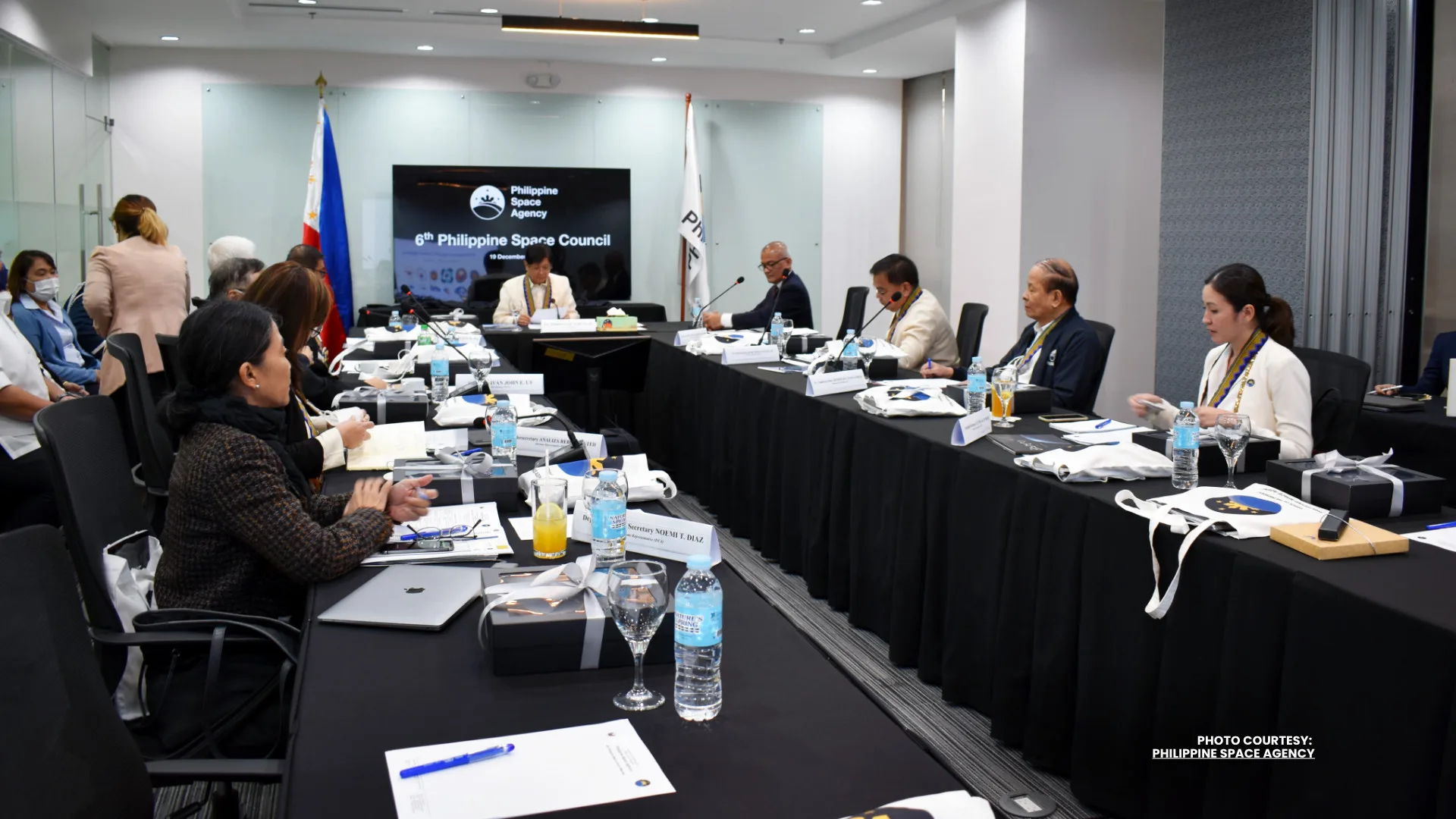
The Philippine Space Council has approved key satellite and space safety programs aimed at strengthening the country’s access to space-based data, secure communications, and coordinated response to space-related risks.
President Ferdinand Marcos Jr. presided over the 9th Philippine Space Council meeting at Malacañan Palace on Tuesday, where officials discussed major initiatives of the Philippine Space Agency, including satellite development, government data use, orbital debris response, and plans to build local space launch capabilities.
Among the measures approved was a resolution declaring the proposed Multispectral Unit for Land Assessment Constellation Program, or MULA, a national priority undertaking.
The program seeks to expand the country’s sovereign Earth observation capabilities through locally developed satellites. The MULA satellite is targeted for launch as early as April 2027 and is expected to support disaster management, agricultural monitoring, environmental mapping, and other government operations.
The council also approved the establishment of the Philippine Sovereign Geostationary Telecommunications Satellite Program, which aims to provide secure and reliable communications services under Philippine control.
The proposed satellite system is designed to help close connectivity gaps in remote and underserved areas, improve disaster resilience, and support mission-critical government communications.
To strengthen the government’s use of satellite data, the council adopted a separate resolution seeking to harmonize satellite data requirements across agencies.
The measure is expected to improve planning, monitoring, and decision-making while reducing duplication of resources among government offices that rely on space-based information.
The Philippine Space Council also approved a national Orbital Debris Response Protocol, which will guide government agencies in responding to incidents involving space debris and rocket reentries within Philippine territory and maritime zones.
PhilSA said it monitored 90 space vehicle drop zones in Philippine waters and airspace from June 2022 to May 2026, underscoring the need for stronger coordination and safety measures as space activity affecting the country increases.
The agency also updated the council on plans to conduct a sounding rocket test launch in Lal-lo, Cagayan, between December 2026 and February 2027.
The planned test launch forms part of efforts to develop local space launch capabilities and strengthen the country’s long-term space science and technology program.