
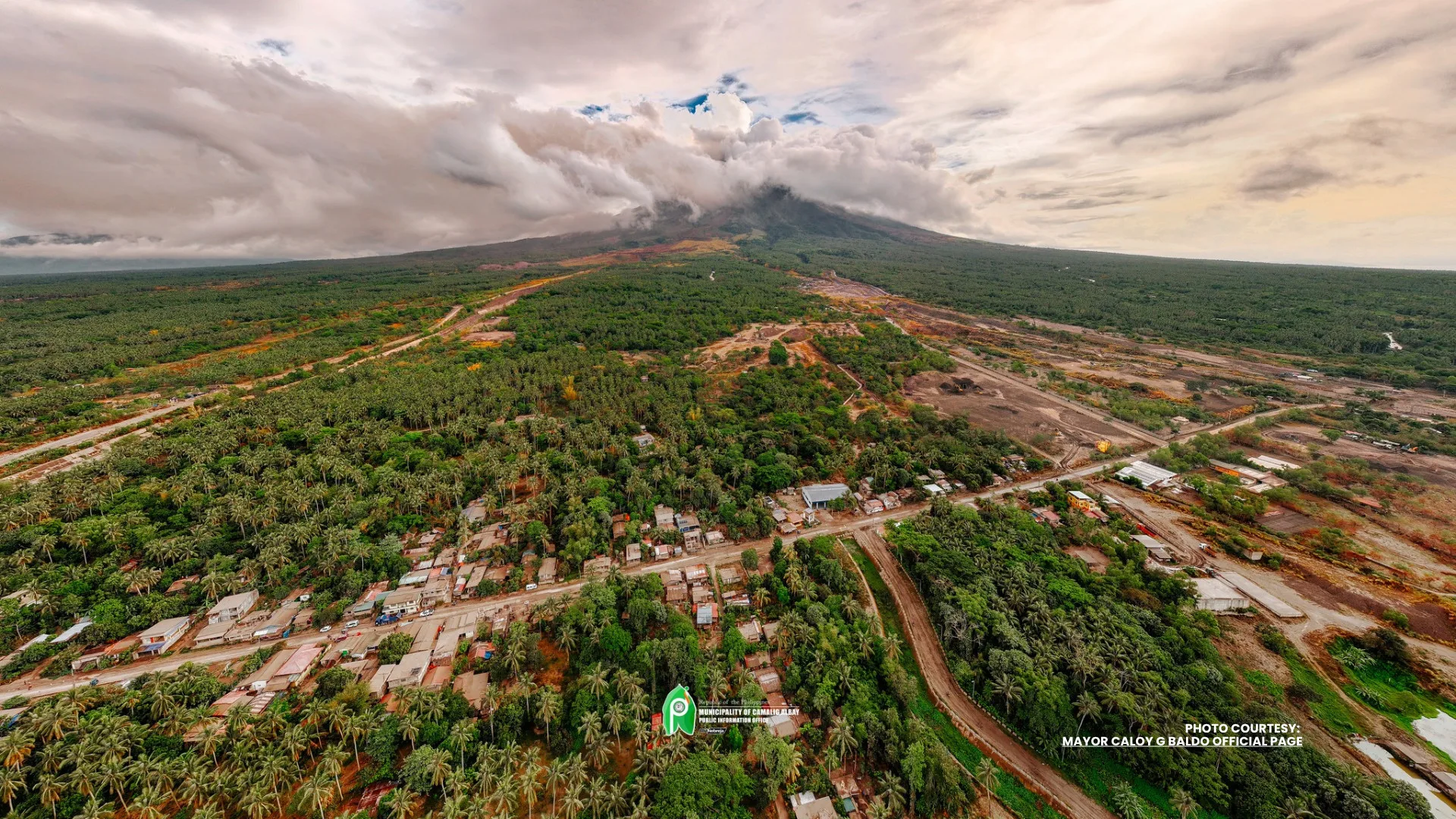
Law enforcement operations have intensified around the base of Mayon Volcano as the Philippine National Police (PNP) prepares for a possible surge in displaced residents amid warnings that the current restricted perimeter may be expanded from six to seven kilometers.
With state volcanologists signaling a potential escalation in Mayon’s activity, police leadership has ordered a significant increase in personnel to secure the area at a moment’s notice.
PNP Chief Police General Jose Melencio Nartatez Jr. confirmed that the organization is now operating under a heightened mobilization strategy aimed at sealing off all access points to the volcano’s high-risk slopes. The approach relies on what officials describe as a “grassroots” defense, linking local police stations directly with village-level intelligence networks to close gaps across Mayon’s rugged terrain.
Police officers are being paired with barangay personnel for joint foot patrols to monitor informal trails and back routes often used to bypass official checkpoints. Authorities say the objective is clear: as the threat level rises, the barrier between communities and the volcano must remain secure.
The heightened alert follows recent advisories from the Philippine Institute of Volcanology and Seismology, which indicate that Mayon’s current activity may require a wider safety buffer. Expanding the danger zone to a seven-kilometer radius would cover additional villages, many already dealing with the strain of evacuation.
Nartatez said one of the biggest challenges remains managing residents who attempt to return to restricted areas to check on livestock, tend farms, or retrieve belongings. To address this, police are incorporating real-time reports from village officials into deployment plans to identify and intercept individuals attempting to re-enter prematurely.
In line with directives from President Ferdinand Marcos Jr. and Interior Secretary Jonvic Remulla, round-the-clock checkpoints have been set up along major access routes to the volcano.
These are supported by mobile patrol units, with aerial surveillance being considered for remote areas that are difficult to monitor on foot. While enforcement remains firm, ground commanders have been instructed to adopt a balanced approach in dealing with individuals found within the restricted zone.
Nartatez said officers are exercising maximum tolerance toward farmers and residents, focusing on education and assistance to guide them back to evacuation centers while underscoring the deadly risks posed by pyroclastic density currents.
However, he stressed that such leniency does not extend to all. Authorities warned that tourists or thrill-seekers who deliberately breach the cordon for sightseeing or photography will face stricter action. Violators will be escorted out and may be subject to administrative charges or penalties coordinated with local government units.
The PNP, Nartatez said, is maintaining a zero-compromise stance on any activity that could put lives at risk as Mayon’s unrest continues.