
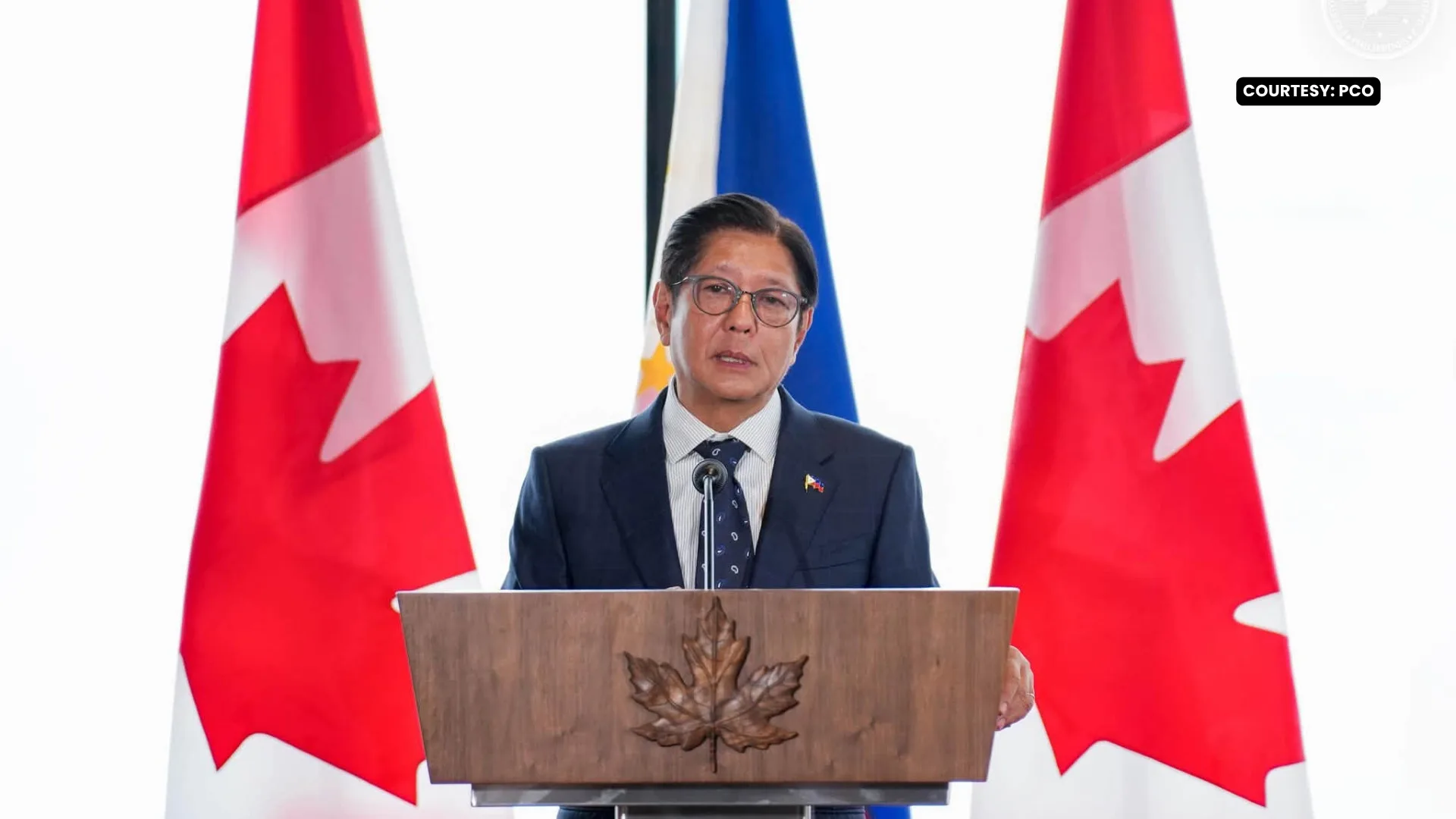
President Ferdinand Marcos Jr. on Sunday said he is concerned that the Philippines’ policy on the West Philippine Sea (WPS) could change under the next administration, stressing the need for consistency in defending the country’s position.
“It’s a very important issue for the Philippines. If you’re asking me if I’m worried that the policy of the Philippines will change after I leave office, of course I am,” the President said in an interview in Canada before he left for Manila.
Marcos and his delegation arrived in Manila at 3:56 p.m. on Sunday, Palace Press Officer Claire Castro said.
The President made the remark ahead of the 10th anniversary of the 2016 Arbitral ruling on the West Philippine Sea, which invalidated China’s claims over almost the entire South China Sea.
The Permanent Court of Arbitration issued the Arbitral Award on July 12, 2016, in a landmark ruling under the United Nations Convention on the Law of the Sea (UNCLOS).
Marcos, whose term ends in 2028, was asked if he was concerned that the next administration could take a different approach or weaken the gains made in enforcing the Arbitral ruling.
He said the issue may not feel existential to ordinary Filipinos, but for the government and the Philippines, “we really have to be consistent in that”.
“I think the rightness in our positioning, in terms of the way we position the Philippines in our foreign policy, vis-à-vis the arbitral agreement, arbitral award, is validated by countries like Canada who support it and see it as simply an enforcement of international law and the defense of our territorial integrity and the exercise of our sovereign rights within our sovereign territory,” he added.
The President said he thanked Canadian Prime Minister Mark Carney during their meeting for Canada’s continued support for a rules-based order in the South China Sea and for upholding the Arbitral Award.
Marcos said he also expressed hope that Canada and other like-minded countries would continue supporting efforts to enforce the rule of law.
“I convey the hope that as we celebrate the 10th anniversary of the Arbitral Award, Canada will continue to be one of the leading voices in upholding the award as an unassailable part of the corpus of international law,” he said.
The President returned to the Philippines on Sunday afternoon after his official visit to Canada from July 1 to 4, bringing home around US$2.5 billion in investments from Canadian partners in mining, critical minerals, energy, services, and information technology-business process management (IT-BPM).
He also secured a commitment to conclude the Philippines-Canada free trade agreement (FTA) this year to further strengthen trade between the two countries.
Marcos said bilateral ties between the Philippines and Canada had been elevated to a Strategic Partnership, calling it both a recognition of the longstanding relationship between the two countries and a roadmap for deeper cooperation.
He said the Philippines and Canada also agreed to strengthen security cooperation, adding that he had tasked Foreign Affairs Secretary Maria Teresa Lazaro to work with Canadian Foreign Minister Anita Anand to create a plan of action focused on “joint initiatives that will help both our countries adapt to shifting global realities, address shared challenges, and build capacities for future-ready partnerships.”
Marcos said both countries also reaffirmed the strategic importance of the Indo-Pacific region and agreed to work together on shared regional priorities.