
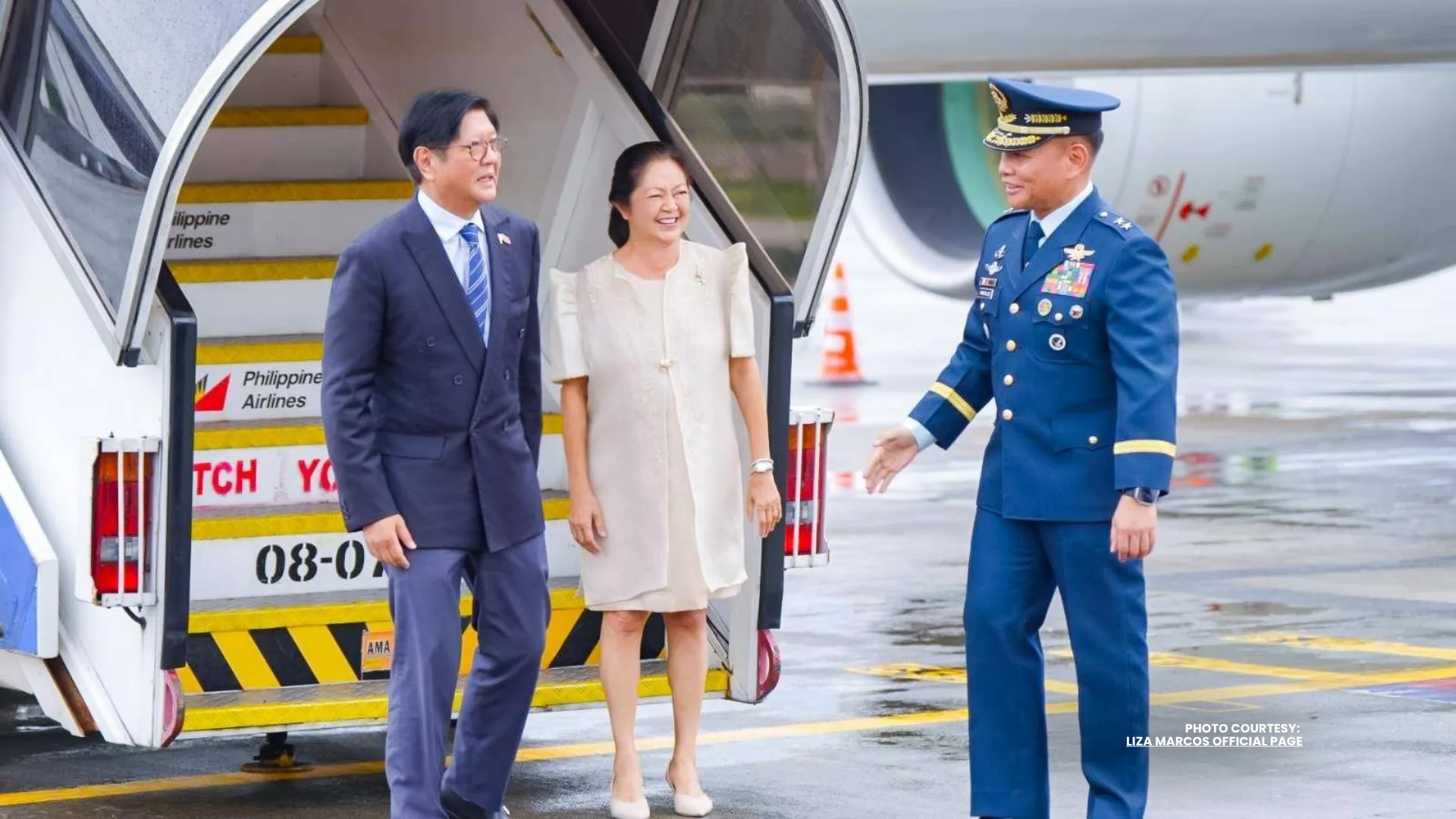
President Ferdinand Marcos Jr. on Tuesday left for a four-day State Visit to Japan, seeking to deepen Manila’s strategic partnership with Tokyo through new initiatives in defense, maritime cooperation, trade, investment, and infrastructure.
In his departure statement at the Maharlika Presidential Hangar in Pasay City, Marcos said the visit comes at a significant time as the Philippines and Japan mark the 70th anniversary of the normalization of diplomatic relations.
The President described Japan as the Philippines’ “first and oldest Strategic Partner” and one of the country’s most reliable allies amid an increasingly complex regional and global environment.
“This State Visit to Japan is essential amid an increasingly challenging and evolving global environment,” Marcos said.
Marcos said the trip forms part of his administration’s broader foreign policy agenda to strengthen political ties, defense and security cooperation, and economic partnerships with major countries in the region.
Among the priority areas for discussion are agriculture, energy and decarbonization, maritime cooperation, trade and investment, infrastructure, defense and security, space technology, and the development of Mindanao.
The President said he would also advance Philippine positions on regional and global issues, including the West Philippine Sea, the Middle East conflict, ASEAN cooperation, engagement with the United States, and the Philippines’ candidacy for the United Nations Security Council.
During the visit, Marcos and First Lady Liza Araneta-Marcos are scheduled to have an Imperial Audience with Emperor Naruhito and Empress Masako.
The President said he and the First Lady will also receive prestigious Japanese honors, while he will confer Philippine civilian honors on the Emperor and Empress in recognition of their contributions to strengthening relations between the two countries.
Marcos is also set to meet Japanese Prime Minister Takaichi Sanae for discussions on security, economic cooperation, and regional peace and stability.
The two leaders are expected to witness the signing and exchange of an agreement on trade and investment, as well as announce key bilateral initiatives in security and maritime cooperation.
Marcos noted that defense ties between the Philippines and Japan have grown in recent years, citing the Reciprocal Access Agreement signed in 2024, the Acquisition and Cross-Servicing Agreement signed this year, and Japan’s Official Security Assistance grants from 2023 to 2025 supporting the modernization of the Armed Forces of the Philippines.
The President also highlighted Japan’s long-standing role as a major trade and development partner, citing projects such as the Metro Manila Subway, the North-South Commuter Railway, the rehabilitation of MRT-3, and the Central Mindanao High Standard Highway.
He said Japan’s support for Mindanao development, including grants for the Basilan, Sulu, and Tawi-Tawi Wireless Backbone Network, remains an important part of the bilateral partnership.
“I believe we can further expand our security, economic, and development cooperation in order to enhance our national defense posture and to uplift the standard of living of Filipinos in different parts of the country,” Marcos said.
Marcos said he would also meet with Japanese business leaders to promote trade and investment opportunities in the Philippines, together with his economic team and private sector representatives.
He is also expected to meet with the Filipino community in Japan, whom he credited for contributing to nation-building through their work and service abroad.