
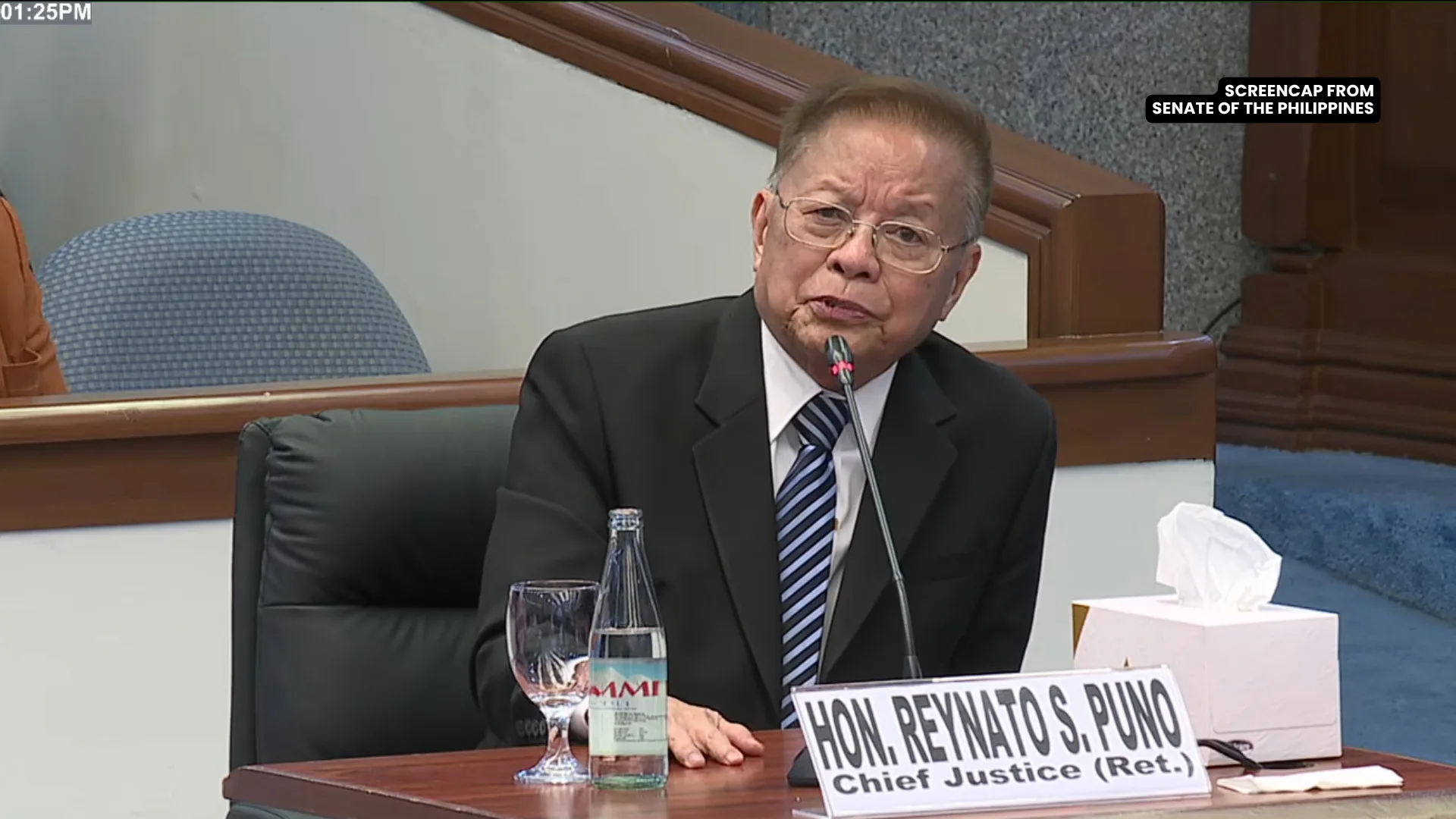
Retired Chief Justice Reynato Puno has cautioned the Senate Impeachment Court against adopting a rigid interpretation of the 1987 Constitution that would automatically set the benchmark for convicting Vice President Sara Duterte at 16 votes.
Appearing before the tribunal to render his legal opinion, Puno explained that the constitutional requirement is dynamic rather than static.
“If we give this kind of reading to Article 11, Section 3(6), the threshold of 16 Senators to convict will be fixed and immutable. However, if that is the intent, Article 11, Section 3(6) should have simply stated that the number of votes to convict is 16, period,” Puno told the senator-judges.
The former top magistrate underscored that the constitutional language purposefully relies on a fraction rather than a fixed number when defining the voting pool.
“Instead, the language used a fraction. It says two-thirds of all members of the Senate,” Puno noted. “By using two-thirds, the number of votes to convict will have to move depending on certain factors.”
Puno’s manifestation addresses the ongoing debate over whether the two-thirds calculation must strictly reflect the Senate’s full theoretical roster of 24 members or adapt to the actual number of lawmakers who are legally and physically capable of casting a vote.
Rejecting a narrow interpretation that evaluates the conviction clause in isolation, Puno advocated for a broader legal view that harmonizes the provision with the rest of the Constitution.
“For these reasons, I join the School of Thought that espouses what is known as contextual and functional interpretation of the Constitution,” he stated.
Under this framework, Puno explained that lawmakers must determine who counts toward the total voting baseline by accounting for real-world circumstances such as death, resignation, expulsion, or legal incapacity, including preventive suspension.
“It is functional because it will give the Senators the flexibility to consider circumstances that will legally prevent a Senator from functioning as a member of the Senate,” Puno remarked, framing these developments as key factors for the chamber to evaluate when establishing the final quorum.
Warning that a strict word-for-word reading could yield unintended and unfair results, Puno urged the court to look past rigid arithmetic when applying constitutional mandates.
“The provisions of the Constitution should not be interpreted narrowly or pedantically, for the prescriptions therein are not mathematical formulas.”