
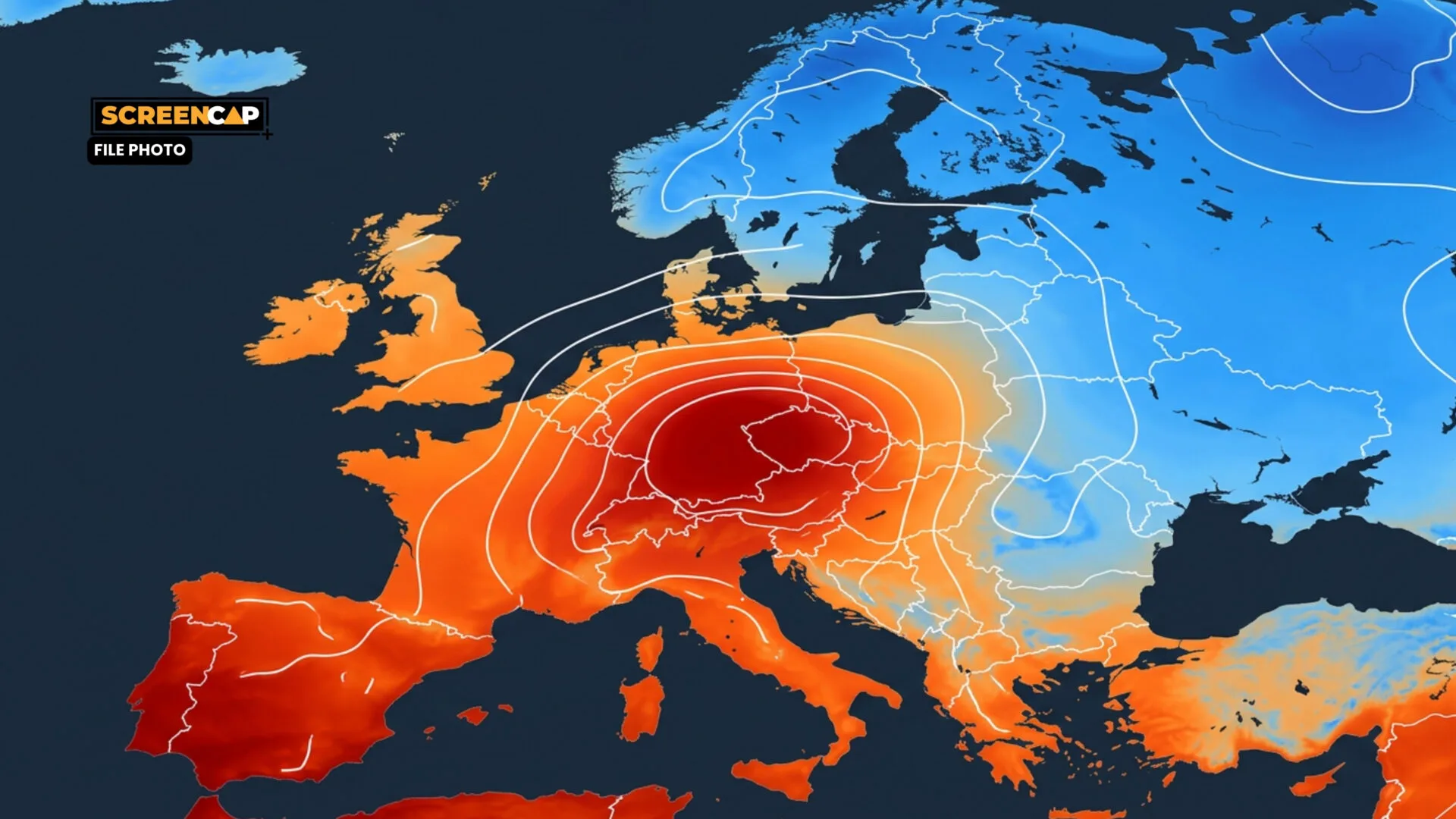
An unprecedented early-summer heatwave is cementing its grip on the European continent, smashing temperature records from the British Isles to Central Europe and pushing vital infrastructure to its absolute breaking point.
Driven by a stubborn atmospheric phenomenon, the suffocating weather system is currently tracking eastward across Germany toward Poland, leaving a trail of disrupted public services and heightened health alerts in its wake.
The German National Meteorological Service issued extreme heat warnings for nearly the entire country over the weekend, forecasting baseline temperatures of 36 °C with localized peaks potentially scaling 42°C. A preliminary all-time national record has already been clocked near the French border in Saarbrücken, where mercury levels touched a staggering 41.3°C.
Climate scientists have pulled no punches regarding the root cause of the crisis, stating that a heatwave of this magnitude would be virtually impossible without man-made climate change. Modern greenhouse gas emissions have made the oppressive overnight temperatures currently being experienced roughly 100 times more likely to occur than they were just two decades ago.
The sheer intensity of the sun has threatened heavy damage to transportation networks, raising fears of buckling roads, swelling railway tracks, and compromised electrical grids.
In response, German national rail operator Deutsche Bahn took the unusual step of allowing passengers to cancel long-distance bookings through early next week entirely free of charge, aiming to reduce traffic on stressed infrastructure. Regional operator National Express proactively suspended services along its Rhine-Ruhr-Express line in Germany’s most populous state, citing the danger of trains stalling in the midday heat.
Compounding the crisis is a regional housing stock designed historically to trap warmth rather than repel it, driving a massive surge in demand for electric fans and air conditioning units.
With municipal water supplies feeling the pinch, Andre Berghegger, CEO of the German Association of Towns and Municipalities, pleaded with citizens to practice voluntary water conservation to avoid mandatory local bans.
The fallout extends far beyond Germany’s borders, plunging neighboring nations into an emergency response posture. In France, dozens of heat-related fatalities have been reported across various demographics, forcing the government to suspend schools, enforce localized alcohol bans, and cancel major outdoor public gatherings.
Meanwhile, Italy’s health ministry has declared a red alert for 18 major cities, including Rome, Milan, and Florence. The extreme conditions have even grounded high-profile cultural events to a halt. Athletic fields have been similarly impacted, forcing organizers of the prestigious Ironman European Championship in Frankfurt to scramble to shorten both the cycling and running courses to protect athletes competing in the grueling long-distance triathlon.
According to data compiled by meteorological monitors, temperatures across the continent are hovering up to 18°C above seasonal averages. The prolonged baking is the result of an “Omega block”—a high-pressure weather pattern shaped like the Greek letter “Omega” that effectively traps a massive, stagnant dome of hot air over a region while pinning cooler air to its outer fringes.
While meteorologists predict the most severe core of the heat will begin breaking up with violent thunderstorms over the weekend, relief for the continent at large remains distant. The World Meteorological Organization warned that the high-pressure system will simply migrate by the end of the month, shifting its dangerous thermal energy directly toward Central Europe and the Balkan peninsula.