
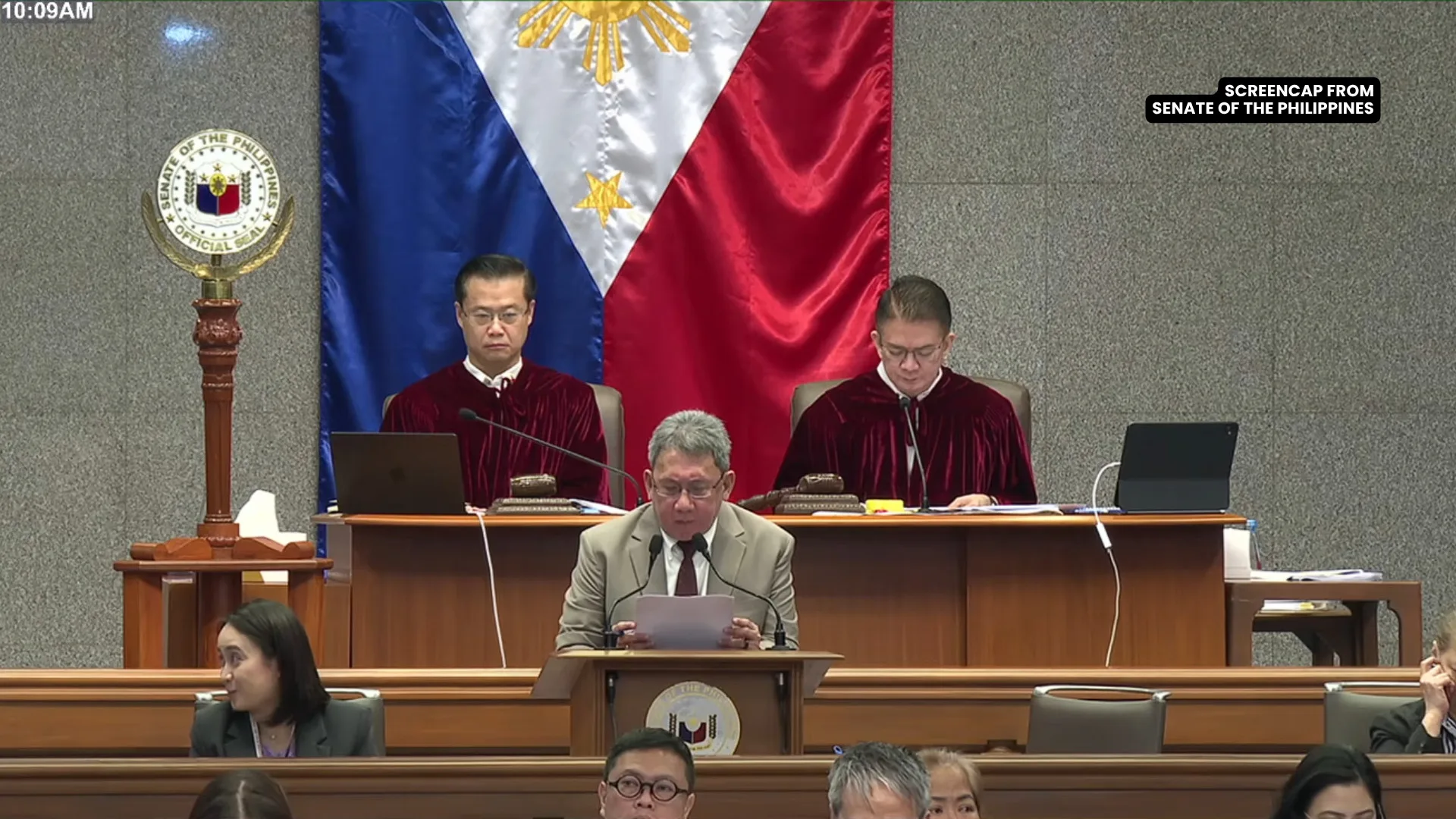
Retired Chief Justice Hilario G. Davide Jr. has weighed in on the ongoing impeachment trial of Vice President Sara Z. Duterte, telling the Senate Impeachment Court on Wednesday that the two-thirds voting threshold required for conviction should be based strictly on active and legally qualified lawmakers, not automatically fixed at the full 24-member chamber.
In a comprehensive memorandum submitted to the tribunal, Davide tackled key constitutional questions regarding how the required vote must be calculated when certain senators are physically or legally unable to participate.
While the 1987 Constitution mandates that “No person shall be convicted without the concurrence of two-thirds of all the Members of the Senate,” the former magistrate argued against a rigid numerical interpretation. He stressed that the term “members” must be understood through the intent of the framers rather than a literal headcount that leads to absurd outcomes.
Davide emphasized that “members refer to living persons who are not suffering from any mental, physical or health conditions” that prevent them from fulfilling their duties, as well as those free from legal restraints. Taking the opposite view, he warned, “would defy reason, logic and common sense; tolerate an absurdity; and perpetuate an injustice.”
To clarify the calculation, Davide argued that the baseline should automatically exclude senators who have resigned or been expelled, those facing severe mental or physical incapacities, individuals currently outside Philippine jurisdiction, senators whose whereabouts are unknown or who are hiding, and those legally barred from exercising their official functions.
“Clearly then, the basis of computing the two-thirds must be the number of senators who are qualified to vote. Not the twenty-four (24) in the present Senate,” Davide concluded.
Addressing legal precedents, Davide noted that the 1949 landmark case Avelino v. Cuenco does not serve as a direct precedent because it pertained to legislative quorums rather than an impeachment trial. “The undersigned respectfully submits that it is not directly applicable in impeachment cases,” he wrote, adding that “however, by analogy, it may only provide some guiding light.” Under that framework, he reaffirmed that “those who are detained, abroad, suspended or whose whereabouts are unknown cannot be included, or must be excluded” when determining the final voting pool.
On whether non-attending members can vote, Davide stated that any senator-judge who completely failed to attend sessions or discharge their duties should be treated as absent without leave, placing them in the same category as those outside the country’s jurisdiction.
For members who attended but remained quiet, Davide urged them to act according to their conscience, reminding the court that refraining from asking questions does not equate to non-participation. “I wish to underscore, however, that failure to ask questions on the witnesses is not proof of non-participation,” Davide explained. “As judges, they should even refrain from asking questions except to clarify a point.”
Concluding his guidance, the former Chief Justice reminded the senator-judges that their primary duty is to stay present, listen carefully, and weigh the evidence in accordance with the fundamental oath of governance, “Public office is a public trust. Public officers and employees must, at all times, be accountable to the people.”