
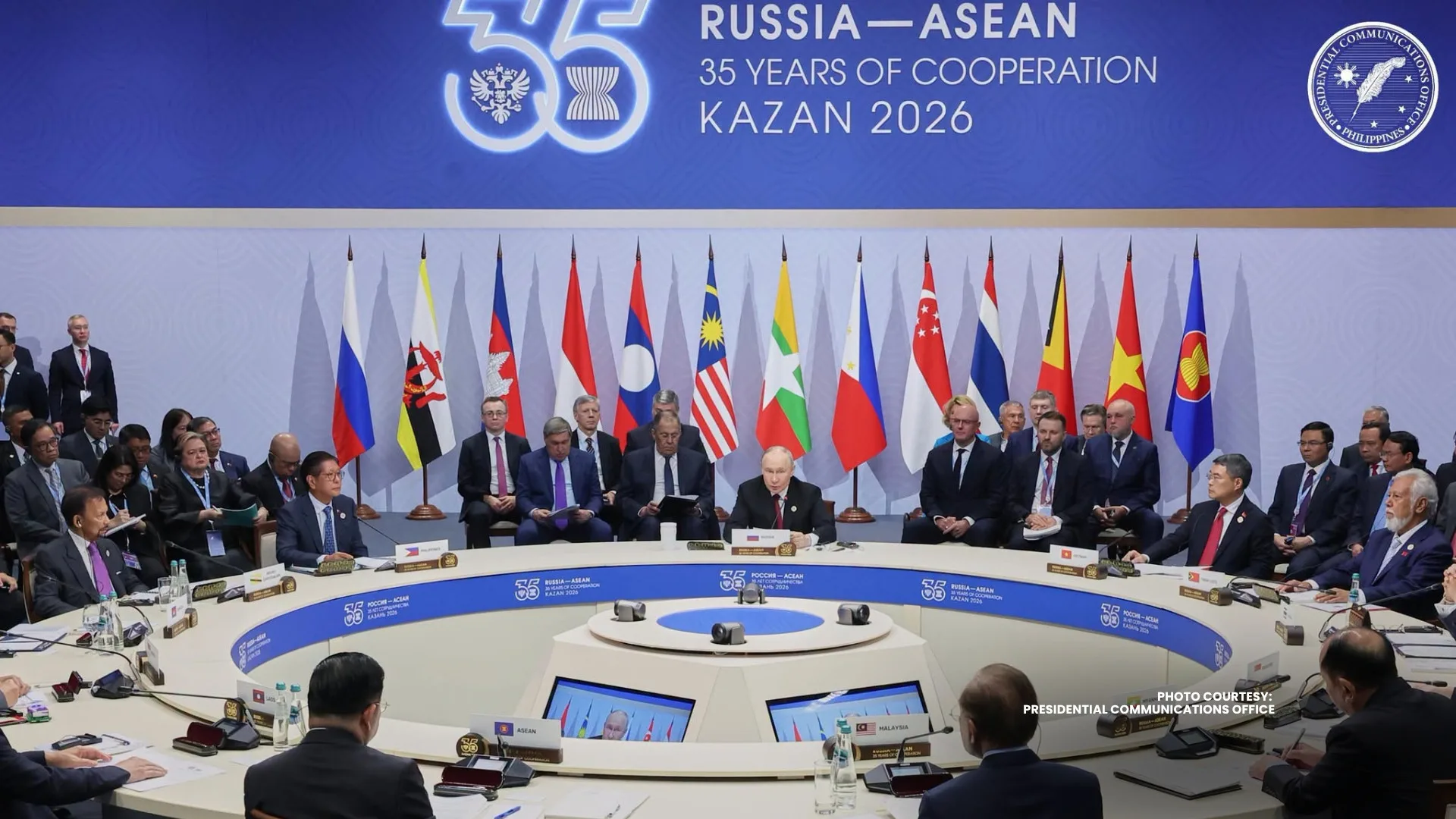
Association of Southeast Asian Nations (ASEAN) member states and Russia on Thursday welcomed the ceasefire agreement between the United States and Iran, expressing hope that it will help stabilize tensions in the Middle East and ease pressure on global energy and food markets.
The statement came during a joint press conference in Kazan, Russia, following the 35th ASEAN–Russia Commemorative Summit, where Russian President Vladimir Putin said leaders shared broadly aligned positions on major international issues, including the Middle East conflict.
“Unanimously, we welcome the agreement between Iranian and American sides on cessation of the military conflict and about the work on modalities of a future peaceful agreement,” Putin said in Russian.
He said the agreement—reportedly signed by US President Donald Trump and Iranian President Masoud Pezeshkian—was viewed by summit participants as a potential foundation for longer-term stability.
“We expect that this document is a serious document that will be the foundation for future agreements,” he added.
The ceasefire follows months of heightened tensions in the Middle East, including airstrikes involving the United States and Israel that escalated in February 2026 and disrupted key shipping routes through the Strait of Hormuz. The waterway handles around 20 percent of global oil trade and roughly one-third of liquefied natural gas shipments.
Analysts have warned that prolonged instability in the region could significantly affect global energy pricing and food supply chains.
Putin said leaders also emphasized the importance of closer foreign policy coordination, international cooperation, and respect among partners amid global uncertainty.
Beyond the Middle East, ASEAN and Russia discussed expanded cooperation in nuclear energy for civilian use, digital technologies, cybersecurity, artificial intelligence, and smart city development.
Both sides also agreed to deepen cooperation in transport and logistics, including maritime and rail connectivity, alongside broader efforts to expand humanitarian exchanges in education, science, culture, and tourism.
President Ferdinand Marcos Jr., speaking as ASEAN Chair, said the summit produced key outcome documents including the Kazan Declaration 2026 and the ASEAN–Russia Comprehensive Plan of Action for 2026–2030.
“These documents provide a comprehensive roadmap for expanding practical cooperation and delivering tangible results and benefits to our peoples,” Marcos said.
He said ASEAN welcomes continued Russian engagement and reiterated commitment to ensuring that summit momentum translates into “concrete outcomes and meaningful cooperation.”