
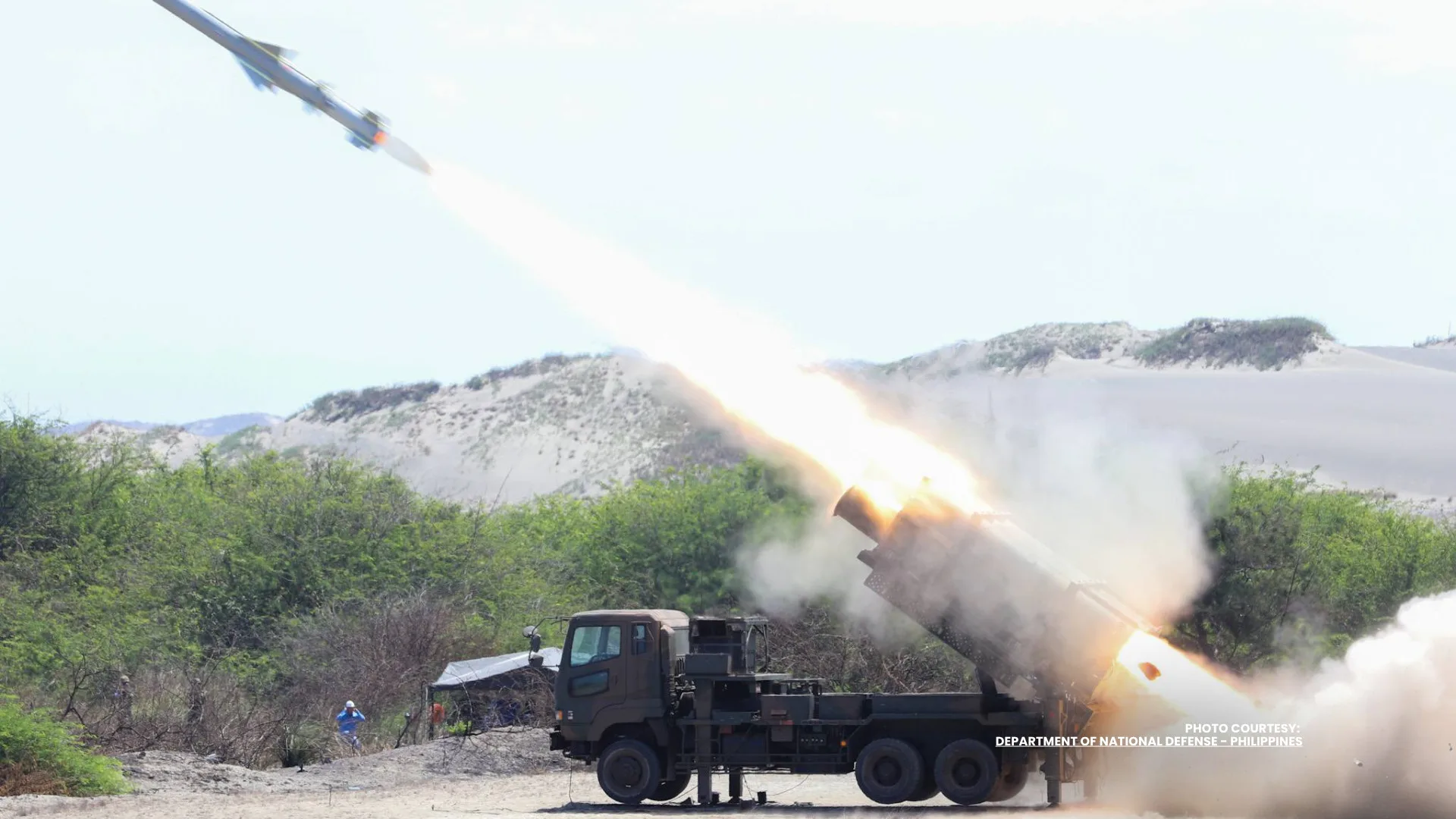
Japanese missiles struck and sank a decommissioned Philippine Navy vessel on Wednesday during a large-scale maritime strike exercise under Balikatan 2026, marking one of the most complex live-fire drills of the ongoing multinational training activity.
The target ship, the former BRP Quezon (PS-20), was hit offshore of Paoay, Ilocos Norte after coordinated strikes involving forces from the Philippines, US, Japan, and Australia. It eventually sank minutes after multiple rounds of simulated and live munitions were fired in sequence.
According to Col. Dennis Hernandez, spokesperson for the Philippine side of Balikatan, the exercise began around mid-morning with US forces firing Guided Multiple Launch Rocket System (GMLRS) rounds that struck the vessel approximately 40 kilometers from shore at about 10:15 am.
This was followed by a simulated engagement using US Naval Expeditionary Ship Interdiction System and Philippine Navy anti-ship systems, which tested targeting and coordination procedures without live firing.
At around 10:30 am, Japan’s Type 88 surface-to-ship missile system delivered the decisive live strike, hitting the hull of the already damaged vessel. Seventeen minutes later, the ship sank.
Additional US High Mobility Artillery Rocket System (HIMARS) units later fired toward the area where the vessel had gone down, though the ship had already submerged by that time.
Aircraft from the Philippine Air Force were also scheduled to take part in the strike sequence but did not release munitions as the target had already sunk.
Another decommissioned naval vessel is expected to be used in a separate live-fire event on Thursday, with officials saying allied forces, including Canada, are scheduled to participate alongside Philippine naval units.
Hernandez said the exercise is designed to improve interoperability among partner nations, particularly in detecting, tracking, and engaging maritime targets under a unified operational framework.
President Ferdinand Marcos Jr. observed the drill remotely from Camp Aguinaldo, along with Armed Forces of the Philippines chief Gen. Romeo Brawner Jr. and other defense officials. Japanese Defense Minister Shinjirō Koizumi and Defense Secretary Gilberto Teodoro Jr. also witnessed the exercise.
Defense officials described the drill as a demonstration of growing coordination among allied forces.
Teodoro said the activity highlights expanding defense partnerships in the region, while crediting leadership support for enabling more complex joint exercises.
Col. Hernandez, when asked about the President’s reaction, said Marcos appeared satisfied with the outcome and the level of coordination among participating forces.
The maritime strike forms part of Balikatan 2026, which began on April 20 and is set to conclude later this week.
Earlier in the week, a US Typhon missile system launched a Tomahawk missile from Eastern Visayas that successfully hit a designated training target inside Fort Magsaysay in Nueva Ecija, another key event in the exercises.
The launch drew criticism from progressive groups, including the Koalisyong Makabayan, which raised concerns over safety and the use of Philippine territory for foreign military drills.
Military officials defended the exercise, saying strict safety protocols were observed, including advance notices to air and maritime traffic, coordination with local governments, and controlled launch timing to minimize risk to civilians.
They also clarified that the impact zones are within military reservations and training ranges, not civilian farming communities.
Officials said Balikatan continues to serve as a platform for strengthening defense readiness, improving joint operational capabilities, and enhancing cooperation among allied forces amid evolving regional security challenges.