
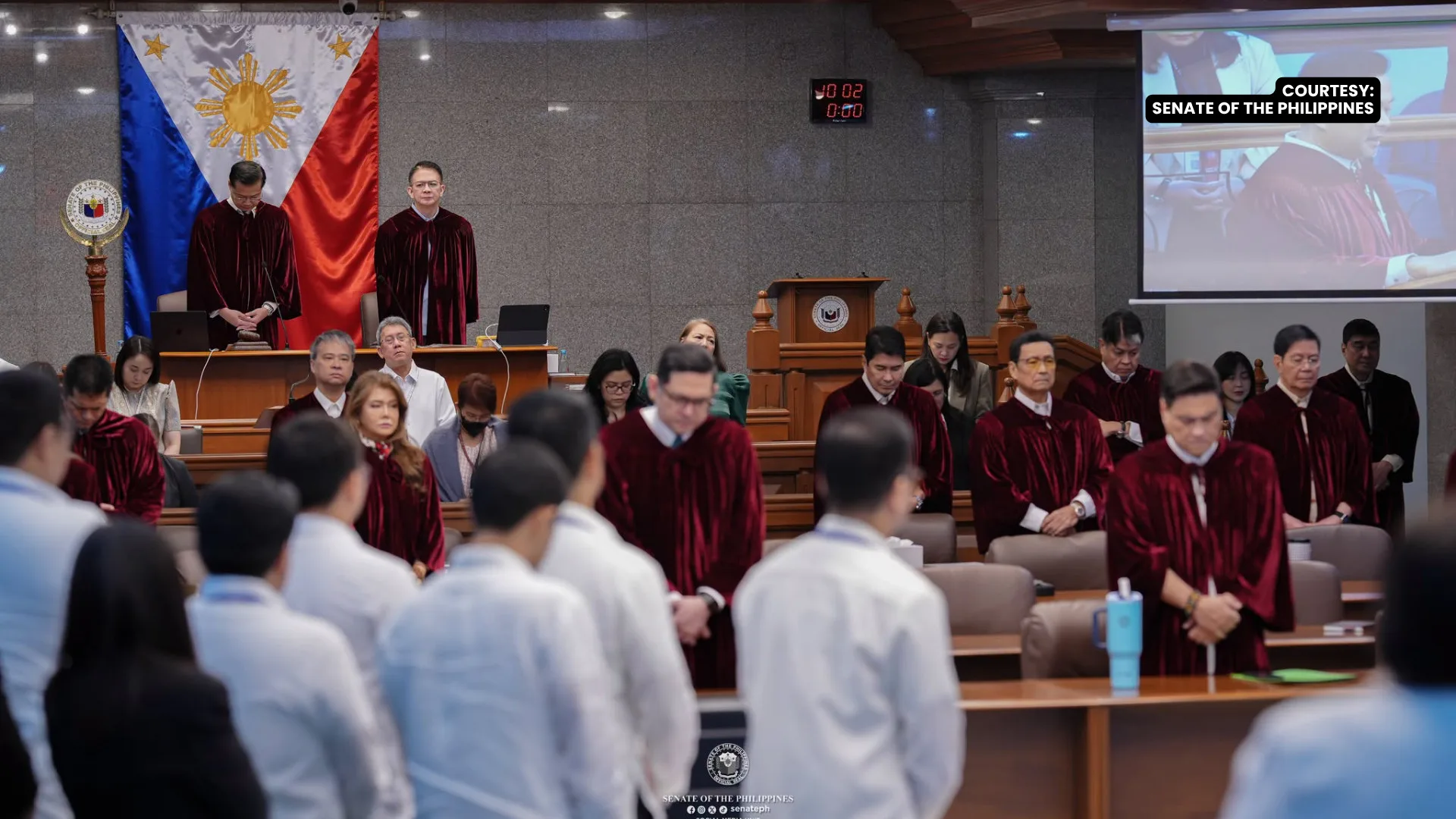
A near majority of Filipinos want to examine the pieces of evidence presented in the ongoing impeachment trial of Vice President Sara Duterte before forming a final judgment, according to the third quarter survey by OCTA Research released on Wednesday.
The independent survey, conducted from September 28 to October 4 with 1,200 adult respondents and a margin of error of ±3 percent, revealed that 47 percent of Filipinos believe it is still too early to tell and prefer to see the evidence supporting the allegations against the Vice President. This figure is down from 55 percent in previous findings.
Meanwhile, 25 percent of respondents, up from 21 percent, indicated they want an acquittal, while 21 percent, up from 17 percent, favor a conviction and her removal from office.
Six percent of respondents remained undecided or expressed no opinion, almost unchanged from 7 percent.
OCTA noted that the gap between those preferring an acquittal and those supporting a conviction is “too small to be read as a clear national lead.”
The research group added that because impeachment is both a legal and a political process, “the Senate impeachment court will render the verdict, weighing the evidence within a process that is, by design, also political. Alongside it sits the court of public opinion, which will shape whether that verdict is accepted as legitimate.”
Geographically, the preference to wait for evidence was highest in the Visayas at 53 percent and Luzon at 50 percent, followed by the National Capital Region (NCR) at 47 percent and Mindanao at 37 percent.
Across socioeconomic groups, 56 percent of respondents in class ABC preferred to see the evidence first, compared to 47 percent in Class D and 40 percent in Class E.
Regional leaning showed notable contrasts, with 34 percent of respondents in the NCR favoring a conviction, followed by 26 percent in the Visayas and 25 percent in Luzon. Conversely, a majority in Mindanao at 52 percent preferred an acquittal, alongside 26 percent in the Visayas, 17 percent in NCR, and 15 percent in Luzon.
Among socioeconomic classes, 32 percent of respondents in Class E favored a conviction, followed by 26 percent in Class ABC and 19 percent in Class D. Preference for an acquittal stood at 27 percent among both Class D and Class E, compared to 11 percent in Class ABC.
By age group, the preference to see evidence first was highest among respondents aged 45 to 54 at 55 percent, followed by those aged 25 to 34 at 54 percent, 75 and above at 51 percent, and 35 to 44 at 50 percent. Support for a conviction was highest among respondents aged 75 and older at 40 percent, while preference for an acquittal peaked among those aged 35 to 44 at 33 percent.
Demographic breakdowns also showed that 50 percent of women and 45 percent of men preferred to wait for evidence, alongside 48 percent of rural residents and 47 percent of urban residents.
By educational attainment, majorities or pluralities across all levels preferred seeing evidence first, led by those with vocational education at 76 percent. Preference for an acquittal was highest among respondents with elementary or no formal education at 33 percent, while preference for a conviction was highest among college-educated respondents at 32 percent.