
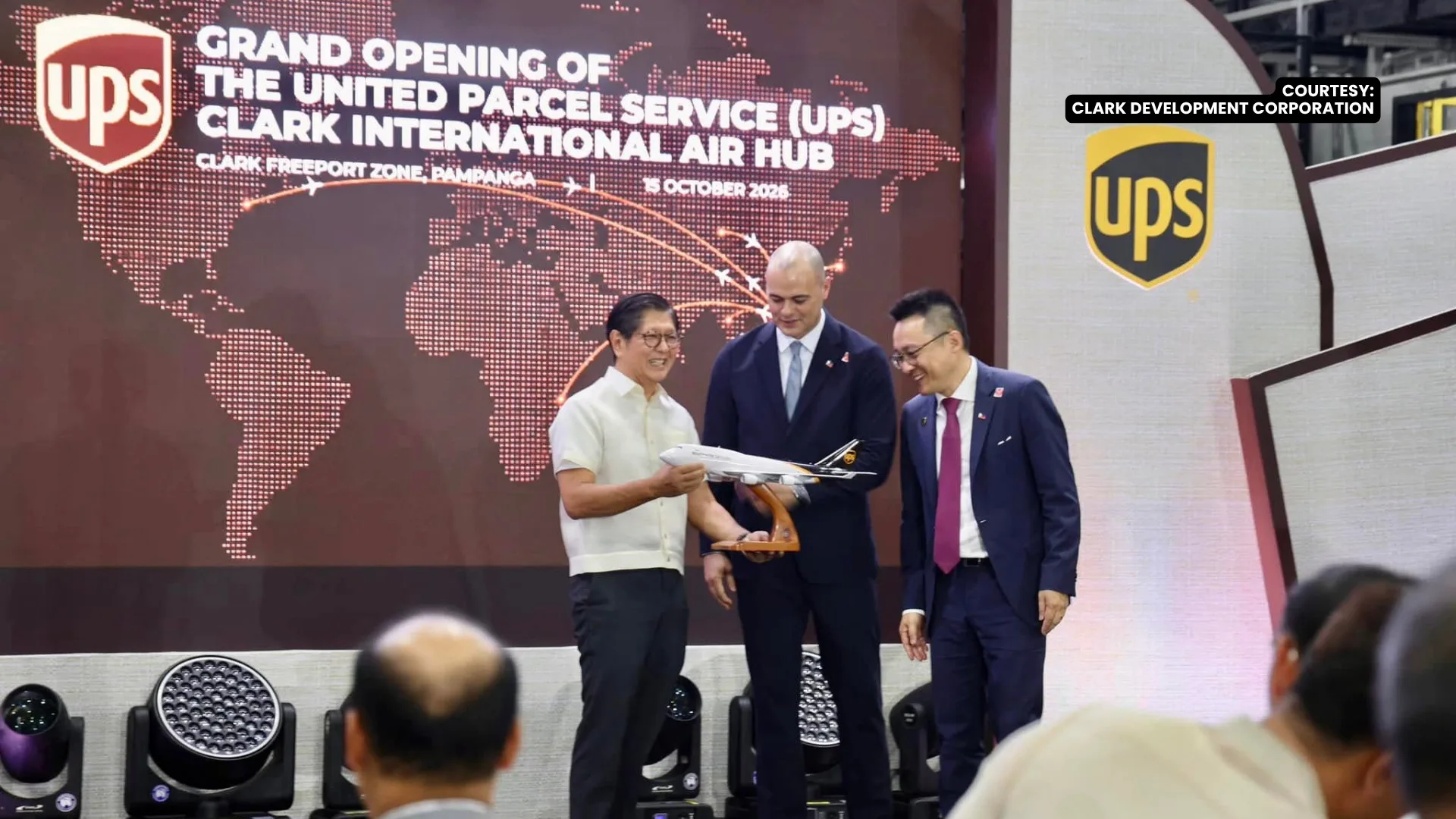
President Ferdinand Marcos Jr. on Thursday instructed concerned government agencies to accelerate the completion and timely operation of various infrastructure projects across the country to improve national logistics and transportation systems.
Speaking at the grand opening of the United Parcel Service (UPS) International Air Hub at Clark International Airport in Pampanga, the President directed the Department of Transportation (DOTr) and the Department of Public Works and Highways (DPWH) to expedite road, bridge, and transport system upgrades.
Marcos also ordered the Bases Conversion and Development Authority (BCDA) and the Department of Trade and Industry (DTI) to review, identify, and ensure the timely completion of unfinished Clark investments and projects, particularly those with target opening dates.
“When an investor promises a project, it is our job to ensure it opens on schedule,” Marcos said, describing the new facility as an “important milestone in strengthening our country’s logistics network.”
Constructed with an investment exceeding $80 million, the new air hub will support UPS operations across more than 1,100 global trade lanes. The facility is designed to handle an average daily volume of 46,000 packages, generate nearly 600 local jobs, and spur regional economic activity.
The UPS International Air Hub will support 170 weekly flight segments to and from Clark, facilitating faster deliveries to key markets across the Asia-Pacific region, India, Europe, the United States, Eastern China, and Southeast Asia.
The President noted that the project comes as the country works to overcome elevated shipping costs throughout the archipelago. Logistics costs in the Philippines currently account for up to 27 percent of sales, ranking among the highest in Southeast Asia.
Marcos highlighted that congested ports, inadequate road networks, and insufficient cold chain facilities continue to cause delays, raise expenses, and increase consumer prices.
“To address these challenges, and better connect agricultural production areas to ports and businesses, the DPWH and the DOTR are working to improve our roads, bridges, and transport systems,” Marcos said, calling on Transportation Secretary Giovanni “Banoy” Lopez to take note of the directive.
Marcos emphasized that as an archipelagic nation, efficient logistics remain essential to sustainable economic development and public welfare.
Following the event in Clark, the President visited the Balanga Green Mobility Hub in Bataan, reiterating the government’s commitment to mitigating the impact of fluctuating fuel prices on drivers, transport operators, and commuters.
Marcos stated that the administration plans to expand similar hubs and increase charging station coverage for electric vehicles (EVs).
The Balanga facility features four EV charging stations capable of powering up to eight vehicles simultaneously at a rate of P5 per kilowatt-hour. Under this system, operating costs for an e-trike stand at P0.45 per kilometer compared to P3.72 for a gasoline-powered tricycle, while e-bus operational costs drop to P2.87 per kilometer from P26.29 for a diesel bus.
The hub is designed to accommodate up to 24 vehicles and 1,394 passengers daily, serving as a model for local government units seeking to reduce transit costs, lower dependency on imported oil, and improve public transportation options.