
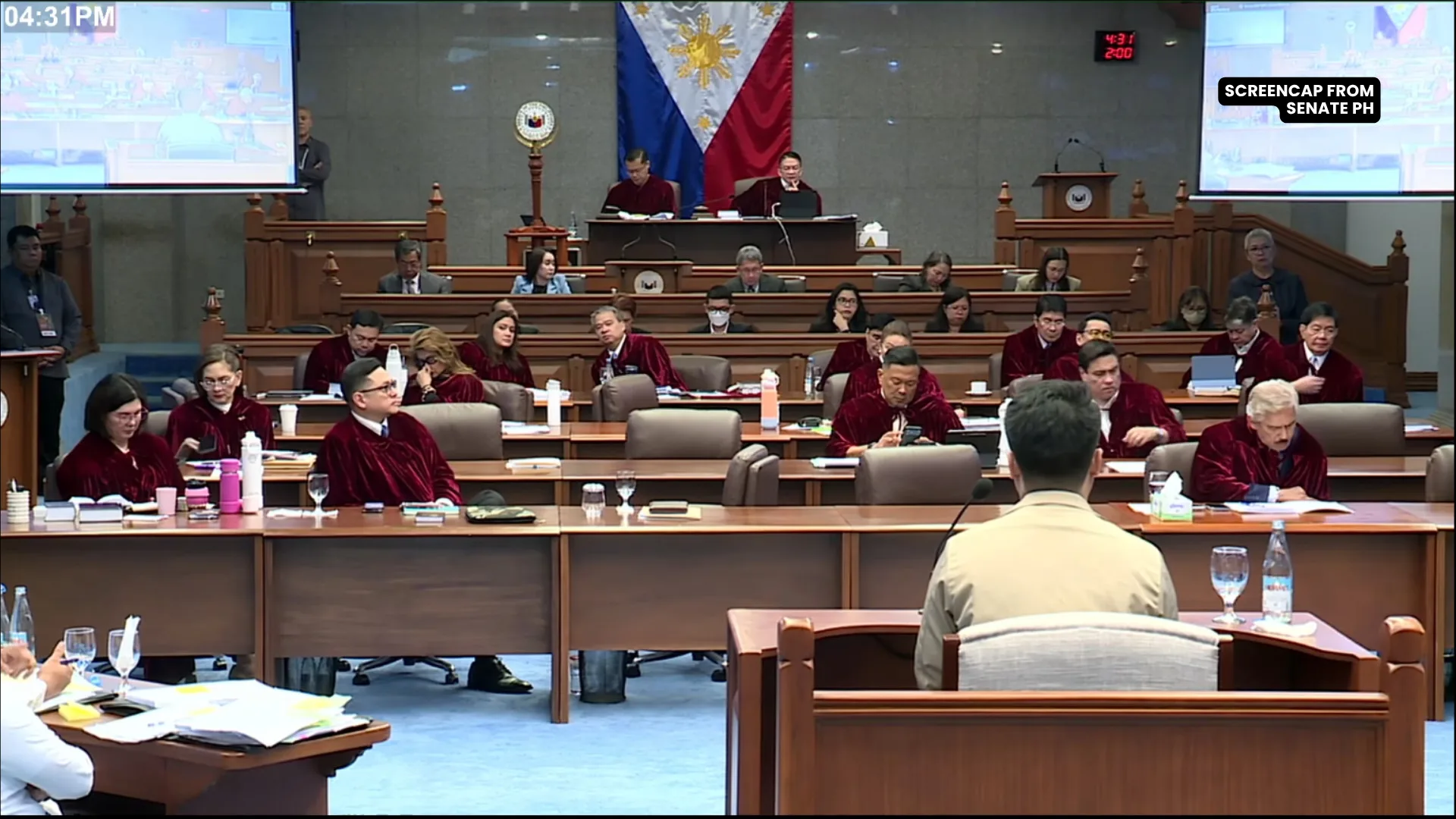
The House prosecution opened its evidence presentation in the impeachment trial of Vice President Sara Z. Duterte with the testimony of a National Bureau of Investigation cybercrime investigator who authenticated a video at the center of the grave threats article against her.
On the second day of trial, NBI Senior Agent John Mark Calilung told the Senate impeachment court that he served as the “agent on case” in the bureau’s investigation into Duterte’s November 23, 2024 online livestream.
Calilung said he was tasked to gather digital evidence related to Duterte’s alleged threats against President Ferdinand R. Marcos Jr., First Lady Liza Araneta-Marcos, and former Speaker Ferdinand Martin G. Romualdez.
“It means that I viewed, identified, preserved, collected, and authenticated digital evidence in the course of the investigation,” Calilung said during direct examination by House prosecution counsel Amando Virgil Ligutan.
Among the evidence gathered by the NBI was the video of Duterte’s November 23 online press briefing, which was livestreamed on the Facebook page of former presidential spokesperson Harry Roque.
Calilung said he authenticated the recording by comparing a screen-recorded copy with the original livestream.
“After screen recording, there’s an output video. I compared the output video with the November 23, 2024 video and ensured that the contents are identical,” he said.
He said the NBI then generated a hash value to preserve the integrity of the recording and ensure that it would not be tampered with before being presented in court.
“After ensuring that the contents are identical, I generated a hash value calculation on the video to ensure that the video won’t be tampered until presented in court,” Calilung said.
After Calilung identified the relevant timestamp, prosecutors played the authenticated portion of the video before the impeachment court.
In the clip, Duterte was heard saying: “Huwag kang mag-alala, ma’am, sa security ko, kasi may kinausap na ako na tao. Sinabi ko sa kanya, kapag pinatay ako, patayin mo si BBM, si Liza Araneta, at si Martin Romualdez. No joke. No joke. Nagbilin na ako, ma’am, ’pag namatay ako, sabi ko, huwag ka tumigil, ha, hanggang ‘di mo mapatay sila. And then he said yes.”
Calilung testified that investigators focused on that statement, which he said appeared between the one-hour, 15-minute mark and the one-hour, 17-minute, 18-second mark of the more than two-hour recording.
He said the NBI also submitted a preservation request to Meta, Facebook’s parent company, to secure the livestream record. The bureau later executed an Affidavit of Authentication of Digital Evidence documenting the forensic process.
Calilung also testified that the NBI conducted an open-source investigation to determine whether Duterte had made similar statements before the November 23 livestream.
Investigators identified an October 18, 2024 online press conference where Duterte allegedly made remarks directed at Marcos, including statements about imagining cutting off his head, criticizing his leadership, and threatening to exhume the remains of the late President Ferdinand E. Marcos Sr. and throw them into the West Philippine Sea.
The prosecution presented the earlier recording to establish context for Duterte’s November 23 remarks.
House prosecutors said both videos support Article IV of the Articles of Impeachment, which accuses Duterte of culpable violation of the Constitution and betrayal of public trust over alleged grave threats.
The November 23 livestream took place while Duterte was outside the House detention facility where her chief of staff, Atty. Zuleika Lopez, was being held after being cited in contempt by the House Committee on Good Government and Public Accountability.
The committee had been investigating the Office of the Vice President’s use of confidential funds.
As House officials prepared to transfer Lopez to the Correctional Institution for Women, Duterte addressed reporters through the livestream that later became the subject of the NBI investigation.
Through Calilung’s testimony, the prosecution laid the foundation for the presentation of additional witnesses, digital records, and documentary evidence on Article IV.