
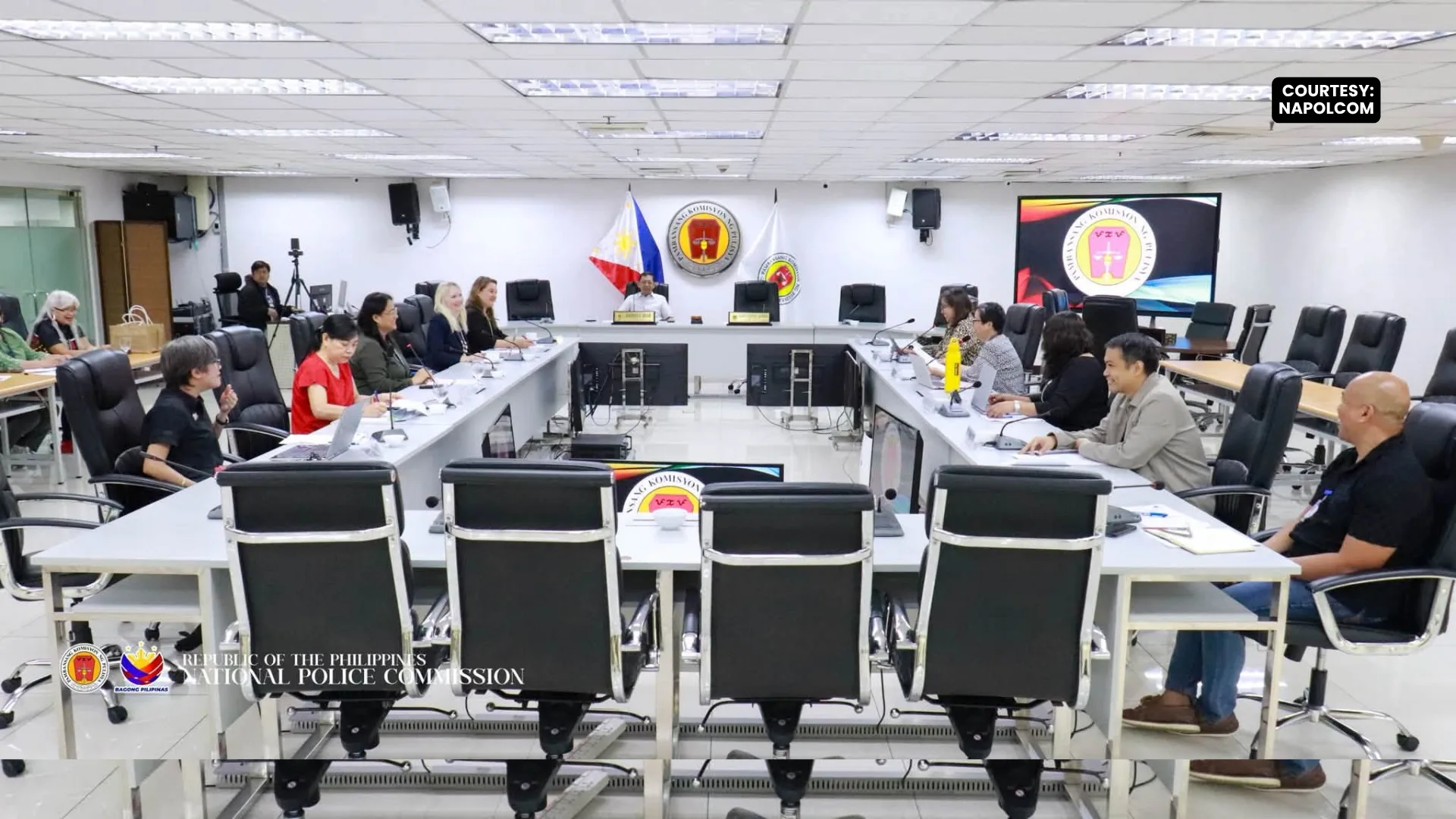
The National Police Commission reaffirmed its commitment to integrity, transparency, and accountability as it took part in the Independent Evaluation of the United Nations Office on Drugs and Crime Global Anti-Corruption Programme, or GLOZ99, at the NAPOLCOM Central Office in Quezon City.
The activity gathered officials from NAPOLCOM, representatives from UNODC Philippines, and the Independent Evaluation Team composed of Ms. Nina Retzlaff and Ms. Suzanne Mulcahy.
The evaluation forms part of UNODC’s global assessment of the programme’s effectiveness and its impact on strengthening anti-corruption initiatives among partner institutions.
Commissioner Josephus G. Angan formally welcomed the participants and emphasized NAPOLCOM’s commitment to promoting integrity and accountability in carrying out its constitutional mandate of civilian oversight over the Philippine National Police.
The Commission highlighted key milestones in its partnership with UNODC, including the Corruption Risk Assessment and Management Workshop conducted in October 2024 with the PNP.
During the workshop, corruption risks across key policing functions were identified using a preventive and risk-based approach. It also produced a Draft Corruption Risk Mitigation Plan that continues to guide NAPOLCOM’s institutional integrity initiatives.
NAPOLCOM also presented the ongoing development of its Protected Reporting Policy, with technical assistance from UNODC and international expert Dr. Ashley Savage.
The proposed policy seeks to establish secure reporting mechanisms, protect reporting persons from retaliation, and strengthen institutional accountability in line with the principles of the United Nations Convention against Corruption.
The Commission also cited its participation in UNODC’s Training Workshop on Investigating and Prosecuting Financial Crimes, which enhanced the capabilities of personnel from the Legal Affairs Service and the Inspection, Investigation and Monitoring Service in financial crime investigations, anti-money laundering, and inter-agency cooperation.
Beyond these programme activities, NAPOLCOM presented its continuing institutional integrity initiatives, including the implementation of the Public Assistance and Complaints Desk, Citizen’s Charter, ISO 9001 Quality Management System, Transparency Seal, merit-based recruitment and promotion systems, personnel rotation in sensitive assignments, and the ongoing development of a Digital Case Management System to improve transparency and accountability in administrative investigations.
The Commission also shared proposed institutional reforms it endorsed for inclusion in the National Anti-Corruption Strategy.
These include the institutionalization of the Protected Reporting Policy, digital transformation of human resource and administrative case management systems, corruption risk assessments and integrity audits, conflict-of-interest disclosure mechanisms, and enhanced transparency and accountability measures.
Commissioner Ralph Calinisan expressed NAPOLCOM’s appreciation to UNODC for its sustained technical assistance and reaffirmed the Commission’s commitment to pursuing reforms that promote ethical governance, transparency, and public trust.
Through its continued partnership with UNODC, NAPOLCOM said it remains steadfast in strengthening civilian oversight of the PNP and advancing a culture of integrity, accountability, and professionalism in public service.