
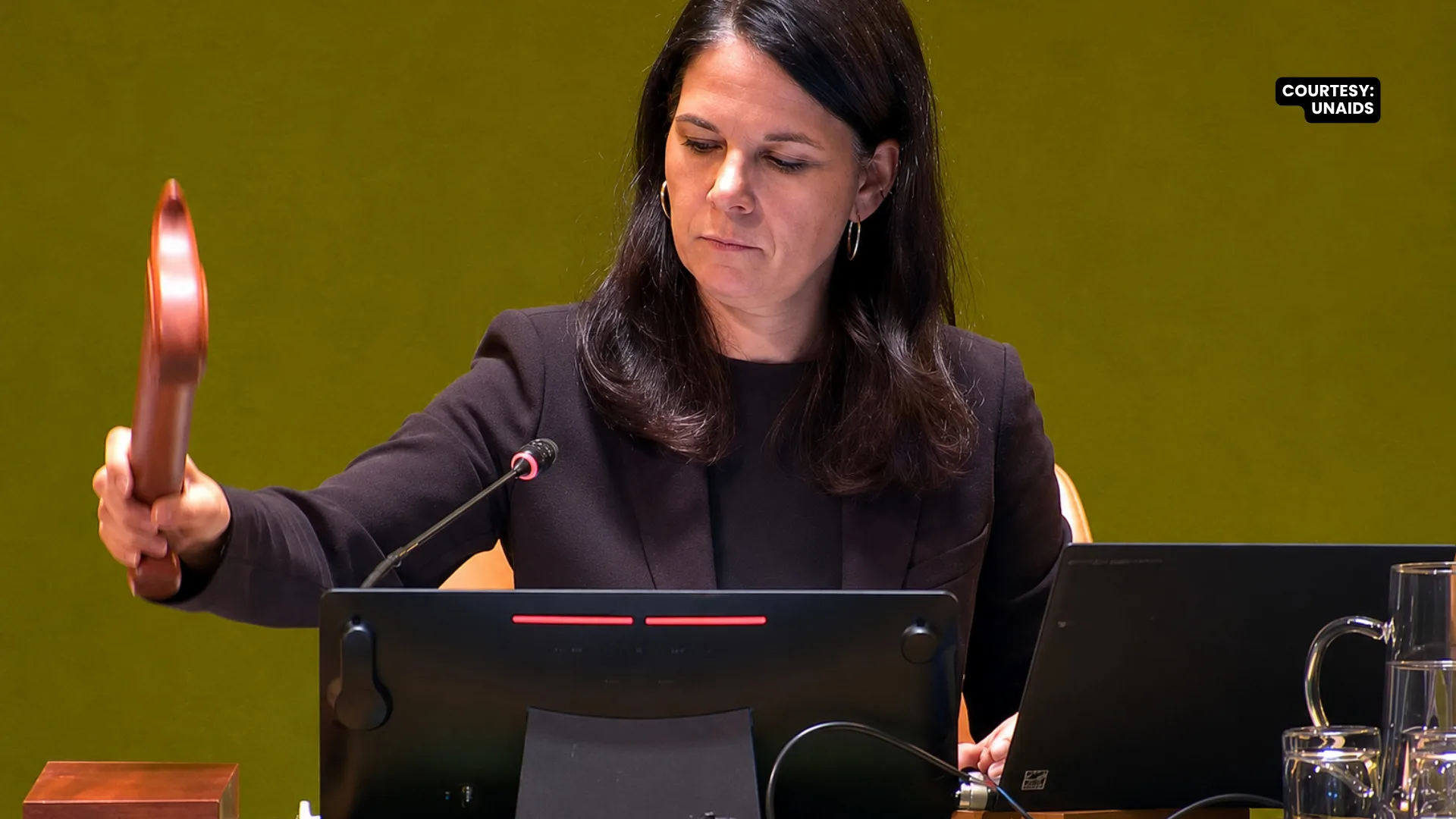
An overwhelming majority of United Nations Member States adopted a new Political Declaration on HIV and AIDS on June 23, reaffirming the global goal of ending AIDS as a public health threat by 2030. The declaration, concluded at the two-day 2026 UN High-Level Meeting on HIV/AIDS in New York, establishes concrete targets for the next five years even as the response faces unprecedented financial and political challenges.
The meeting, held June 22–23 under UN General Assembly President Annalena Baerbock, brought together government delegations, UN agencies, civil society groups, and people living with HIV. It was the first high-level gathering since 2021 and the last before the 2030 deadline. Negotiations were co-facilitated by the ambassadors of Botswana and Georgia.
The declaration builds on the Global AIDS Strategy 2026–2031, translating its targets into a political mandate. Member States committed to integrating HIV services into universal health coverage and primary care systems to avoid siloed care.
They pledged to expand access to combination HIV prevention tools, including long-acting injectable PrEP, while continuing behavioral and community-led interventions. Governments also agreed to eliminate mother-to-child HIV transmission and end pediatric AIDS through better maternal and child health integration.
Addressing stigma, discrimination, and punitive laws that prevent marginalized groups from accessing care is another core commitment, alongside efforts to increase access to affordable medicines and diagnostics and support local production and research toward vaccines and cures.
The declaration also strengthens funding and protections for community-led organizations that provide front-line services to the most vulnerable populations.
Member States agreed to reconvene in 2031 to review progress on the 2030 targets and guide the next phase of the global response.
UNAIDS Executive Director Winnie Byanyima described the declaration’s adoption as taking place in a period of “growing pressure and roadblocks to international cooperation.” The HIV response continues to contend with sharp cuts to international funding in 2025, which could result in millions of additional infections and deaths if unaddressed. Civil society groups had flagged financing as the declaration’s weakest point, pushing for stronger government commitments to mechanisms such as the Global Fund.
Global estimates underscore the urgency: in 2025, 40.9 million people were living with HIV, over half of them women and girls. Approximately 1.2 million people newly acquired HIV that year, and roughly five million remained unaware of their status, leaving critical gaps in testing, treatment, and viral suppression.
The World Health Organization, a co-sponsor of UNAIDS, reiterated its commitment to translate the declaration into actionable programs. “WHO will provide strategic and technical leadership to turn the commitments of this Political Declaration into measurable impact,” said Dr. Tereza Kasaeva, Director of WHO’s HIV, TB, Hepatitis, and STI programs. The pharmaceutical industry welcomed the declaration’s ambition but cautioned that progress remains fragile and requires sustained political attention and financing.
With the declaration adopted, the focus now shifts to implementation. Advocates stress that the true test will be turning political commitments into funded national strategies and community-level programs. The built-in 2031 review will provide the first formal checkpoint, but progress will ultimately be measured by whether the pledges reach the clinics, communities, and countries still grappling with the epidemic.