
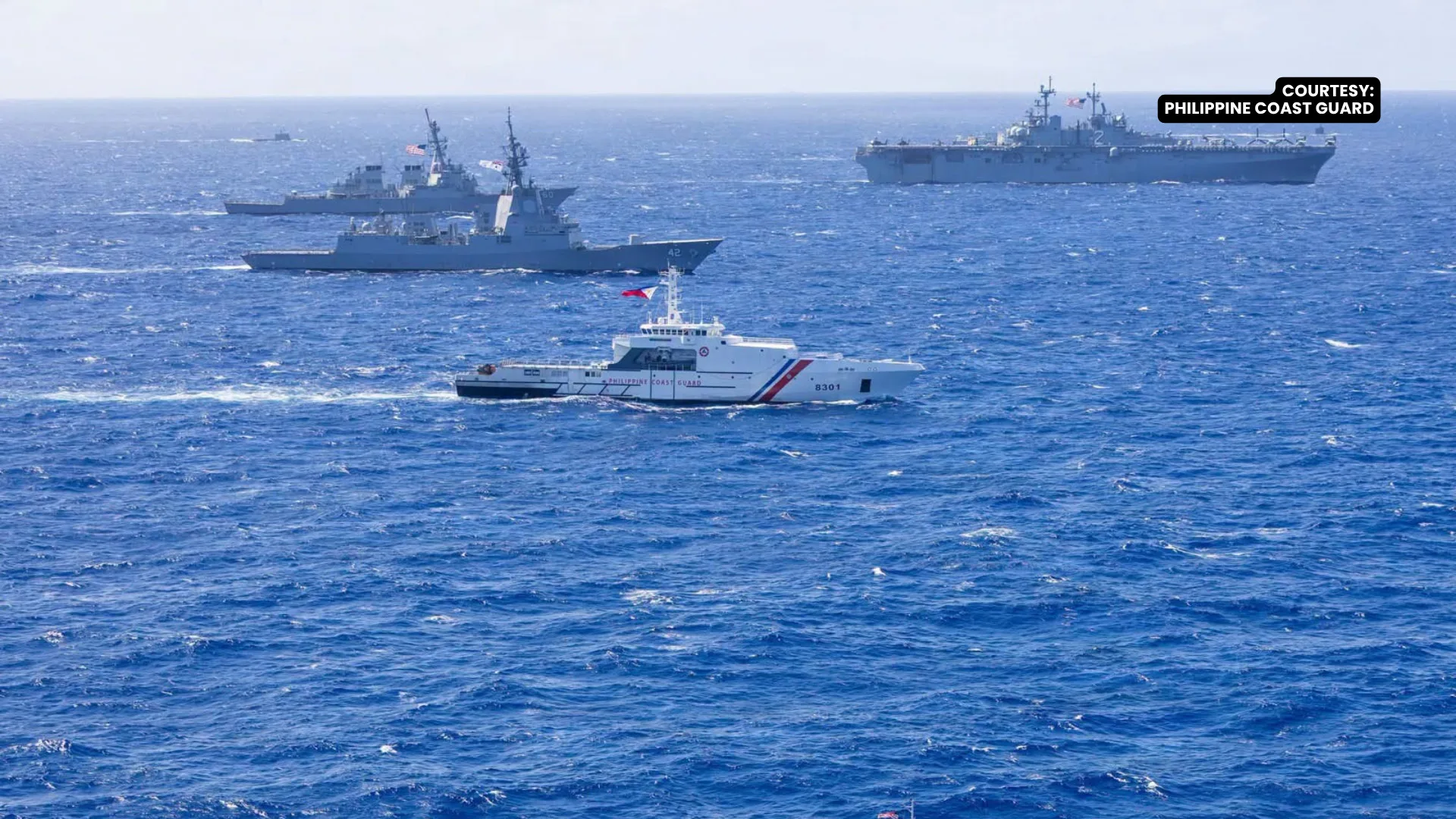
Defense Secretary Gilberto Teodoro Jr. has called on the country to establish a firm presence in the Philippine Rise and adjacent Pacific waters, warning that delay risks opening the door to rival foreign claims.
Speaking at the 3rd Balangay Forum 2026 in Makati City, the defense chief underscored the maritime domain’s critical role in national growth, framing the blue economy as “our future” and “our link to sustainability, to development and to prosperity.”
“We have a whole expanse of Pacific Ocean maritime domain, the Philippine Rise and other areas which we have to occupy once again and we have to explore and exploit on our own with like-minded countries unless somebody else has a different narrative and occupies it ahead of us,” said Teodoro.
Located off Luzon’s eastern coast, the Philippine Rise is an expansive 24-million-hectare submerged plateau within the country’s 200-nautical-mile Exclusive Economic Zone (EEZ). In 2012, the United Nations Commission on the Limits of the Continental Shelf officially confirmed a 13.4-hectare outer area as part of Philippine continental shelf territory.
Highlighting the economic stakes, Teodoro pointed out that open maritime routes are vital to domestic stability. “We need the sea in order to secure supply chains that are essential for our daily life and essential also for productivity,” said Teodoro. “Without these supply chains, then we constrict our economic base. We imperil our society and we imprison future generations to a marginalized life.”
Reflecting on past defense policies, Teodoro expressed regret that Manila did not move faster to enforce its rights under the 1982 United Nations Convention on the Law of the Sea (UNCLOS), which guarantees coastal nations exclusive authority to manage resources within their EEZ.
“in hindsight, during the start of UNCLOS after 1982, we should have already taken steps to protect whatever UNCLOS has given us. Yet, we placed everyone in the world in the same degree in giving them the benefit of the doubt of good faith. Yet, that reliance was misplaced as we see now,” said Teodoro. He stressed that “we have to act on it now.”
To safeguard trade routes and sea lanes, Teodoro pushed for stronger security partnerships with allied nations, criticizing Beijing’s historical nine-dash line claims over nearly the entire South China Sea. He dismissed Beijing’s expansive territory mapping as “impossible” and a “figment of their (Chinese) imagination.”
“Unfortunately, it’s imagination backed up by action and by disinformation and misinformation,” said Teodoro.
To defend these sovereignty claims, Teodoro called for modernization within the Armed Forces of the Philippines to back international law with credible force. “The Philippines cannot be a mere signatory to treaties and espousing norms that in the end of the day are our principal weaknesses. We cannot continue to be a voice without muscle,” said Teodoro. He added that the nation requires an “expeditionary Navy to be able to protect Filipino seafarers and Filipino vessels in the high seas alongside like-minded countries.”
Teodoro also condemned Beijing’s refusal to recognize the 2016 Permanent Court of Arbitration ruling that dismantled its territorial claims, accusing China of trying to build a “Sinocentric” global power structure.
“But it is scary if that is the future of the world. How can you have the credibility of one that will hold the existence of future generations particularly in the maritime domain where it has a regime which is opaque, non-transparent, unequal, and violent for that matter,” he added.