
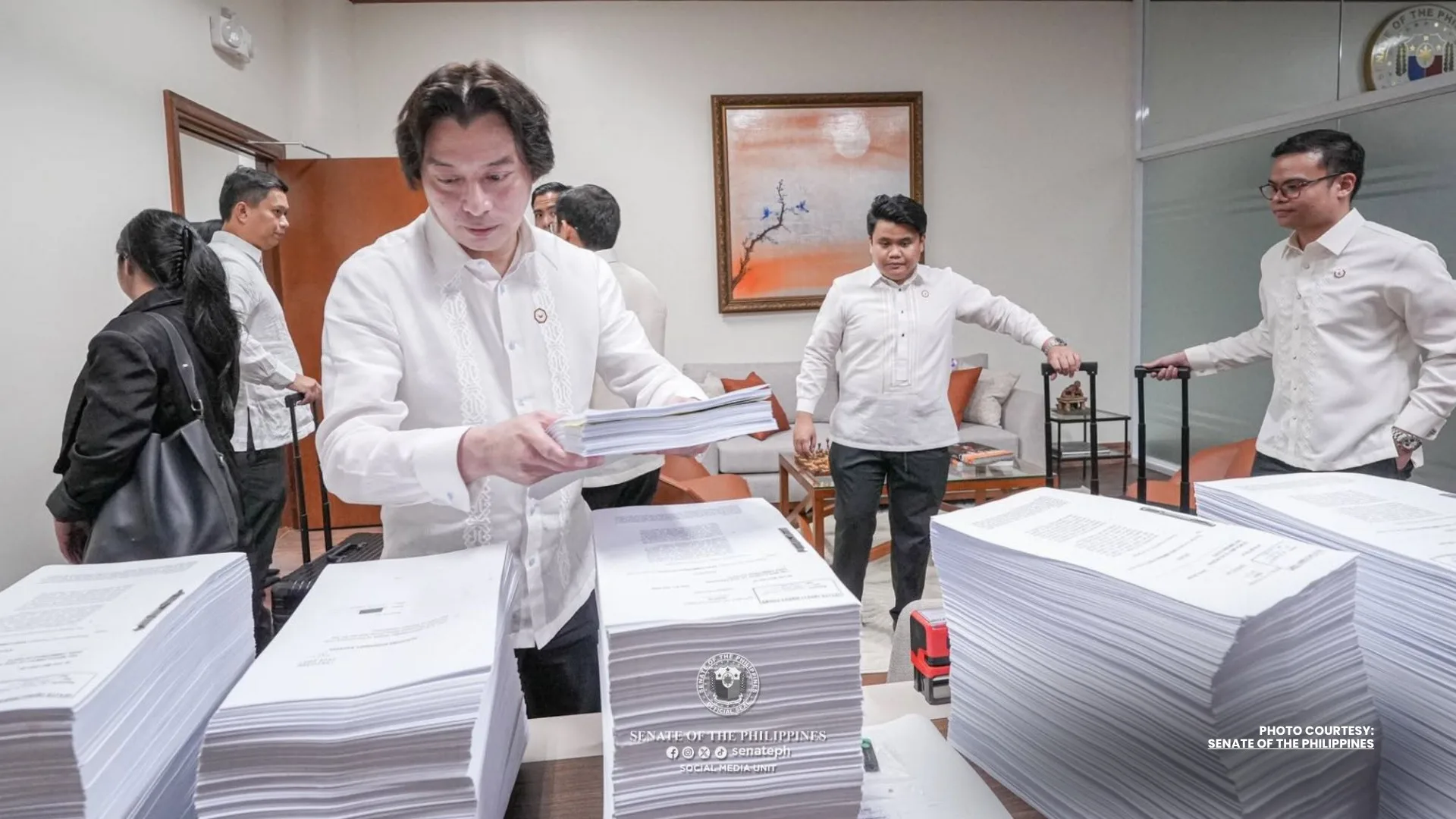
The House prosecution panel has opted to file a manifestation instead of a reply to Vice President Sara Duterte’s answer to the Articles of Impeachment, arguing that her submission failed to raise factual issues that require a formal response.
House Secretary General Cheloy Garafil submitted the five-page manifestation to the Senate on Monday. It was received by Senate Secretary General Renato Bantug Jr. at 11:15 am, with copies also furnished to the Office of the Vice President and the law firm Fortun Narvasa & Salazar.
In its filing, the 11-member prosecution team said Duterte’s answer focused mainly on procedural, jurisdictional, and constitutional objections rather than directly addressing the factual allegations in the impeachment complaint.
“Under the applicable rules, the allegations and defenses in the Answer are deemed controverted even without a Reply,” the manifestation read.
“More fundamentally, the Answer raises no material factual issue that requires a responsive pleading. It does not meaningfully engage the factual allegations in the Articles of Impeachment, but instead concentrates on procedural, jurisdictional, and constitutional objections directed against the continuation of the proceedings,” it added.
Duterte faces four Articles of Impeachment involving the alleged misuse of P612.5 million in confidential funds, bribery, unexplained wealth, and grave threats against President Ferdinand Marcos Jr., First Lady Liza Araneta-Marcos, and former House Speaker Ferdinand Martin Romualdez.
The prosecution said the answer did not directly refute the allegations or explain why the Vice President should not be held liable for the impeachable offenses charged against her.
“This is evident across all four Articles, where respondent repeatedly asserts that she committed no impeachable offense,” the manifestation read.
“Yet, beyond these general denials, the Answer offers no coherent factual narrative that directly refutes the charges set forth in the Articles of Impeachment,” it added.
According to the prosecution, Duterte did not present her own account of the events or provide an explanation on the transactions questioned in the complaint, including the alleged non-disclosure of cash on hand in her Statements of Assets, Liabilities and Net Worth.
The panel said the answer appeared to seek the outright dismissal of the impeachment case before the Senate impeachment court could hear the evidence.
“In substance, therefore, the Answer does not function as a genuine response to the charges, but as an attempt to secure the outright dismissal of the impeachment case on constitutional and procedural grounds,” the manifestation read.
The prosecutors argued that neither the Constitution nor the Senate Rules on Impeachment Trials allows the dismissal of an impeachment case before trial. They said an impeachment proceeding may only be terminated through an acquittal rendered by the impeachment court after a full hearing of the evidence.
The panel also maintained that the Senate should not rule on Duterte’s jurisdictional and constitutional challenges against the House proceedings, noting that these issues are already pending before the Supreme Court.
“To the extent that these matters have been elevated for judicial determination, the Senate, sitting as an Impeachment Court, cannot be placed in the position of reviewing or pre-empting issues currently pending before the Supreme Court,” the manifestation read.
The prosecution further argued that the Senate should not pass judgment on the House’s impeachment process, saying the Constitution gives the House the exclusive power to initiate impeachment proceedings and enforce its own rules.
“At the same time, these objections go into the very core of the House’s exclusive power to initiate impeachment proceedings. This power cannot be subjected to review, revision, or nullification by the Senate acting as an Impeachment Court, without effectively disturbing the constitutional allocation of powers between the two Houses of Congress,” it added.
The prosecution panel urged the Senate impeachment court to proceed with the trial, saying further pleadings and paper submissions would only delay proceedings that the Constitution requires to be conducted “forthwith.”
The Senate, however, has yet to resolve its internal leadership dispute before the impeachment trial can begin. Initial reports indicated that the trial could take place in July.