
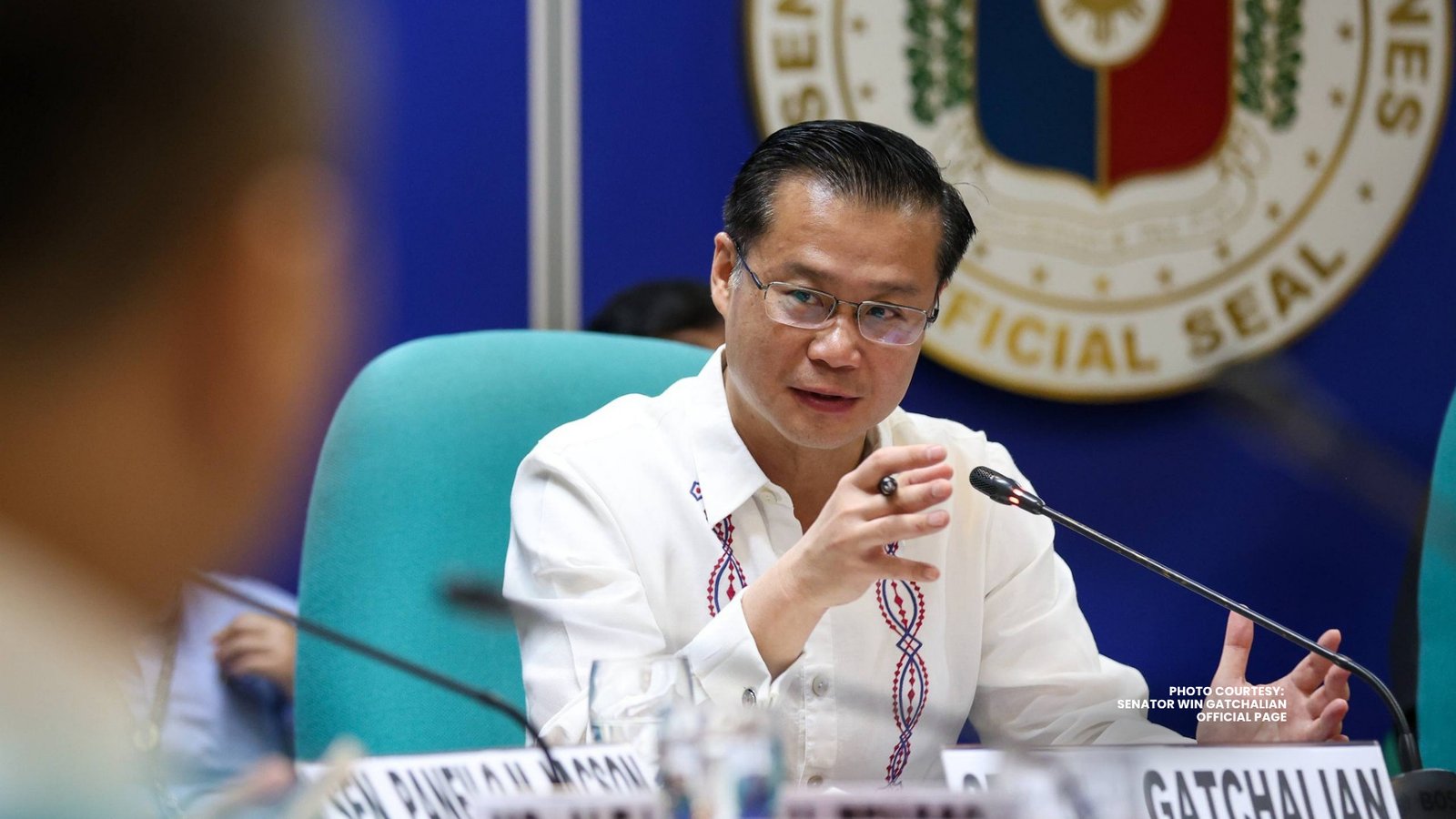
A senior lawmaker on Sunday confirmed that moves are underway to change the Senate leadership, saying the minority bloc is pushing for Sen. Sherwin “Win” Gatchalian to take over the chamber’s top post as part of efforts to restore public confidence in the institution.
In a radio interview, Senator Panfilo Lacson said the initiative followed the turmoil that gripped the Senate after the May 13 shooting incident inside the upper chamber’s building and amid growing calls for Senate President Alan Peter Cayetano to step down.
“One word, confirmed. There really are efforts,” Lacson said in Filipino when asked whether there were moves to replace the Senate leadership.
Lacson said the minority bloc has agreed to rally behind Gatchalian, describing him as a “fresh face” who could help rebuild the Senate’s credibility and bridge political divisions among senators.
“We will not agree if Senator Gatchalian will not be the next Senate President because we see him as a fresh face who can save the Senate,” he said. “Our first consideration is to save the Senate, bring back its integrity, and hopefully restore the Senate of old in the eyes of our people.”
Lacson rejected speculation that the leadership push was connected to Charter change or the impeachment trial of Vice President Sara Duterte.
“Our primary concern is to restore the Senate’s integrity. We never discussed anything else, not Con-Ass, not the impeachment trial of Vice President Sara Duterte,” he said.
He noted that members of the minority bloc were each working to secure support from other senators, but stressed that backing Gatchalian for Senate President was non-negotiable.
Sen. Francis “Kiko” Pangilinan earlier said members of the SB-11, or Solid Bloc 11, were united behind Gatchalian. Pangilinan said Gatchalian had proven his competence, steadiness, and fairness, particularly during deliberations on the 2026 national budget as chair of the Senate Committee on Finance.
“Principle-wise, Sen. Win is competent, steady, and fair. In realpolitik, he can unite a broader, reform-oriented Senate that is more balanced, more accountable even to some members of the current majority,” Pangilinan said.
The minority bloc is composed of Senators Vicente Sotto III, Lacson, Pangilinan, Gatchalian, Risa Hontiveros, Paolo Benigno “Bam” Aquino, Raffy Tulfo, Erwin Tulfo, Joseph Victor Ejercito, Juan Miguel Zubiri, and Manuel “Lito” Lapid.
Lacson declined to say whether senators who were previously aligned with their bloc, including Mark Villar, Camille Villar, Loren Legarda, and Pia Cayetano, were being asked to return. He also avoided commenting on whether former Senate President Francis Escudero was attempting a comeback for the Senate presidency.
Lacson, however, said he had heard two reasons why some senators left the previous majority bloc led by Sotto. One was the claim that Sotto did not know how to “take care” of senators, a criticism Lacson rejected.
“If taking care of senators means giving billions to colleagues just to keep him as Senate President, that is absurd,” Lacson said in Filipino.
He said he and Sotto had agreed when Sotto accepted the Senate presidency that they would do their best in what they considered their “last hurrah” in public service, without compromising their principles.
Lacson said another reported reason for the defection was dissatisfaction with his findings and recommendations as then chair of the Blue Ribbon Committee, particularly in relation to the flood control projects mess. He denied claims that he had protected former Speaker Martin Romualdez, saying he and Romualdez were not close.
Lacson said he was guided only by the evidence presented during the hearings and that he and Sotto were ready to lose their positions rather than bend their findings to suit political interests.
“We had already accepted that Tito Sen could lose the Senate presidency, that I could lose the Blue Ribbon Committee, or that we could end up in the minority. Even if we became a minority of two, what mattered was that we stood by what we believed was right,” the senator stressed.
Asked whether Cayetano might give in to mounting calls for his resignation, Lacson said the decision rests entirely with the Senate President. Still, he said such a move could help reunite a deeply divided chamber.
“It is his decision. But for us, it may be better if that happens. Maybe the Senate can be united again,” he said.
Lacson also raised the possibility of an awkward Senate setup in which Cayetano could remain Senate President even if his bloc loses majority control. He explained that while only 12 senators may be enough to shift committee control, 13 votes are needed to elect a new Senate President.
In that scenario, Lacson said, a Senate President who no longer commands the majority could become a “lame duck” presiding officer, opening sessions and presiding over debates while losing control over votes and committee leadership.
“The Senate President would be in an awkward position,” he said. “He cannot be unseated if there are not enough votes to elect a new Senate President, but he would no longer belong to the majority.”