
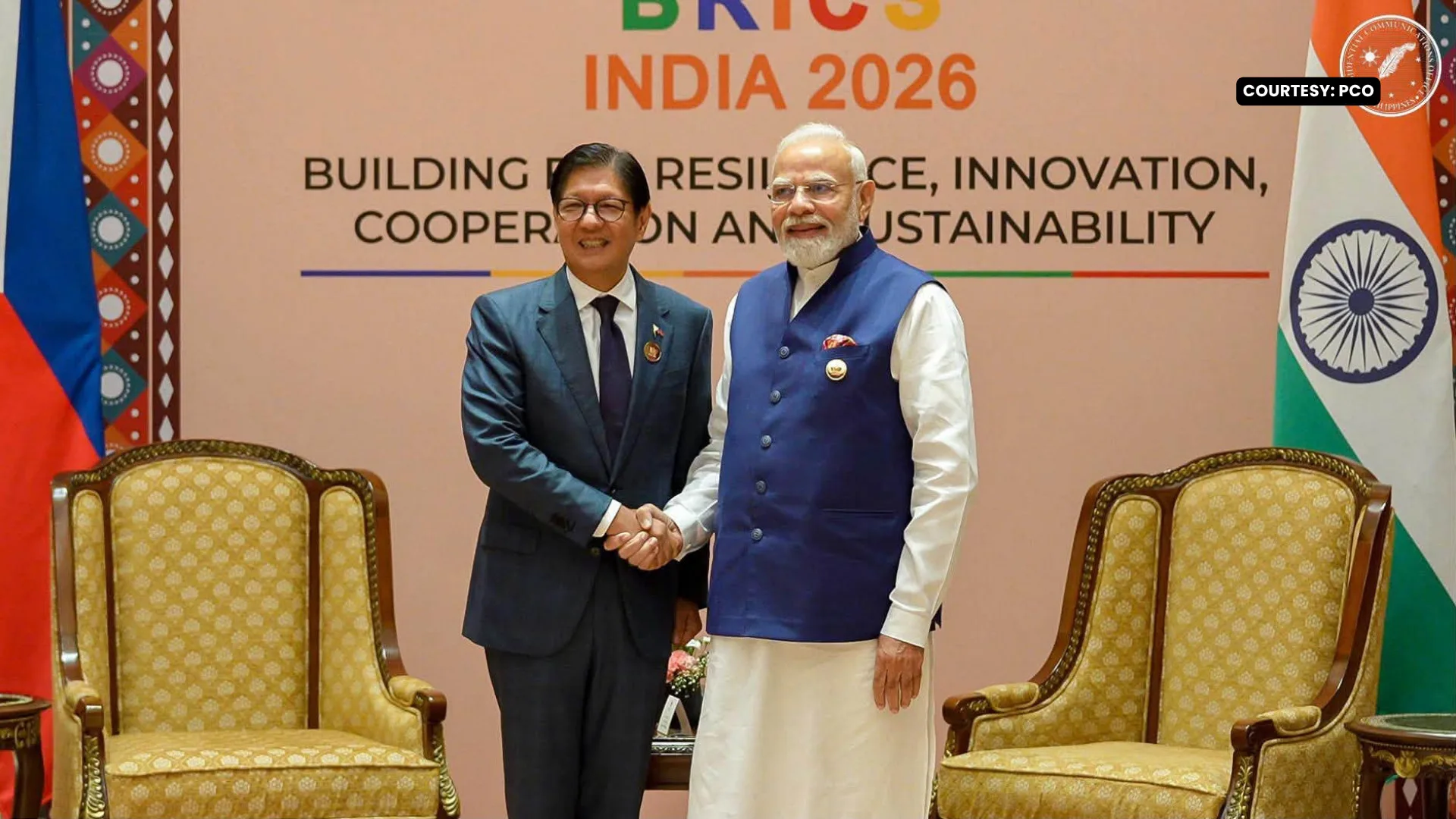
Participating as chairman of the Association of Southeast Asian Nations (ASEAN) at the 18th BRICS Summit, President Ferdinand Marcos Jr. emphasized the region’s commitment to an international rules-based framework, urging world leaders to prioritize stability, economic integration, and inclusive growth.
Addressing the summit’s Open Session in New Delhi, Marcos framed ASEAN as an open, inclusive and outward-oriented bloc driven by three core priorities, “peace and security anchors, prosperity corridors, and people empowerment.” According to the President, these three pillars form the region’s blueprint to build systemic resilience, foster innovation and advance global sustainability.
“We reaffirm that regional and even global stability depends on our fidelity to ASEAN centrality, sustained dialogue, and an unwavering adherence to a rules-based order anchored in international law. We are advancing maritime cooperation, disaster preparedness and climate security against emerging threats,” Marcos asserted.
He noted that establishing these strategic foundations allows ASEAN to withstand broader economic and geopolitical headwinds. “Through these anchors, ASEAN is fostering the practical cooperation and resilience required to weather external geopolitical and economic shocks,” he added.
Highlighting economic initiatives, President Marcos outlined ASEAN’s ongoing efforts to protect vital resources and accelerate regional connectivity. Key measures include reinforcing supply chain resilience, implementing the ASEAN Common Shared Power Grid for clean energy transitions, securing fuel through the ASEAN Petroleum Security Agreement and protecting regional food supplies via dedicated rice reserve mechanisms.
On technological expansion, Marcos highlighted the rapid development of the landmark Digital Economy Framework Agreement alongside efforts to ensure the safe, ethical adoption of artificial intelligence, particularly for micro, small and medium enterprises (MSMEs) and women-led ventures.
“To achieve long-term sustainability and green growth, we are developing pipelines for green investments while implementing a common regional plan for climate-ready, food-secure agriculture,” he explained.
Reiterating that regional growth must directly benefit citizens, Marcos pointed to investments in youth development, digital literacy and family support systems designed to protect vulnerable populations.
“ASEAN’s enduring strength lies in consensus, bridge-building and constructive engagement across regions. By anchoring peace and stability, expanding prosperity corridors and empowering our people, we turn shared aspirations into tangible realities,” Marcos said.
Reflecting on the summit, Marcos took to social media to highlight the significance of bringing Southeast Asia’s perspectives to the international dialogue.
“We are building stronger connections across our region, accelerating the Digital Economy Framework Agreement and opening the opportunities of AI to our MSMEs and women-led enterprises. This is the ASEAN we are working for. Peace anchored in cooperation, prosperity shared across our region and progress centered on our people,” Marcos posted.
Foreign Affairs Secretary Ma. Theresa Lazaro underscored the importance of the President’s presence in India, noting that representing ASEAN at the summit allowed the Philippines to articulate the bloc’s strategic priorities to non-member nations and non-dialogue partners.
Deepening Philippines-India Ties
On the sidelines of the summit, President Marcos met with Indian Prime Minister Narendra Modi to review the Philippines-India Strategic Partnership.
Both leaders evaluated ongoing progress under the Five-Year Plan of Action (2025–2029), exploring deeper bilateral ties across economic relations, defense, maritime security, technology, space exploration, pharmaceuticals, tourism and direct air connectivity. Discussions also covered the proposed Preferential Trade Agreement and broader security challenges in the Indo-Pacific.
Following their meeting, Modi shared via social media that he and Marcos “reviewed the growing momentum in the India-Philippines Strategic Partnership. Key focus areas are: Economic linkages. Technology. Trade. Space. Innovation. Creative industry.” Modi added that they also “discussed ways to further strengthen India-ASEAN engagement.”
During the talks, Marcos, acting in his dual role as ASEAN Chair and Country Coordinator for ASEAN-India Dialogue Relations, extended an invitation to Prime Minister Modi to visit Manila for the upcoming ASEAN-India Summit and East Asia Summit this November.
In a social media statement, Marcos expressed satisfaction over the engagement, “happy to be back in India as we strengthen old friendships, build new partnerships and open more doors for the Philippines and ASEAN.”