
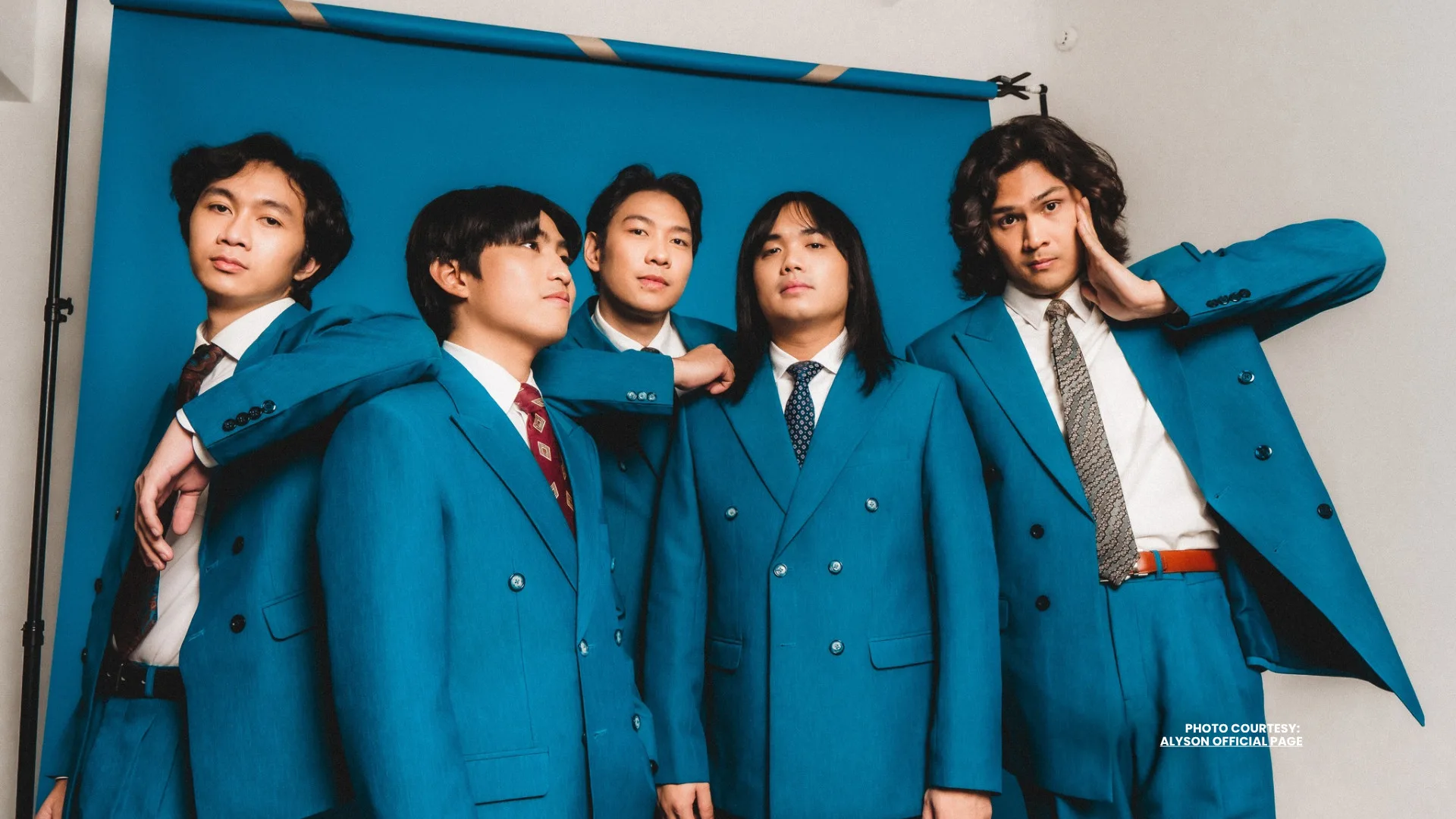
On After Ours, the Filipino city pop collective trades the dizzy rush of young love for something harder to describe, and far more interesting to sit with.
There is a specific feeling that has no clean equivalent in English. The Japanese call it mono no aware, the bittersweet awareness that beautiful things are passing even as you’re experiencing them. Filipinos, meanwhile, tend to fold that feeling into songs, letting melody carry what words cannot quite articulate. ALYSON, the young Manila city pop collective whose 2023 debut Definitely Love! arrived like a glass of something cold and effervescent, has spent the better part of two years trying to bottle that emotion. On After Ours, they come closer than anyone might have expected.
Released May 22 via Offshore Music, the album is the kind of sophomore effort that earns the word “maturity” without making it sound like a compromise. It is warmer and more patient than its predecessor, more willing to let silence and space do part of the storytelling. Where Definitely Love! thrived on the immediacy of infatuation, After Ours lingers in the complicated middle of love: the uncertainty after the high fades, the longing that outlasts excitement, the quiet ache of trying to hold on to something already beginning to change.
It is not a breakup album. It is something more difficult, and more honest, than that.

Much of what makes After Ours feel different comes down to process. ALYSON spent nearly a year writing and rehearsing before formally entering the studio, an almost old-fashioned commitment in an era where records are often assembled piece by piece over shared files and laptop sessions. Many of the tracks were recorded live or in large ensemble takes, with bassist and producer Marcus Mababangloob deliberately minimizing overdubs to preserve what he describes as “the organic ebb and flow of performance.”
The choice reshapes the album entirely. After Ours breathes differently than most contemporary OPM releases. Songs expand and contract naturally; tempos subtly bend around emotion instead of rigidly following a grid. Trumpeter and orchestral arranger David Jorvina’s horn and string arrangements drift through the record with remarkable restraint, appearing only when needed and retreating just as gracefully. It is arrangement work that rewards patience, intricate without announcing itself as such.
The album was also mastered in Tokyo by acclaimed engineer Eiji Hirano, best known for his work with revered Japanese act Ryusenkei. The detail might initially sound like a niche footnote for city pop devotees, but it quietly matters. The warmth and spatial depth of After Ours carries the unmistakable imprint of the genre’s lineage while still sounding distinctly Filipino in texture and sentiment.
ALYSON has never hidden its influences. Japanese city pop, Manila Sound, jazz, Brazilian funk, Motown, Philly soul, and ‘70s Filipino pop all move through the record openly. What makes the album compelling, however, is not simply the breadth of those references but the coherence between them. These are genres deeply concerned with emotional tension, with desire, nostalgia, fantasy, and disillusionment, and ALYSON understands the connective tissue holding them together.
The result is an album that feels lovingly referential without ever collapsing into imitation.
The sequencing of After Ours feels intentional in a way increasingly rare in the streaming era. Rather than functioning as a collection of standalone singles, the album unfolds like a single emotional arc.
“Ikaw Lagi” and “Landi” open with restless energy, bright and flirtatious but already carrying traces of instability beneath the sheen. “Bighani” and “Kung Sakaling Tanawin” push the band toward their most rhythmically adventurous territory yet, layering groove-heavy arrangements with moments of startling vulnerability.

The album’s centerpiece, “Talaga” featuring Filipino artist Paprikka, plays like a lost city pop duet from an imagined anime romance: theatrical, sentimental, slightly overdramatic, and all the more charming because of it. The two voices circle each other delicately, negotiating the fragile space between certainty and longing.
By the time “Goodbye, Summer” and “Di Makapaniwala” arrive, the album has fully settled into itself. These are songs shaped not by spectacle but by accumulation, songs that understand heartbreak is rarely explosive, but gradual.
Tracklist
01. Ikaw Lagi
02. Landi
03. Bighani
04. Kung Sakaling Tanawin
05. Talaga feat. Paprikka
06. Goodbye, Summer
07. 24/7 Love & Care
08. Di Makapaniwala
In conversation, Marcus once described the difference between Definitely Love! and After Ours with surprising clarity: the first album was about wanting to show the world who they were. The second is about actually knowing.
That distinction, between performing identity and quietly inhabiting it, is what separates a promising sophomore record from a defining one.
ALYSON, still remarkably young by any standard, has made the latter.

After Ours does not demand attention through spectacle or excess. It settles beside you slowly. It trusts that you will stay long enough to hear what it is trying to say. And if you do, the album reveals itself as something rarer than nostalgia or romanticism: a record about what love feels like after certainty disappears, when the embers are still warm and nobody yet knows what comes next.